

 English
  Español
  Português
  Deutsch
  Français
  Italiano
  日本語
日本語  中文
中文  हिन्दी
  עברית
עברית  العربية
  한국어
한국어  Nederlands
  Polski
  Türkçe
  Українська
  Русский
  Magyar
  Română
  Български
  Čeština
  Ελληνικά
  Svenska
  Dansk
Dansk  Norsk
Norsk  Suomi
Suomi  Bahasa Indonesia
  Tiếng Việt
  Tagalog
  ไทย
ไทย  Latviešu
  Lietuvių
  Eesti
Eesti  Slovenčina
  Slovenščina
  Hrvatski
  Македонски
  Қазақша
  Azərbaycan
  Afrikaans
  বাংলা
বাংলা Truck Dispatcher Training: How to Start a Dispatching Career

- What Does a Truck Dispatcher Do?
- How Much Does a Truck Dispatcher Make?
- Why Become a Truck Dispatcher?
- How to Become a Truck Dispatcher: Step-by-Step
- 4 Best Truck Dispatcher Training Courses
- Truck Dispatcher License and Regulatory Requirements
- Tools Every Truck Dispatcher Needs
- Career Path After the First Dispatcher Role
- Frequently Asked Questions
The United States trucking industry transports more than 11 billion tons of freight each year, and the operational continuity of that movement depends on the truck dispatcher. The role coordinates loads, drivers, and shippers in real time and remains one of the few logistics positions accessible without a commercial driver’s license or a postsecondary degree. Once you are dispatching for real, tooling matters – see our pick of the best service dispatch software for field teams.
Truck dispatcher training is the most direct entry point into the profession. A structured course can prepare a candidate for paid work within sixty to ninety days, with median compensation near $45,000 per year and clear progression into senior dispatching, operations management, and independent freight brokerage.
This guide outlines the responsibilities of a truck dispatcher, compensation benchmarks, the credentialing landscape, the leading training programs, and the software stack that supports day-to-day dispatching at scale.
What Does a Truck Dispatcher Do?
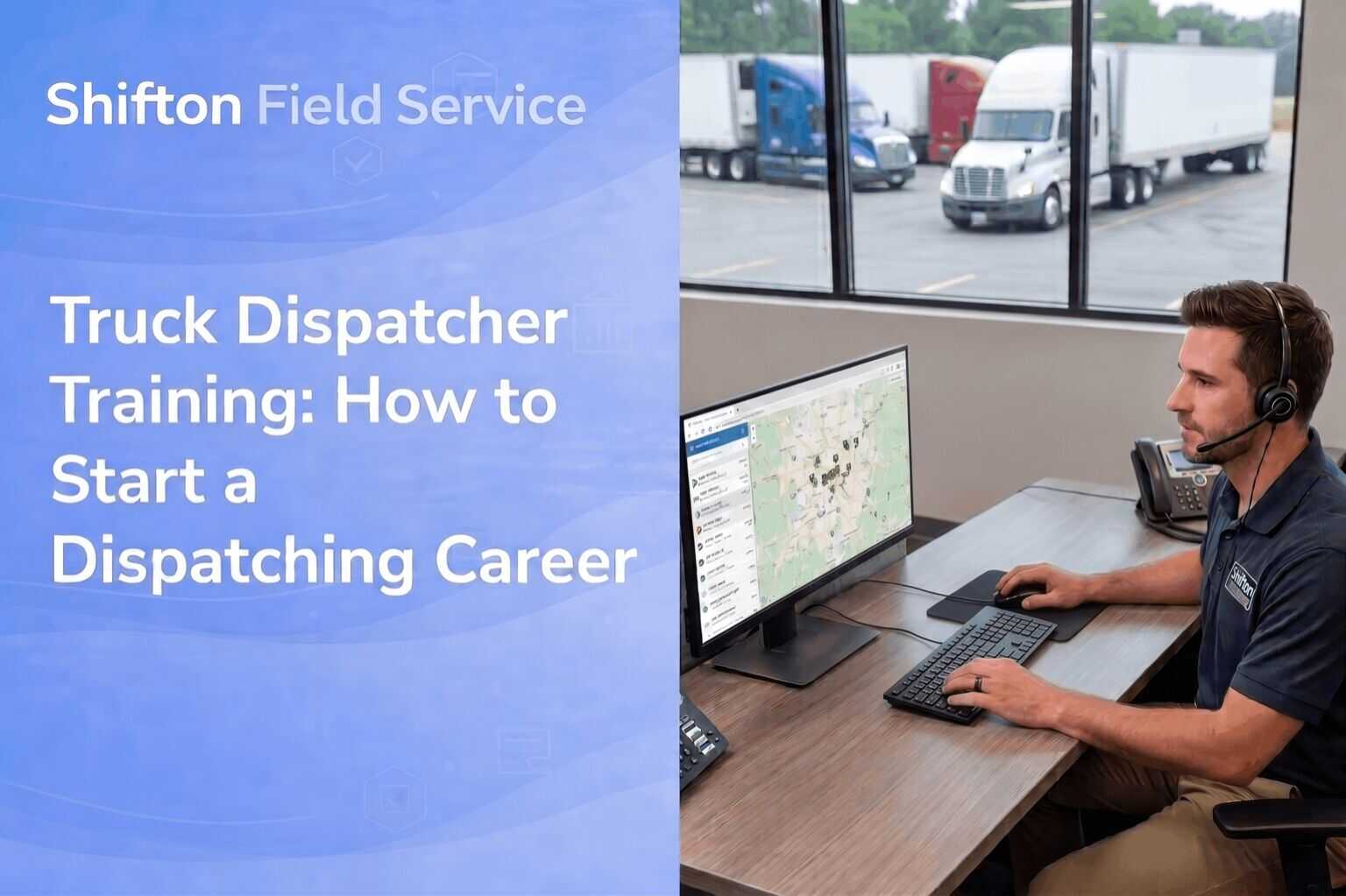
A truck dispatcher serves as the operational coordinator between freight shippers, drivers, and receivers. The role centralizes load procurement, route planning, rate negotiation, shipment monitoring, and exception handling across an assigned fleet or client base.
Dispatching responsibilities scale with fleet size. Smaller carriers consolidate the function into a single role, while larger fleets divide dispatching across lanes, accounts, or shifts. The core competencies remain consistent: real-time decision-making, clear communication, and disciplined documentation.
Related reading: Towing dispatch software — dispatch principles applied to roadside operations.
Core Daily Responsibilities
The work of a truck dispatcher consists of the following recurring tasks:
- Sourcing loads from load boards, brokers, and contracted shippers
- Negotiating freight rates and confirming pickup and delivery windows
- Assigning loads to drivers based on location, equipment, and hours-of-service availability
- Monitoring fleet position in real time and providing status updates to shippers and receivers
- Managing service exceptions including breakdowns, delays, missed appointments, and detention
- Maintaining transportation documentation such as rate confirmations, bills of lading, and invoices
Truck Dispatcher vs Freight Dispatcher
The terms truck dispatcher and freight dispatcher are used interchangeably across the industry, and they describe the same operational function: aligning freight capacity with available trucks. Some training providers use freight dispatcher to denote independent dispatchers serving owner-operators and truck dispatcher to denote in-house dispatchers within carrier operations, but the underlying skill set is identical.
How Much Does a Truck Dispatcher Make?
Truck dispatcher compensation varies by experience level, geographic market, and employment structure.
The Bureau of Labor Statistics reports a median annual wage of approximately $45,820 for dispatchers excluding emergency services. Entry-level truck dispatcher salary at small and mid-size carriers begins near $48,000 and progresses to roughly $62,000 with two to three years of experience. Senior dispatchers and lead operations roles at national carriers can reach six figures.
Independent freight dispatchers typically operate on commission, billing carriers a percentage of each booked load rate. A standard commission rate in the industry is approximately seven percent. Earnings potential as an independent dispatcher is higher than the in-house range, though income variability and the time required to build a stable client base must be factored into the comparison.
Why Become a Truck Dispatcher?
Truck dispatching is one of the most accessible careers in logistics, with structural advantages that explain the consistent demand from employers and from professionals seeking remote, stable work.
Rapid Path to Employment
The standard truck dispatcher training course takes approximately two to three weeks. Combined with networking and a focused job search, candidates typically progress from initial enrollment to a first paycheck within sixty to ninety days. Few professions offering above-median compensation provide a comparable timeline to employment.
Remote-Friendly Role
Truck dispatching can be performed entirely from a home office. The required tools are a computer, a phone, an internet connection, and access to a load board. The role consistently appears on lists of fully remote logistics positions and is well-suited to professionals seeking location-independent work.
Sustained Industry Demand
Freight volume in the United States continues to grow with e-commerce expansion and supply chain reconfiguration. Each ton of freight on the road requires dispatching coordination, which keeps the labor demand for trained dispatchers stable across economic cycles.
Defined Career Progression
The dispatcher role provides a foundation for advancement into operations management, logistics coordination, transportation supervision, and fleet management. The competencies developed at the dispatch desk transfer directly into higher-compensated logistics positions.
Independent Business Potential
An experienced truck dispatcher can transition to running an independent dispatching service, contracting with owner-operators on a commission basis. Independent dispatching operates with low overhead and can be scaled from a home office without significant capital investment.
Run dispatch without juggling 12 tabs
Shifton Field Service consolidates GPS tracking, job assignment, status updates, and reporting in one workspace. Free for the first ten employees.
How to Become a Truck Dispatcher: Step-by-Step
The full path from interested candidate to working dispatcher consists of five sequential steps. None require a degree, and none extend beyond a few weeks of focused effort.
Step 1: Complete Basic Education
A high school diploma or General Educational Development credential is the only formal education requirement for most truck dispatcher roles. Candidates who have completed secondary education can proceed directly to industry preparation.
Step 2: Build Industry Knowledge
Before enrolling in a course, candidates should familiarize themselves with the terminology of freight transportation. This includes bill of lading procedures, equipment categories such as dry van and refrigerated trailers, hours-of-service regulations, and the function of load boards. Foundational knowledge can be developed through Federal Motor Carrier Safety Administration documentation and industry resources within one to two weeks of self-study.
Step 3: Complete a Truck Dispatcher Training Course
Structured truck dispatcher training compresses the learning curve from several months to several weeks. A reputable course covers dispatch software, rate negotiation methodology, regulatory requirements, and standardized workflows before the candidate engages with live freight.
The most effective truck dispatcher training programs include practical exercises with operational load boards, mentorship from working dispatchers, and resume support. Programs that promise immediate income without disclosing curriculum should be avoided, as should programs priced significantly above the industry standard without commensurate content.
Step 4: Build a Professional Network
Hiring at small and mid-size carriers frequently happens through referral rather than open job postings. Establishing connections with working dispatchers is one of the highest-yield steps in a job search. Professional networking platforms, trucking industry associations, and dispatcher communities are reliable channels for relationship-building and job leads.
Step 5: Prepare a Targeted Resume and Apply
A dispatcher resume should emphasize transferable competencies including customer service, multitasking, telephone communication, data entry, and any prior exposure to logistics or transportation operations. Industry-specific terminology such as truck dispatcher, load board, rate negotiation, and route planning should be incorporated to align with applicant tracking systems. Initial applications should target small and mid-size carriers, which hire entry-level dispatchers more frequently than large national carriers.
4 Best Truck Dispatcher Training Courses
Dispatcher training programs vary substantially in scope, format, and outcomes. The four options outlined below are consistently cited by working dispatchers and hiring carriers.
NDFCA Dispatcher Course
The National Dispatchers and Freight Carriers Association offers a self-paced online program covering industry terminology, equipment categories, dispatch software, and regulatory fundamentals. The program issues a printable certificate upon completion and is a suitable entry-level credential for candidates seeking a structured introduction with a modest time commitment.
NDFCA at a glance
- Cost: approximately $449
- Duration: several days, self-paced
- Format: online video with quizzes
- Best for: career starters seeking a structured introduction
Learn Dispatch (Core and Extended Versions)
Learn Dispatch is oriented toward candidates planning to establish an independent dispatching practice. The Core version covers dispatcher fundamentals, while the Extended version adds business setup, owner-operator acquisition, and continued mentor access. The curriculum incorporates current rate negotiation methodology.
Truck Dispatcher Training
This program is the most comprehensive of the four options. It covers both in-house and independent dispatching, includes weekly live sessions with industry speakers, and concludes with a final examination. Completing the program provides access to a mentorship subscription with experienced dispatchers.
FreightWaves SONAR Dispatcher Bootcamp
FreightWaves offers a shorter, data-oriented bootcamp combining dispatcher fundamentals with market intelligence and rate trend analysis. The program is suited to candidates interested in understanding freight markets alongside the operational workflow.
| Course | Cost | Length | Best for |
|---|---|---|---|
| NDFCA | $449 | A few days | Quick intro and credential |
| Learn Dispatch Core | $360 | About a week | In-house dispatcher role |
| Learn Dispatch Extended | $600 | About a week | Starting an independent business |
| Truck Dispatcher Training | $775 | Up to 3 weeks | Deepest curriculum and mentorship |
| FreightWaves SONAR | Varies | 2 weeks | Market and data focus |
Pro Tip
Certain carriers reimburse truck dispatcher training in exchange for a defined employment commitment. Candidates should inquire about sponsored training arrangements before committing to a self-funded program.
Truck Dispatcher License and Regulatory Requirements
There is no federal truck dispatcher license in the United States. A commercial driver’s license is not required, and dispatchers do not register with the Federal Motor Carrier Safety Administration as carriers and brokers do.
The regulatory boundary that determines licensing obligations is the distinction between dispatcher and broker activity. The role definition under which a dispatcher operates determines whether broker authority and a surety bond are required.
The Dispatcher vs Broker Distinction
A dispatcher acts on behalf of one or more carriers under written agreement. A broker connects shippers with carriers as an independent intermediary. When a professional sources loads from shippers and assigns them across multiple unaffiliated carriers, the activity meets the definition of brokerage and requires registration with the Federal Motor Carrier Safety Administration, including an operating authority (MC number) and a $75,000 surety bond.
Operating strictly within the dispatcher role, under written agreement with the carriers represented, does not require broker registration. Reputable dispatcher training programs cover this distinction in detail to help candidates structure their practice correctly.
State-Level Considerations
Truck dispatcher license requirements do not vary materially by state for dispatchers operating under carrier agreement. Concentration of carrier operations is highest in states with significant freight corridors, which influences geographic availability of dispatcher roles, but state-specific dispatcher licensing requirements are not in force.
Tools Every Truck Dispatcher Needs
The dispatcher’s software stack is the determining factor in operational throughput. The toolset covers four core functions.
Load Boards
Load boards are the primary source of freight for dispatchers. DAT Load Board, Truckstop, and 123Loadboard are the principal options. Experienced dispatchers typically subscribe to DAT plus one additional board for cross-referencing rates. Subscription costs range from $35 to $150 per month per board, depending on the tier.
Dispatch and Scheduling Software
Once a load is booked, the dispatcher must assign it to a driver, monitor the truck, and update the shipper. Generic spreadsheets are inadequate above a small fleet threshold. Dedicated dispatch software with task management and job scheduling built for field operations is the standard solution.
GPS Tracking
Real-time GPS tracking on each vehicle allows the dispatcher to respond to status inquiries without contacting the driver directly. Most carriers use electronic logging devices that integrate GPS functionality. For independent dispatchers, lightweight GPS tracking provides equivalent visibility at a fraction of the cost.
Driver Communication and Mobile Tools
Drivers require an efficient channel to receive load assignments, transmit estimated arrival updates, and report exceptions. SMS communication is workable in low-volume operations but does not scale beyond a small fleet. Dedicated mobile applications for drivers, with bidirectional dispatch capability, are standard at carriers operating beyond small-fleet size.
Career Path After the First Dispatcher Role
Truck dispatcher training provides the entry credential, but the long-term career develops during the three to five years following the first paid role. Three primary advancement paths are observed in the industry.
The first path is internal promotion within the same carrier organization: from dispatcher to senior dispatcher to operations supervisor and ultimately to logistics manager. This progression typically requires approximately five years and is the lowest-risk option, with the trade-off of timing dependent on organizational growth and turnover.
The second path is transition to independent dispatching. After approximately two years of in-house experience, a dispatcher can establish an independent practice, retain professional contacts within carrier organizations, and recruit owner-operators as clients on a commission basis. The earnings ceiling is higher than in-house roles but requires sustained business development.
The third path is transition into freight brokerage. Dispatcher experience reduces the difficulty of broker examination and licensing. Freight brokers operate businesses with greater scaling potential than independent dispatching and earn higher average compensation.
Related reading: HVAC dispatch software — dispatcher competencies transfer to adjacent field service industries.
Frequently Asked Questions
How long does it take to become a truck dispatcher?
Most truck dispatcher training courses run between one and three weeks. With networking and job search activity overlapping the course, total time from enrollment to first paycheck typically falls within sixty to ninety days. Independent dispatchers building an initial client base require longer, often six months to a year, before income stabilizes.
Can I become a truck dispatcher with no experience?
Yes. Truck dispatcher training courses are designed for candidates without prior logistics experience. A high school diploma or General Educational Development credential is the only formal prerequisite. Carriers hire entry-level dispatchers consistently, particularly at smaller fleets. A completed training course combined with a focused job search is the standard entry path.
Do I need a truck dispatcher license?
No federal license is required to work as a truck dispatcher in the United States. A commercial driver’s license is not necessary, and Federal Motor Carrier Safety Administration registration is not required when operating under written agreement with one or more carriers. Licensing requirements apply only when the activity meets the regulatory definition of freight brokerage.
How much does a truck dispatcher make?
The median annual wage for dispatchers is approximately $45,820 according to the Bureau of Labor Statistics. Entry-level in-house truck dispatcher salary averages near $48,000 and progresses into six figures for senior dispatchers at large carriers. Independent dispatchers operating on commission can achieve comparable or higher earnings once a stable client base is established.
Can I work as a truck dispatcher from home?
Yes. Truck dispatching is among the most remote-friendly logistics roles. The required tools are a computer, a phone, an internet connection, and access to a load board. Many carriers hire dispatchers as fully remote employees, and independent dispatchers operate complete businesses from a home office.
What is the difference between a truck dispatcher and a freight dispatcher?
The terms are used interchangeably across the industry. Some training providers use freight dispatcher to indicate independent dispatchers serving owner-operators and truck dispatcher to indicate in-house dispatchers at carriers. The skill set and daily responsibilities are identical, and labor market data treats the two designations as the same role.
Is being a truck dispatcher hard?
The work is not physically demanding but requires sustained attention, multitasking under time pressure, and concurrent management of multiple service issues during peak periods. The first six months represent the steepest learning curve. Once the dispatcher is familiar with assigned lanes, carrier preferences, and recurring shippers, the workflow becomes manageable and predictable.
How much does truck dispatcher training cost?
Truck dispatcher training programs range from approximately $360 to $775 for established providers. Free resources exist online, but structured paid courses produce better outcomes for most career-changers because they include mentorship, supervised load board practice, and job search support.
What are typical working hours for a truck dispatcher?
Most dispatcher positions are full-time with shifts aligned to freight movement. Carriers operate dispatching across early morning, daytime, and evening schedules, and weekend coverage is standard for fleets running seven days a week. Independent dispatchers set their own schedules but must be available during driver operating hours, which frequently requires extended or split-shift coverage.
Are scholarships or financial aid available for truck dispatcher training?
Some training providers offer payment plans, and select carriers reimburse training costs in exchange for an employment commitment. Eligible veterans may apply GI Bill benefits to approved logistics programs, and certain state workforce development boards fund dispatcher training under reskilling grants for displaced workers.



Start making changes today!
Optimize processes, improve team management, and increase efficiency.