English
  Español
  Português
  Deutsch
  Français
  Italiano
  日本語
日本語  中文
中文  हिन्दी
  עברית
עברית  العربية
  한국어
한국어  Nederlands
  Polski
  Türkçe
  Українська
  Русский
  Magyar
  Română
  Български
  Čeština
  Ελληνικά
  Svenska
  Dansk
Dansk  Norsk
Norsk  Suomi
Suomi  Bahasa
  Tiếng Việt
  Tagalog
  ไทย
ไทย  Latviešu
  Lietuvių
  Eesti
Eesti  Slovenčina
  Slovenščina
  Hrvatski
  Македонски
  Қазақ
Қазақ  Azərbaycan
  Afrikaans
  বাংলা
বাংলা 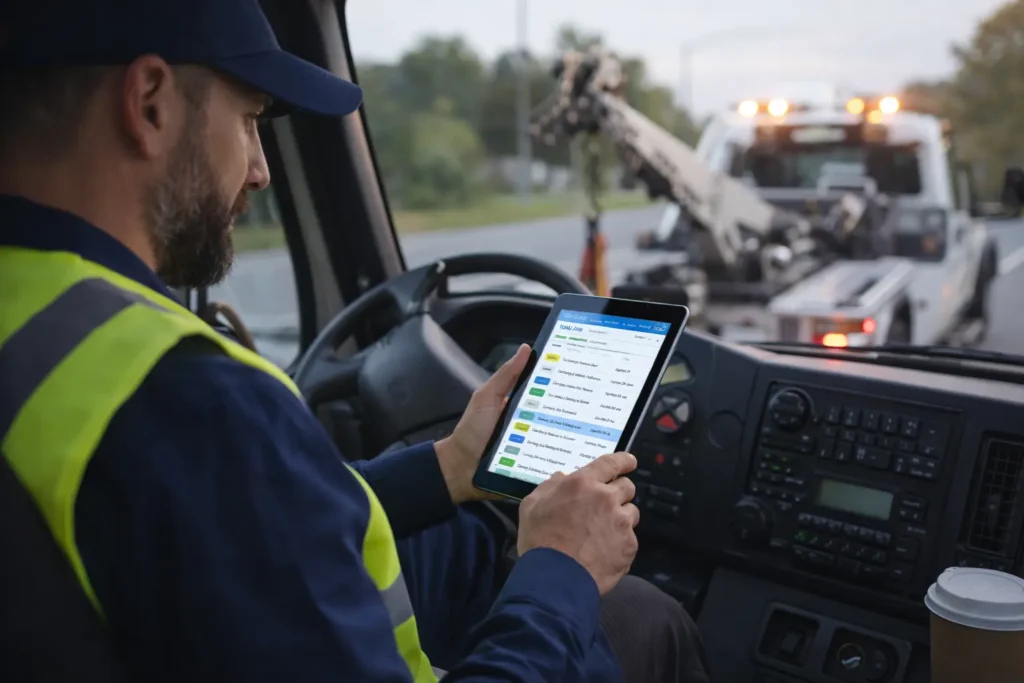
In towing, your work is judged before the truck even arrives. People care about two things: how fast help comes and whether updates feel honest. When dispatch is messy, even great drivers look slow because the process creates delays, missed details, and confusing ETAs.
Towing dispatch software should not feel like a shiny add-on. It should support what good dispatchers already do: collect the right details, assign the right driver, track progress, and close jobs with clean records. This guide focuses on real towing and recovery operations, so you can improve dispatch without turning your day into a complicated experiment.
What dispatchers and drivers deal with during a busy shift
Dispatch is decision-making under pressure. A normal day includes urgent roadside calls, scheduled transports, partner jobs, and constant changes. A vehicle gets moved, a customer stops answering, traffic blocks a route, and one job runs long and affects everything after it.
In many towing operations, “busy shift” can also mean late evenings and overnight coverage. If your team rotates into nights or stays on call during peak demand, practical advice on night shift adjustment tips can help reduce fatigue and keep decision-making sharper when pressure is highest.
Drivers need job details they can trust: correct pickup point, contact info, access notes, and the job type. Dispatchers need visibility: who is free, who is overloaded, and what is late. Customers need updates that make sense, not silence and guessing. If one part breaks, dispatch turns into back-and-forth calls instead of clean execution.
towing dispatch software should prevent the same three problems
Most towing companies, even strong ones, keep repeating three issues.
The first is weak intake. A request arrives with missing details, so the dispatcher calls back, the driver calls back, and time disappears.
The second is guess-based assignment. When you assign from memory instead of visibility, you send the wrong unit, create delays, and waste fuel.
The third is messy closure. If there is no clear job record, disputes take longer and reporting becomes opinion-based.
A good dispatch workflow fixes these without adding unnecessary steps.
Intake that stops repeat questions before they start
Most delays start in the first minute of the call. That is where mistakes happen because everything is rushed. A better intake process makes it easier to capture what matters.
In towing, the details that save the most time are usually the exact pickup location plus a backup description, vehicle details that affect equipment choice, whether it can roll, access notes like gates or tight spaces, and a reliable call-back number. When this is consistent, drivers stop calling the office for basics and dispatch can move to assignment faster.
If you want a simple way to keep every request trackable from start to finish, the FSM feature called Job Progress Tracking and Work Order History shows how teams can maintain a clear timeline of what was assigned, what changed, and what was completed.
Assignments that match reality, not hope
Dispatch is not only “send the closest truck.” It is “send the closest suitable truck.” That means the dispatcher needs to see availability and workload clearly, not guess based on who sounded free five minutes ago.
When assignment is visible and consistent, you reduce the common failures: sending the wrong equipment, double-booking one driver, or pushing an urgent call into the middle of a route that is already overloaded. Recovery work makes this even more important because incorrect assignment can turn into long delays and higher risk.
Routing and ETAs that customers actually believe
ETAs are where towing companies win or lose trust. Customers can accept waiting if they feel informed. They get frustrated when the ETA feels random or keeps changing with no explanation.
Routing support helps you cut wasted miles and choose a unit that can reach the job faster when the day is overloaded. Just as important, it helps dispatchers avoid promising unrealistic windows. Honest ETAs often reduce inbound calls because customers feel they are not being ignored.
When you build dispatch policies around safety and roadside procedures, it helps to use reliable sources. Many operations teams reference the NHTSA road safety resources for general roadside guidance and the FMCSA safety and regulations for commercial vehicle compliance context.
Status updates that stop dispatch from becoming a call center
When customers keep asking where the truck is, it usually means the status workflow is not visible or not trusted. Software only helps if drivers actually use it, and drivers only use it when updating status is quick and simple.
A small set of statuses is enough for many towing teams. Assigned, en route, on site, and completed works because it is easy to understand and easy to follow. Once status is consistent, dispatchers can answer questions faster and partners can get clean updates without the office chasing drivers all day.
Proof of service that protects you later
Disputes are not rare in towing. Sometimes it is billing. Sometimes it is a missed appointment claim. Sometimes it is confusion about location or what was done. A clean job record reduces the time you spend arguing.
Notes, timestamps, and a job history create a trail you can trust. Over time, job history also helps you improve operations because patterns become visible, such as which job types take longer, which areas cause delays, and what time windows create the most cancellations.
Industry context that matches towing and recovery work
Towing is not identical to general roadside service. Recovery work, impounds, scheduled transports, and partner jobs have different needs, which is why it helps to look at the towing workflow as its own vertical. If you want the most relevant industry context page on your site, the car towing and vehicle recovery industry overview is the cleanest place for readers to connect dispatch decisions to real towing operations.
A useful internal read for teams building a cleaner dispatch flow
Many dispatch improvements become easier when every call is treated as a job with a clear lifecycle instead of a one-off phone event. If you want to go deeper on that idea inside your own content library, the article about work order software explains how structured job details, assignment, and completion records reduce rework and confusion.
How to roll out dispatch changes without breaking your day
Most dispatch improvements fail because teams try to change everything at once. The practical way is to start with the smallest changes that reduce stress immediately.
Begin with consistent intake fields and a simple status flow. Once that is stable, set basic proof-of-service standards so every completed job leaves a reliable record. After that, review patterns weekly and adjust your process based on what actually happens, not what you assume.
If you want to test a cleaner workflow
If your goal is to move dispatch away from scattered calls and notes, the best test is to run a normal week through a structured process and see whether the dispatcher gets fewer follow-up calls and fewer wrong assignments. When you are ready to try it, you can create an account and set up a workflow around real jobs rather than demos.
FAQ
What is towing dispatch software used for
It helps dispatchers capture towing requests, assign drivers, track job progress, manage realistic ETAs, and keep a job history for reporting and disputes.
What details should dispatch collect at intake
Pickup location, vehicle details, whether it can roll, access notes, contact info, and job type. Clean intake prevents wrong assignments and reduces repeat calls.
Do towing companies really need routing support
Routing reduces wasted miles and helps dispatchers choose the best unit for urgent calls, which improves response time and keeps the schedule more stable.
What job statuses work best for towing teams
Simple is best. A few clear stages like assigned, en route, on site, and completed are enough when drivers update them consistently.
How does a job history help with disputes
A clear timeline with notes and timestamps makes it easier to confirm what happened, explain ETA changes, and resolve billing questions.
How can a small towing company improve dispatch without big changes
Start with structured intake and a consistent status flow. Once that is stable, add job history standards and review performance weekly.