

Marketing Operations Management Software for Team Capacity
Plan campaign resource, split the working day into real deliverables and report hours per project with marketing operations management software for in-house teams.

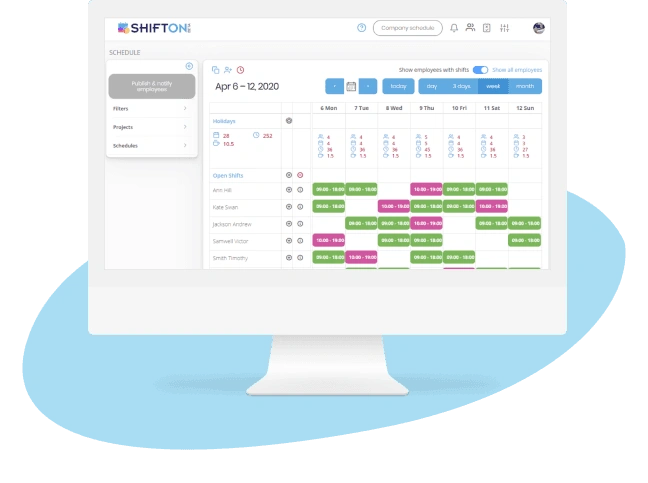
Build the week your team is actually working
Marketing weeks are rarely identical, because the work is shaped by what is launching rather than by a fixed pattern. The weekly grid puts every person on their own row with their hours against them, and any coverage you have not committed to anyone sits in the open shifts row where the team can pick it up.
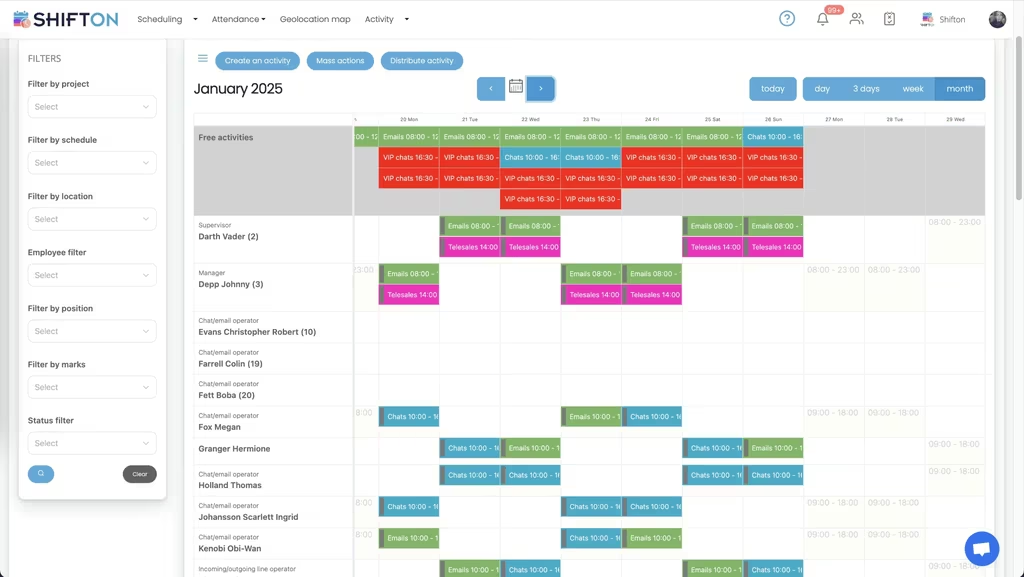
Split the day into the work it really contains
A booked day tells you somebody is working. It does not tell you what on. The activities view breaks each shift into the individual types of work inside it, each with its own start time and colour, so a month of scheduled hours becomes a month of specific output rather than a block of availability.
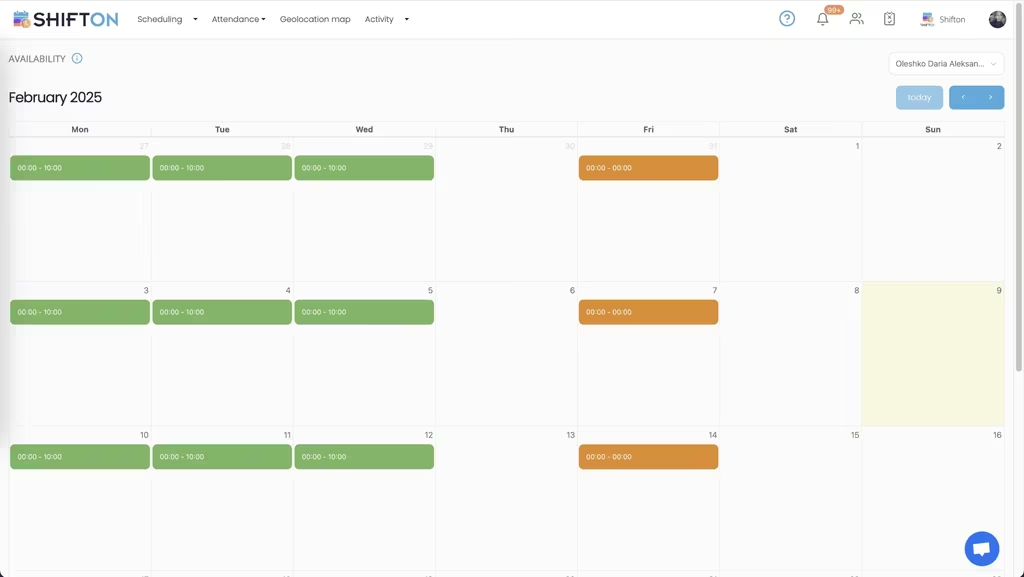
Collect availability before you plan anything
Hybrid schedules, study commitments and agreed focus hours all mean a marketing team is less uniformly available than a headcount suggests. The availability calendar collects it directly from each person: green where they can work, orange where they cannot, one month at a time.
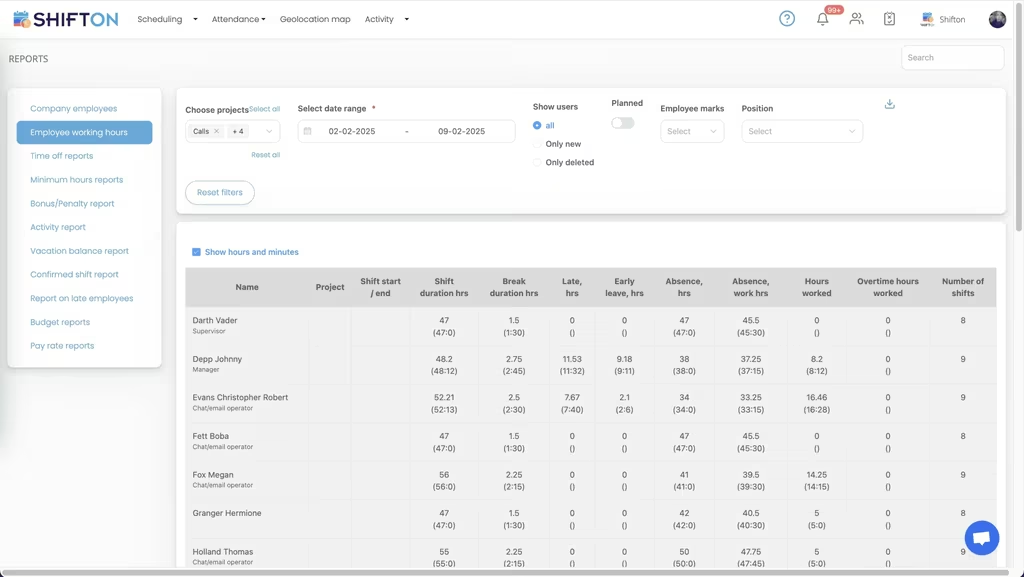
Hours per person, per campaign, ready to report
Utilisation arguments are unwinnable without figures. The employee working hours report lists each person's shifts by project with worked hours, overtime, breaks and the time lost to late starts or early finishes, filtered to whatever period you need.
Start with the Free Plan
No time limits. Get full access to core features and upgrade when you're ready.
Read the full guide to marketing team scheduling
Marketing capacity is almost always overestimated. On paper a team of nine has forty-five working days a month, and in practice a great deal of that is already committed to reporting, approvals, recruitment, holidays and the campaign that overran. Marketing operations management software matters because the gap between nominal headcount and usable hours is where deadlines quietly go to die.
The other problem is visibility. Marketing work is largely invisible until it ships, which makes it very hard to say no with evidence. A request for one more asset looks free because nobody can point to the hours it will displace. Marketing team management software fixes that by making the hours explicit: what is booked, who holds it, and what has to move if something new arrives.
What marketing operations management software has to cover
Four jobs. Show the team's real capacity for a period rather than its headcount. Let work be planned against people who have actually confirmed they are available. Record the hours that went into each campaign so utilisation is a measurement rather than an opinion. And do all of it somewhere the team will look, which means a phone rather than a document nobody opens twice. Marketing operations scheduling software that does the first three but lives in a spreadsheet fails on the fourth, and the fourth is the one that decides whether it gets used. That is also why marketing staff scheduling software succeeds or fails on its mobile app rather than on its feature list.
Campaign resource planning against real capacity
Campaign resource planning goes wrong in a predictable way: the plan is built from the deliverables backwards, and the people are assumed to be available because they are employed. Working forwards from capacity produces a different and more honest answer. In Shifton each campaign or workstream is a project, so hours are booked against it and the total is visible per person and per period. When two campaigns want the same specialist in the same fortnight, the clash appears in the grid rather than in a status meeting three weeks later. Marketing team scheduling software is worth having at exactly the point where the number of parallel workstreams exceeds the number of people who can hold them all in their head.
Most teams start with a marketing schedule template in a spreadsheet, and it holds up while there is one campaign at a time. It stops working the moment two overlap, because a template records intent while a roster records commitment, and only one of those can tell you whether Thursday is already full. An existing marketing schedule template can be imported rather than retyped, then maintained as a live plan instead of a document somebody remembers to revisit.
Splitting a working day into actual deliverables
A scheduled day says somebody is at work. It does not say what came out of it. Activities sit inside a shift with their own times, which lets a day be broken into the distinct pieces of work it contains, and the same activity can be distributed across several people in one action rather than assigned one by one. Work that has to happen but has no owner yet can be parked and picked up later. Our activity tracking feature covers the detail. For an in-house team this is the difference between a plan that says the week is full and a plan that says what the week produces.
Where marketing platforms end and workforce planning begins
Search results in this space are crowded with a different product category. Most tools sold as marketing management software plan channels, assets, audiences and approvals, and plenty of them are excellent at it. None of them know how many hours your team has next month, who is on leave, or what the last launch actually consumed in labour. Marketing workforce management software answers those questions and stays out of channel delivery entirely. In-house marketing scheduling software and a delivery platform are complements rather than alternatives, and treating them as competitors is how teams end up with a beautiful content plan and nobody free to execute it. Teams who bill clients by the hour have a different shape of problem, which our page for agency teams covers.
Availability, focus hours and hybrid patterns
Marketing teams rarely work a uniform week. Some people compress hours, some hold protected time for deep work, and hybrid arrangements mean physical presence and working hours are two separate questions. Availability is collected from each person by the hour for the month ahead, and time-off requests go through the app for approval, so the roster is built on confirmed information. Marketing department scheduling software that assumes everybody is available nine to five will produce a plan that looks fine and breaks in week one. Marketing employee scheduling software has to treat availability as information collected from people rather than a policy applied to them. Positions and authority levels also matter here, because a team lead should be able to adjust their own group's schedule without being handed the whole company roster.
Launches, events and the hours outside the pattern
Marketing shift scheduling software sounds like an odd category for an office team, right up until the first launch weekend. Some marketing work refuses to sit inside office hours. Launches land at awkward times, events run over weekends, and a live campaign sometimes needs somebody watching outside the normal day. Rather than an informal arrangement that quietly becomes unpaid, publish the cover as an open shift so anyone qualified can claim it, and let shift swaps happen between team members with a manager confirming. Bonuses can be attached to individual shifts where extra cover deserves recognising. Campaign team scheduling software that treats out-of-hours work as an exception to be handled in chat is how goodwill gets spent without anyone noticing. Teams that also cover a press office out of hours are handled on our page about PR agency scheduling.
Utilisation, hours per project and what a campaign cost
Once hours are recorded against projects, several arguments become straightforward. The working hours report shows worked and overtime hours per person, filtered by project, position and period, with breaks and lateness as their own figures. Budget and pay rate reports translate that into a labour cost per campaign, which is the number that supports a headcount case far better than a description of how busy everyone feels. Marketing time tracking software is often resisted by creative teams, and reasonably so when it is used for surveillance. Used for capacity it does the opposite: it is the evidence that a team is at its limit. Content team scheduling software earns trust when the output of the data is a better workload rather than a scoreboard, and the same caution applies to content team time tracking software: it works when the team can see the reports written about them.
Shifton for an in-house marketing team
Shifton is deliberately narrow. It plans people, records hours and reports on both, across as many campaigns, offices and teams as you run, and it does not attempt to be a delivery platform. Digital marketing team scheduling software with that scope is easy to adopt because there is very little to learn: a grid, an app, a set of reports. Creative marketing team scheduling software has to stay light enough that it never becomes the work itself, and a marketing scheduling solution that needs training days does not survive a busy quarter. Under 10 team members it is free with no time limit, covering shift scheduling, basic time clock and attendance, the mobile app and reports, which suits a small department outright. Past that, pricing runs per employee per month with forecasting and automatic distribution as paid modules. The result is a marketing operation that can say what it has capacity for, and prove it.
Frequently Asked Questions
What is marketing operations management software?
In a workforce sense it is the system that plans who in the marketing team works on what and when, and records the hours that went in. Shifton builds the schedule, splits shifts into specific activities, collects availability and reports hours by person and by project.
Is this the same as a marketing platform?
No. Campaign delivery tools handle channels, assets and audiences. Shifton handles people: capacity, schedules, availability and hours. Most in-house teams run both, because knowing what to publish does not tell you whether anyone has the hours to produce it.
Can we see how much time a campaign consumed?
Yes. Every shift is booked against a project, so the working hours report can be filtered to one campaign and a date range, showing worked and overtime hours per person. Budget and pay rate reports turn those hours into a cost figure.
How does it handle hybrid and flexible schedules?
Each person records their own availability by the hour for the month ahead, and time-off requests are submitted in the app for approval. You plan against what people have actually confirmed rather than against a nominal working pattern.
Can a shift be broken into different types of work?
It can. Activities sit inside a shift with their own times, so a day can be split into the distinct pieces of work it contains, and the same activity can be distributed across several people at once. That turns scheduled hours into a plan of specific output.
What does it cost for a small marketing team?
Up to 10 team members Shifton is free with no time limit, including shift scheduling, basic time clock and attendance, the mobile app and reports. Beyond that, paid modules such as demand forecasting and automatic distribution are charged per employee per month, so it works as a marketing team scheduling app for a handful of people or as full marketing rostering software for a department of forty.






See your marketing team's real capacity before the next launch
Start free with up to 10 team members and put campaign resource planning on the same screen as your team's hours.