

Hotel Staff Scheduling Software for Every Department
Hotel staff scheduling software for housekeeping, front desk and night cover: staff every hour to expected occupancy and keep overtime where you planned it.

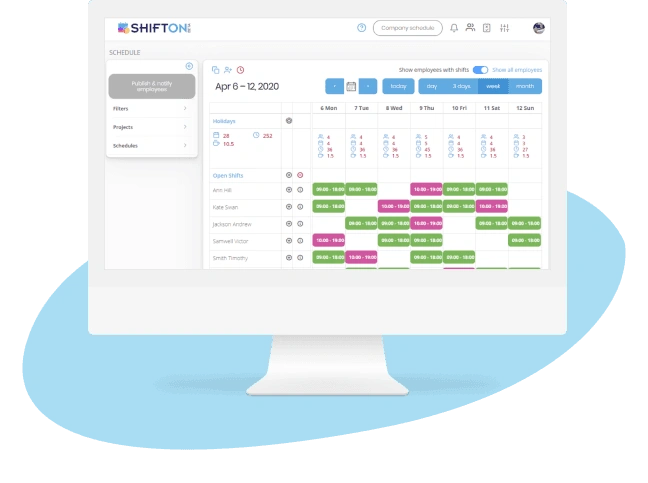
Build the week, publish it to every phone
The weekly grid holds the whole property on one screen: staff as rows, days as columns, each shift colour-coded with its start and end time. Anything still uncovered sits in the Open Shifts row, so a thin Saturday is visible while there is still time to fix it rather than at handover.
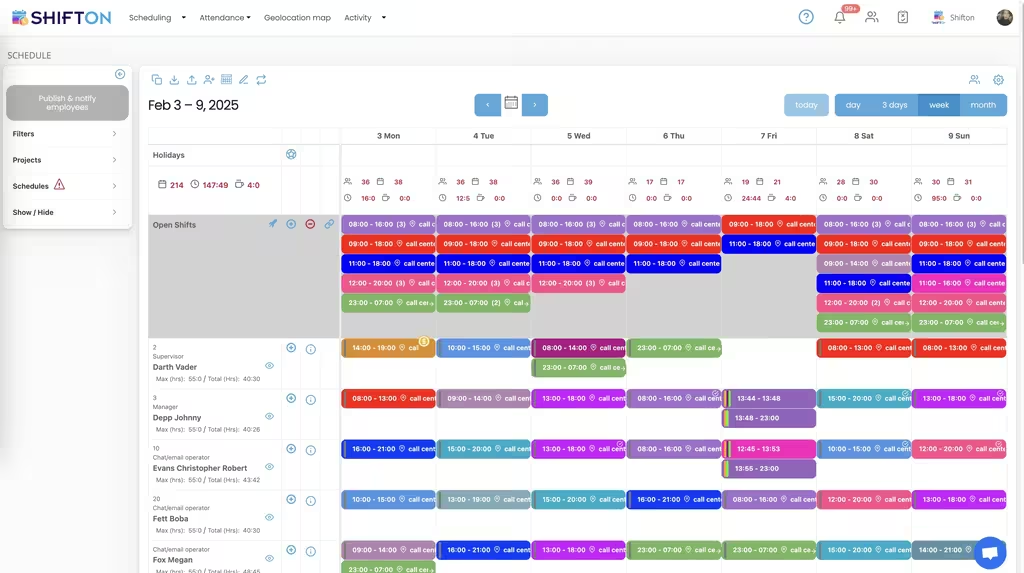
Nights, earlies and cover by role
A hotel week does not fit one shift per person per day. This view stacks several shifts on the same date, including the overnight block from 23:00 to 07:00, with each person's role shown beside their name so the mix on every shift is readable before you publish.
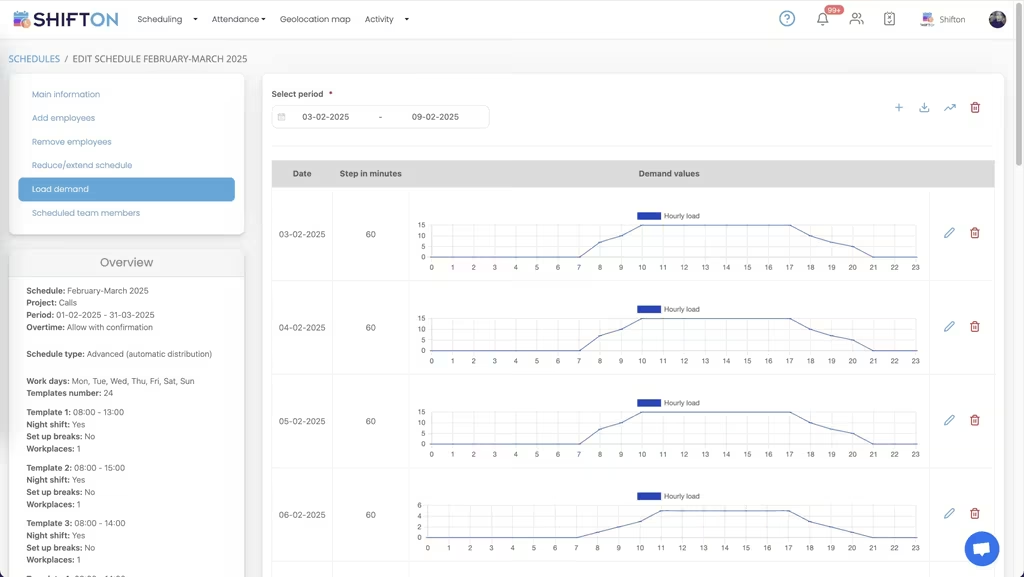
Staff each hour to the demand you expect
Load demand records the work expected on each date and, at a chosen step in minutes, across each hour from midnight to midnight. Shift templates sit alongside with their own times, night flag and number of workplaces. Set the schedule to automatic distribution and the rota is generated against that curve, with the overtime rule deciding whether extra hours need confirmation.
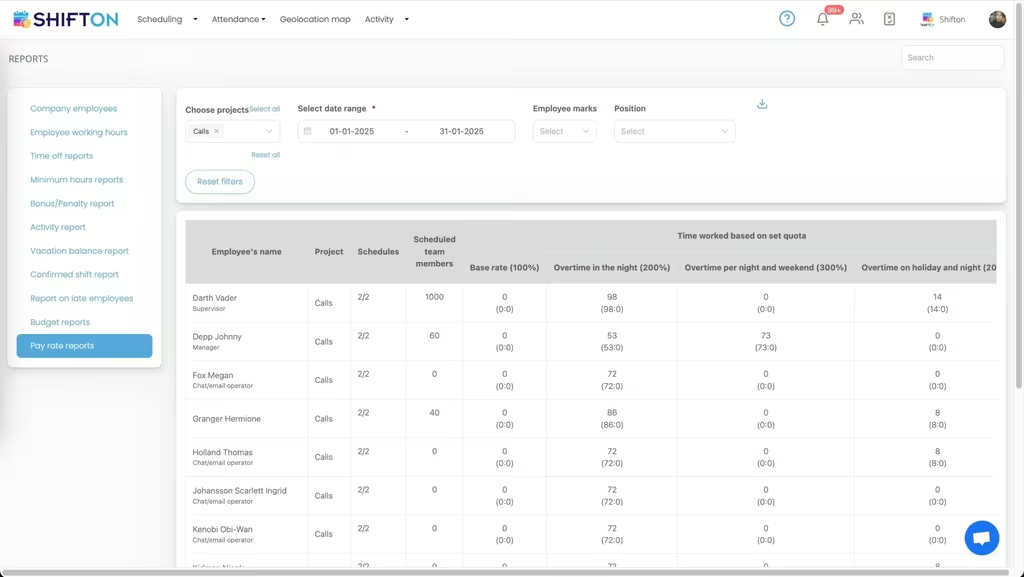
Pay rate reports: where the premiums went
The pay rate report splits hours worked into the tier that paid for them: base rate at 100%, night overtime at 200%, night and weekend overtime at 300%, and holiday night hours on their own line. Filter by department, position, date range or employee marks and the premium load stops arriving as a single payroll figure.
Start with the Free Plan
No time limits. Get full access to core features and upgrade when you're ready.
Read the full guide to hotel staff scheduling
A hotel is several businesses sharing a building, and the rota is where they collide. Housekeeping is driven by departures, reception by arrivals, maintenance by whatever broke overnight, and the night team by the simple fact that somebody has to be awake. Hotel staff scheduling software has to hold all of those patterns at once and still let a duty manager fix Saturday in five minutes.
Labour is also the biggest cost line a hotel can actually move week to week. When the rota lives in a spreadsheet, the overspend only becomes visible after payroll, by which point the decisions that caused it are three weeks old.
What hotel staff scheduling software has to get right
Four things carry most of the value. Build a full week across several departments quickly. Keep every person's hours inside contract and legal limits while you assign, rather than discovering the breach later. Reach the team on their phones the moment anything changes. And report hours in the tiers that will be paid, so night and holiday cover is a known cost.
Shifton is built around those four: day, week and month views, shift templates, demand-based automatic distribution, open shifts, swaps, availability and time-off requests, a mobile time clock, and pay rate reporting. It is hotel workforce management software for the people side of the operation, and it does not touch rooms, rates or reservations.
The same requirement gets written down in different ways. Owners ask for a hotel staff management system, duty managers want hotel rota software, and finance wants the wage bill to stop moving without warning. Hotel employee scheduling software has to answer all three from one grid, or it becomes another tab nobody opens.
Housekeeping is the hardest rota in the building
Room attendants are scheduled against a workload that changes daily and is only confirmed the night before. Sections have to be balanced, supervisors have to be on every shift, and the whole plan can be wrong by nine in the morning if a floor turns over unexpectedly.
Two mechanisms carry the weight. Templates hold your real patterns, so a week starts from a known shape rather than an empty grid, which is what people are really after when they search for a housekeeping schedule template or a hotel housekeeping schedule template. Open shifts turn extra rooms into work the team can claim in the app instead of a supervisor working the phones. Housekeeping scheduling software that gets those two right removes most of the morning scramble, and the running hour totals beside each name stop the same three people absorbing every extra section.
The practical test of hotel housekeeping scheduling software is what happens at 08:30 when the sheet is already wrong. Reassigning a section takes seconds, the affected attendant gets a notification, and the housekeeping schedule app on their phone shows the change without anyone printing anything. Housekeeping schedule software that only produces a document has solved the easy half of the problem.
Front desk, night audit and 24/7 rotations
Reception never closes, so its rota is a rotation rather than a week. Early, late and overnight shifts stack on the same day, the overnight block runs across midnight, and each shift needs a specific level of authority present. In Shifton, shifts of any length can cross midnight and count on the correct day and pay tier, and each person's role sits next to their name in the grid so a shift with no supervisor is obvious before publication. A front desk schedule template applied forward keeps the rotation consistent, a hotel front desk schedule template can be saved per property, and swaps between staff still pass through manager confirmation. Hotel shift scheduling software that cannot express an overnight block correctly will misreport hours every single week.
Staffing to occupancy instead of to habit
Most rotas are copied from the previous week, which means they are staffed for the previous week's occupancy. That is the single largest source of avoidable labour cost in a hotel: too many people on a quiet Tuesday, too few on a busy Friday, and premium hours filling the gap. Hotels with conference and banquet space feel that swing more sharply, and for such venues we cover exhibition centre staffing separately.
Shifton lets you record expected demand for each date and each hour, define the templates you run, and generate the rota against that curve. Overtime is a rule rather than an accident: block it, allow it, or require confirmation before anyone crosses their limit. This is where hotel labor scheduling software earns its licence, because a shared calendar has no concept of how much work an hour contains.
Seasonal peaks and a workforce that turns over
Seasonal hotel staffing means onboarding people quickly and giving them a rota they can read without training. New starters are invited by email, appear in the team list with their position and access level, and see only their own shifts in the app. Availability is collected from each person as a calendar rather than a conversation, so a student with fixed lecture hours or a returning seasonal worker is scheduled around what they actually told you.
Templates matter here too. A peak week is largely last year's peak week with different names, and a saved hotel staff schedule template turns a two-day rebuild into an afternoon. Keeping last season's hotel schedule template is worth more than any amount of planning done from a blank grid.
Night, weekend and holiday premiums in the wage bill
The same shift costs different money depending on when it falls, so a rota that looks balanced on hours can be badly unbalanced on cost. Pay rate reports split a period into base rate, night, night-and-weekend and holiday tiers, per person and per department, and sit alongside working hours, time-off balance, budget and late-arrival reports in the same panel. Our reports page lists what each one returns. Add clock-in and clock-out data and hotel time and attendance software stops being a monthly reconstruction from paper. Bonuses and penalties are recorded against the shift where they happened, so an adjustment three weeks later still has a trail behind it.
One property or a group
A single hotel needs speed and nothing more. A group needs properties kept apart, general managers who see only their own, and totals that roll up for the owner. Shifton covers both without changing product: projects and schedules separate properties and departments, permissions decide who edits what, and staff shared between sites see one calendar. Boutique hotel scheduling software requirements and group-level ones sit on the same foundation of shifts, templates, availability and hours, which is why a hotel scheduling system that works for one property usually scales without a migration. A hotel workforce management system is only the same product with more projects in it, and hotel rostering software that forces a second account per site creates work rather than removing it. Operators running venues beyond accommodation can compare the wider hospitality scheduling page.
What to test before you commit
Run any hotel scheduling app through one real week before deciding. Build housekeeping, reception and nights from scratch and time it. Enter an overnight shift and check it is counted on the right day at the right rate. Push somebody past their hour cap deliberately and see whether you get a warning. Then pull the reports and confirm premium hours are separated rather than totalled, because that is the number a general manager will be asked about.
Shifton is free for up to ten team members with no time limit, which covers a small property outright, and paid plans are per employee per month as the team grows; the pricing page shows where each module sits. Import your team, build one department's week, publish it, and see how much of the rota admin disappears.
Frequently Asked Questions
What does hotel staff scheduling software do?
It holds the rota for every department in one place and keeps it accurate as the week changes. Staff are assigned to shifts, the rota publishes to their phones, hour caps and overtime stay visible while planning, and actual clock-in and clock-out times are recorded for payroll reporting. Shifton covers the workforce side of a hotel, separate from the systems that handle rooms and rates.
Can it schedule housekeeping and reception separately?
Yes. Each department is set up as its own project and schedule, so housekeeping, front desk, maintenance and night cover are built independently but roll up into one view of the property. Managers can be restricted to their own department through access levels, while staff who cover more than one area see all of their shifts in a single calendar.
How does staffing to occupancy work?
You enter the expected load for each date and each hour of the day at a step you choose, define the shift templates you actually run, and let automatic distribution build the rota against that curve instead of copying last week. Occupancy figures are entered as demand; Shifton does not connect to room-booking systems.
Does it handle night and holiday premium rates?
Yes. Shifts can cross midnight and carry their own rate multiplier, and the shift detail shows the rate applied, the hours counted and the total. Pay rate reports then split a period into base, night, weekend and holiday tiers per person and per department, which is how the cost of overnight cover becomes visible before payroll closes.
Is there a free plan for a small hotel?
The free plan covers up to 10 team members with no time limit and includes shift scheduling, a basic time clock, the mobile app and reports. A small guesthouse or boutique property can run on it outright. Above 10 people, paid plans are charged per employee per month, and modules such as the geolocation map are paid additions.
How do staff see changes to the rota?
Each person uses the Shifton app on iOS or Android and sees only their own shifts. Push and SMS notifications go out when a shift is added, moved or reassigned, so nobody works from a printed sheet that stopped being true. Shift swaps and time-off requests are submitted in the app and confirmed by a manager before they take effect.






Get every hotel department onto one rota
Build next week across housekeeping, reception and nights, publish it to every phone, and watch the hour totals as you go.