

Restaurant Scheduling Software for Front and Back of House
One rota for servers, kitchen and bar, published to every phone, with the hours payroll needs recorded as they happen.

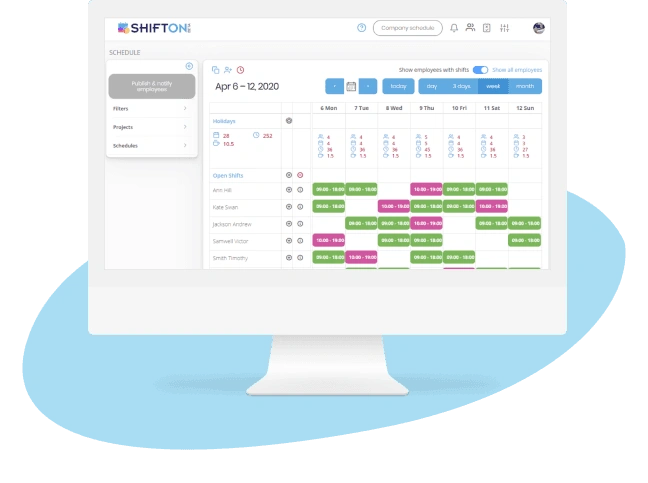
Build the week around service, not the working day
A restaurant week is not forty hours spread evenly. It is a quiet Tuesday lunch, a Friday that needs everybody, and a Sunday brunch that runs on half the team. The rota has to show coverage against those peaks rather than a tidy grid of names.
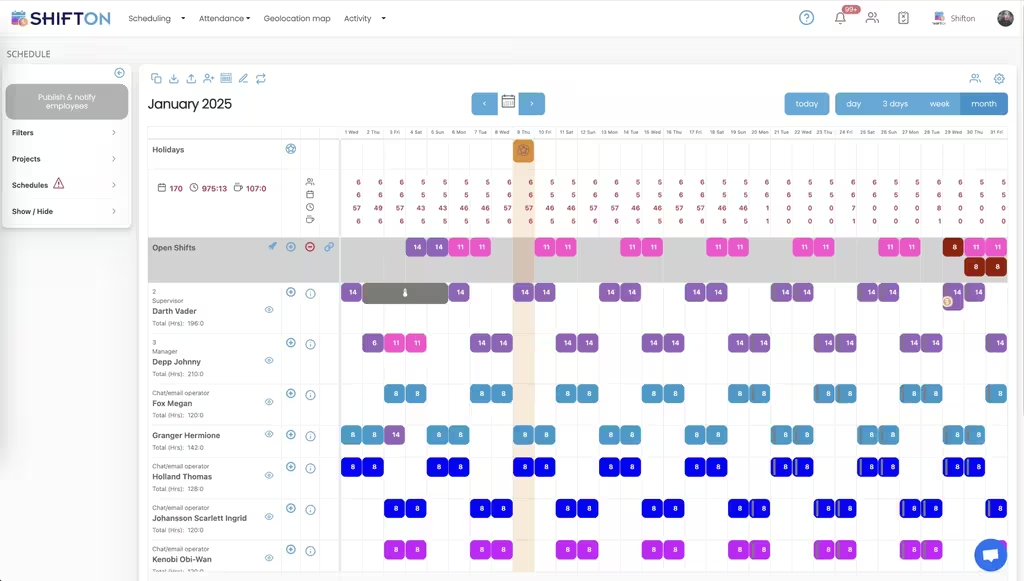
Cover a call-out before doors open
Somebody calls at four for a six o clock start. Ringing round the group chat works until it does not. Publishing the shift to everyone qualified turns a scramble into a notification, and the first person to accept fills it.
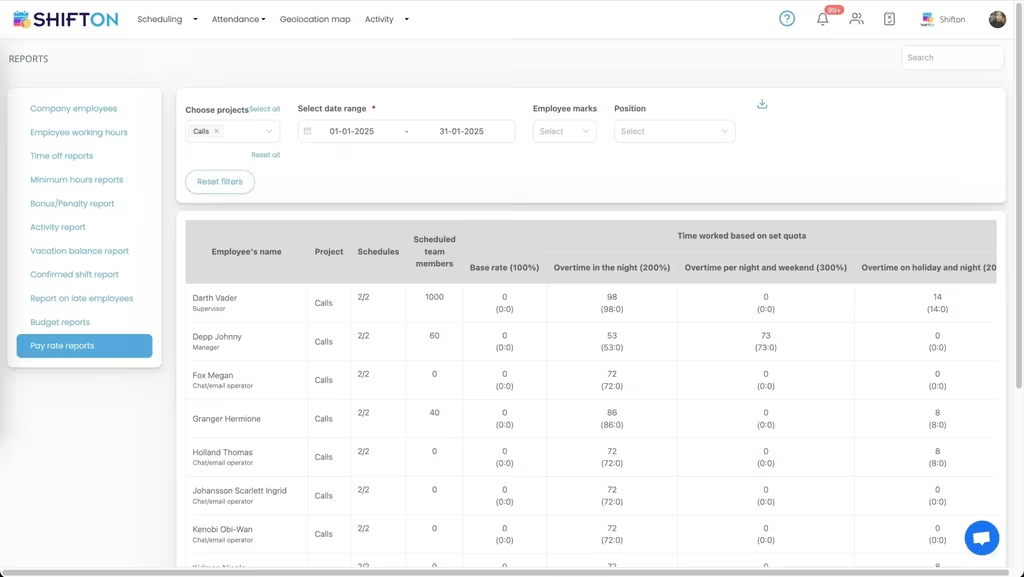
Record hours as they happen
Clock-in on the door beats a paper sheet filled in from memory on Sunday night. The real start, the real finish and the breaks sit next to the planned shift, so the twenty minutes somebody stayed to close is in the record rather than in an argument.
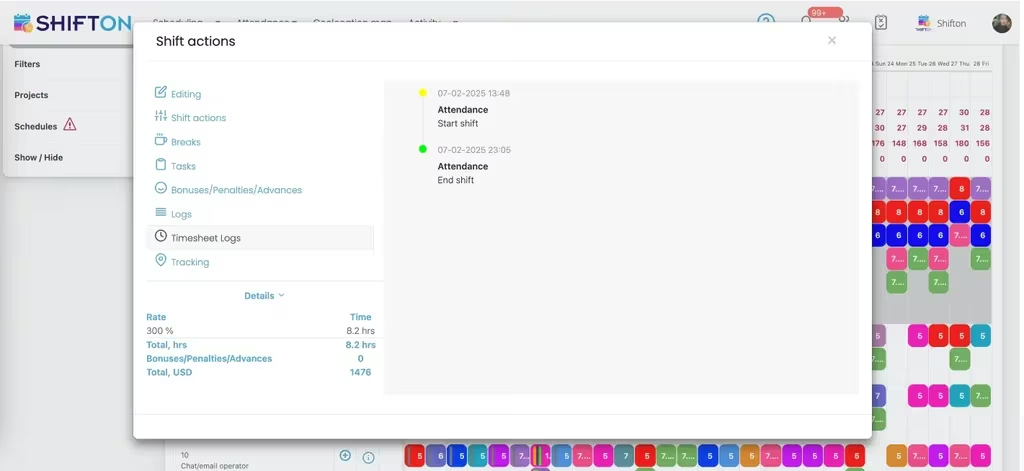
Watch labour against the shape of the week
Labour is the cost a restaurant can still move on a Wednesday. Weekly reports group recorded hours by role and by day, which turns a vague sense that the kitchen is overstaffed on Mondays into a number you can act on.
Start with the Free Plan
No time limits. Get full access to core features and upgrade when you're ready.
What restaurant scheduling software has to do
Restaurant rotas fail in public. A short Friday is not a spreadsheet error, it is a forty minute wait for a table and a review about it on Monday. That is the first thing separating this category from general staff scheduling: the cost of getting it wrong lands the same evening, in front of customers.
The second is turnover. Hospitality churns faster than almost any other sector, which means the rota is constantly being built for a team that is not quite the same as last month. Software that assumes a stable roster and a manager with time to learn it does not survive contact with a real venue.
And the third is margin. Food cost is mostly fixed by suppliers. Rent is fixed by the lease. Labour is the number a manager can still influence on a Wednesday afternoon, and it is the one most often measured a month too late.
Planning against service, not against hours
A useful restaurant rota is read vertically, by service, not horizontally by person. The question is never how many hours Anna is on this week. It is whether Friday dinner has enough servers, whether the kitchen can cope with a fully booked Saturday, and who is on the closing shift that nobody wants.
Roles make that readable. Planning servers, kitchen and bar as separate groups on the same week lets a manager check coverage one section at a time and still publish a single rota. Staff open the app and see their own shifts, not the whole board.
The shift nobody has taken
Empty squares are ambiguous. An open shift is not: this service needs somebody, nobody is on it, here is who could be. Leaving committed but unstaffed work visible until it is filled is a small change that removes most of the Friday morning surprises.
Read the week vertically. Coverage, not headcount.
Absence at four in the afternoon
Every venue has a version of the same story. A server calls in two hours before service, the manager starts working through the group chat, and half the replies arrive after the shift has already started. The problem is not the people, it is the broadcast.
Publishing the gap as an open shift to everyone qualified changes the shape of the problem. The offer goes out once, acceptance is first come, and the record shows who was asked and who answered. What took twenty minutes of phone calls becomes a notification and a tap.
Swaps work the same way in reverse. Staff arrange cover between themselves, the manager approves or declines, and the published rota only changes once somebody with authority has agreed.
Hours that match what happened
A paper timesheet completed from memory on Sunday night is a payroll dispute waiting for a date. Clock-in and clock-out recorded on the day, held beside the planned shift, remove the reconstruction entirely. The row shows what was scheduled and what was worked, and the twenty minutes somebody stayed to finish a close is in the record rather than in a conversation.
Breaks deserve their own line. Deducting half an hour from a total is where paid and unpaid time quietly merge, and it is also where compliance questions start. Logging them separately keeps both sides clean.
Half an hour deducted from a total is not a break. It is a rounding.
Multiple venues on one account
Groups run into a specific version of the problem: a member of staff who works two sites and appears twice in the system, with two sets of hours that have to be added up by hand. Keeping one record per person and attaching shifts to locations solves it, and it makes the group-level report possible at all.
Labour as a number you can act on
Most venues discover their labour percentage after the month closes, which is exactly when nothing can be done about it. A weekly report grouping recorded hours by role and by day moves the conversation forward by three weeks.
The patterns it exposes are usually not subtle. A kitchen carrying two extra people every Monday lunch. A Saturday that runs an hour of overtime for four people every single week because the close is scheduled too tight. Both are fixable in the next rota once somebody can see them.
Compliance without a separate system
Hospitality carries rules that vary by market and by contract: break entitlements, minimum rest between shifts, predictive scheduling notice in some jurisdictions, different treatment for under-eighteens. None of them are difficult individually; all of them are difficult to remember at five o clock while covering a call-out.
Keeping the schedule and the time record together at least puts the evidence in one place. What was published and when, what was worked, what breaks were taken. That is what a query or an inspection asks for, and reconstructing it from a whiteboard photo and a paper timesheet is where the cost actually lands.
Under-eighteens and students
Venues that employ students carry extra constraints on hours and lateness. Availability marked by the staff member before the rota is built is the simplest way to keep those constraints in view, because it turns a rule the manager has to remember into a fact on the screen.
Choosing between the tools in this category
Restaurant scheduling software overlaps with three other categories, and the labels blur. Point of sale systems schedule as a side feature. Payroll platforms schedule to feed their own timesheets. Hospitality suites bundle scheduling with ordering and inventory. Each is reasonable if you want the whole suite, and each is heavier than a manager who wants a rota deserves.
The questions worth asking are narrow. Can staff swap between themselves with approval, or does every change go through the manager. Does the app show a published change without the staff member having to ask. Are planned and actual hours two separate numbers. Can you run two venues without duplicating people.
Where a free plan stops
Shifton is free for up to 10 team members with no time limit, which covers a small independent venue outright. The rota, the basic time clock, the mobile app and reporting are all in that plan. Beyond ten people it becomes a per employee cost, with modules added one at a time from $0.50 per employee a month and a trial of up to 60 days on each.
Frequently Asked Questions
Can I schedule front of house and kitchen on the same rota?
Yes. Roles and sections are planned separately so a manager can look at servers alone or the kitchen alone, and published together so the whole team sees one week. Staff see only their own shifts in the app.
How fast can I fill a shift when somebody calls in sick?
Open the shift and it goes out to everyone who can work it. The first person to accept takes it, and the manager sees who responded. Swaps arranged between staff go through the same approval step before the rota changes.
Can staff see the rota and request time off from their phone?
Yes. The mobile app for iOS and Android carries the published rota, swap requests, availability and time off. Read confirmation shows the manager who has opened the week and who has not.
Does it track breaks separately from worked hours?
It does. Breaks are logged as their own record rather than being deducted from a total, so paid and unpaid time stay distinct and the payroll export reflects what actually happened.
Can I run more than one venue from the same account?
Yes. Each venue is set up as its own location or project, and staff who work across two of them keep a single record. Reports can be read per venue or across the group.
Is there a free restaurant scheduling app?
Shifton is free for up to 10 team members with no time limit, including the rota, the basic time clock, the mobile app and reports. Paid modules start at $0.50 per employee a month, each with a trial of up to 60 days.





Get the rota off the whiteboard
Free for up to 10 staff, with roles, open shifts that fill from the phone and clock-in times payroll can rely on.