

Healthcare Scheduling Software for Hospitals and Clinics
Healthcare staff scheduling software built for round-the-clock cover: roster nurses and support staff, fill open shifts fast and keep overtime under control.

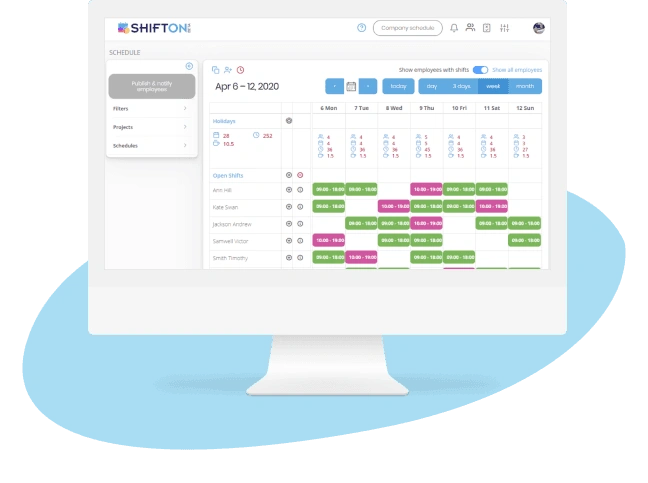
Build and publish the week in one screen
The weekly grid holds every unit on one screen: staff down the left, days across the top, each shift colour-coded with its start and end time. Unfilled slots sit in the Open Shifts row at the top, so a gap in cover is visible before the week goes live rather than the morning it bites.
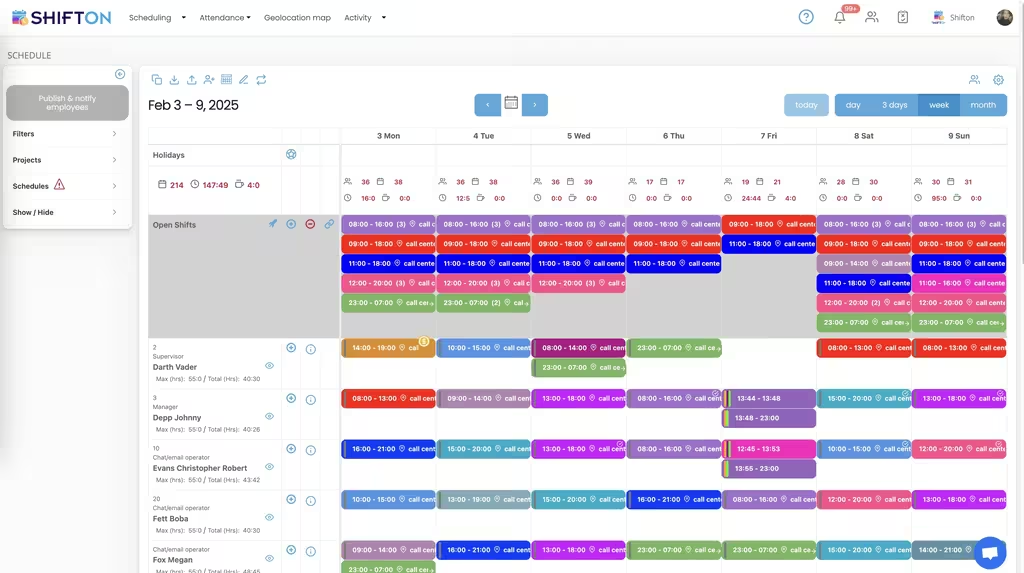
Nights, earlies and role-based cover
Clinical rosters rarely fit one shift per day. This view stacks several shifts on the same date, including overnight blocks that run 23:00 to 07:00, with each person's role shown next to their name so the skill mix on every shift is readable at a glance.
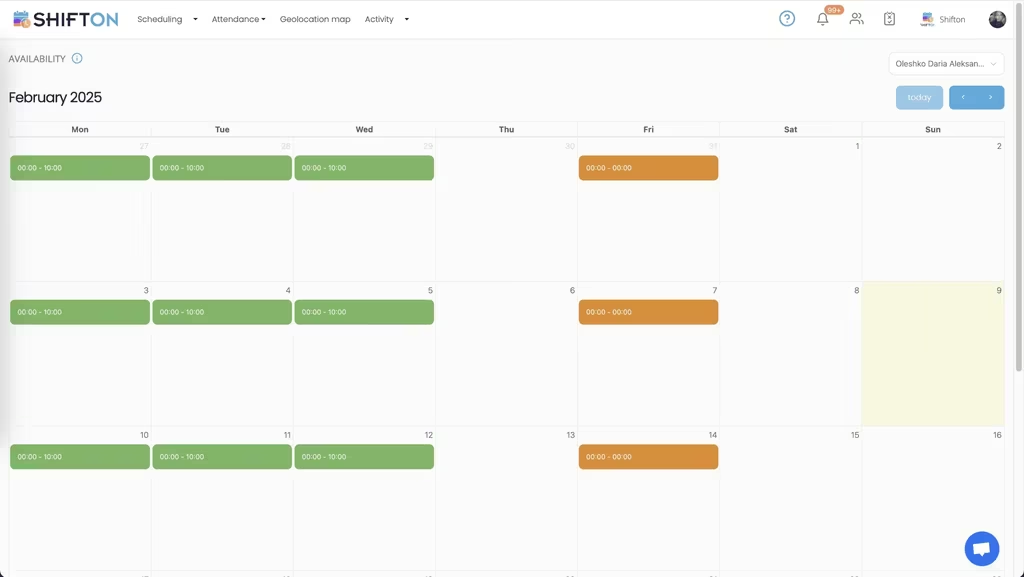
Availability collected before the roster is built
Staff mark their own month in the availability calendar: green for the hours they can work, orange for the hours they cannot. Planners open one employee at a time and see the pattern for the whole month, which turns nurse self scheduling from a stack of messages into a single screen.
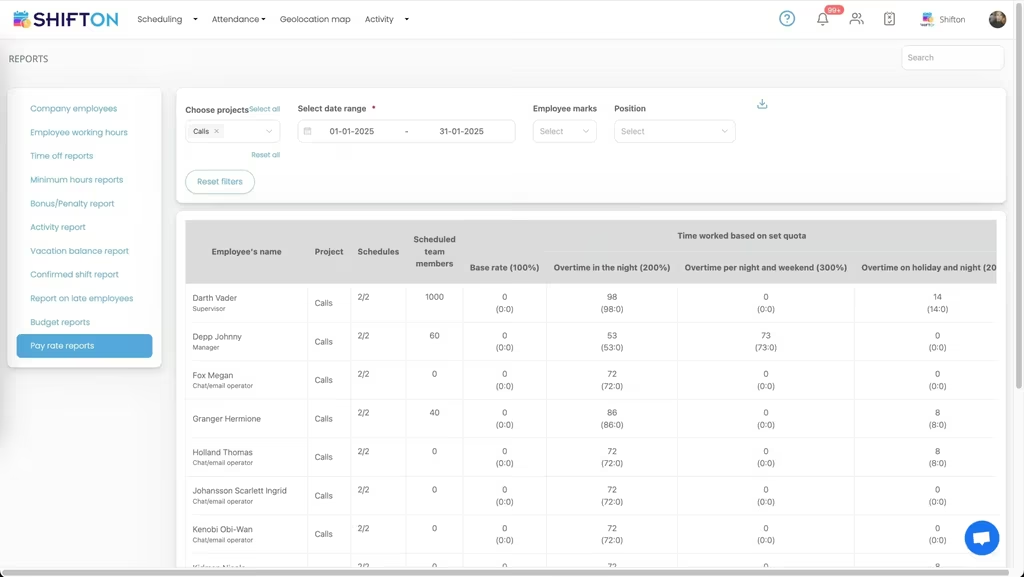
Pay rate reports: where the premiums went
The pay rate report splits hours worked into the tier that paid for them: base rate at 100%, night overtime at 200%, night and weekend overtime at 300%, and holiday night hours on their own line. Filter by project, date range, position or employee marks and the premium load stops being a payroll surprise.
Start with the Free Plan
No time limits. Get full access to core features and upgrade when you're ready.
Read the full guide to healthcare staff scheduling
Healthcare never gets a quiet week. A ward, an outpatient clinic and a medical practice all run against the same constraint: a minimum number of qualified people has to be present in every hour of every day, and the pool available to fill those hours changes constantly. Healthcare scheduling software exists because that arithmetic outgrew the spreadsheet years ago, and because the cost of getting it wrong lands twice, once on the agency invoice and once on the staff who quietly stop picking up extra shifts.
Whoever builds the roster usually does it between other duties. So the tool has to be quicker than the whiteboard it replaces, honest about hours and premiums, and usable from a phone. Anything that needs a training week gets abandoned in the second month.
What healthcare scheduling software actually has to do
The job is narrower than most feature lists suggest. Cover every hour with the right skill mix. Keep individual hours inside contracted and legal limits. Let staff see the roster and respond to it without chasing a manager. Show what a published schedule will cost before payroll finds out. Healthcare staff scheduling software that does those four things properly beats a platform with fifty modules nobody opens.
Shifton is built around that short list: day, week and month views, open shifts, swaps, reusable templates, availability and time-off requests, attendance, and reporting that ties hours back to pay rates. No clinical records, no appointment diaries. It is workforce management software for healthcare and it stays on the staffing side of the line.
That focus is deliberate. Whether the shortlist says hospital scheduling software, clinic schedule software or medical staff scheduling software, the underlying question is the same: is the next fortnight covered, and at what cost. A pharmacy is a separate case, since a pharmacist must be present whenever the counter is open: see pharmacy staff scheduling.
Why nurse scheduling software is not an office rota tool
Clinical staffing has properties an office schedule does not. Shifts run twelve hours and cross midnight. Nights and weekends carry premiums. Contracts are a mix of full-time, part-time and bank hours. Competencies are not interchangeable, so a body in the building is not the same as cover. Any nurse rostering software worth installing has to hold all of that at once, which is why generic staff scheduling software for healthcare tends to fail on the second week rather than the first. Scheduling software for nurses has to treat a night as a different unit of work from a day, not merely a different colour on the grid.
Shifton handles it through roles and positions attached to each person, hour caps that show a running total as you assign, and shift templates that carry a pattern forward instead of making you redraw it. A nursing staff scheduler working a rotation can copy a proven cycle across the next quarter and adjust only the exceptions. The nurse scheduling app on each phone shows the same cycle, so the roster staff read and the roster the planner edits never drift apart.
Coverage, skill mix and staffing ratios
Most gaps are not really absence problems, they are visibility problems. A roster looks full until you count qualified people per shift instead of names per shift. Healthcare staffing ratios only hold if the planner can see role composition while assigning, not after publishing.
The week and month grids in Shifton show every shift colour-coded with its role label, and unfilled slots sit in a dedicated open shifts row rather than hiding as blank space. Post those slots and every qualified person receives them at once, which replaces the round of phone calls that agency nurse scheduling usually turns into. Hospital on call scheduling works the same way: publish the requirement, let the people who can take it respond, confirm in one tap. Good nursing staff scheduling software makes the gap loud and the response cheap.
Overtime, night premiums and the wage bill
Labour is the largest controllable cost in almost every facility, and in healthcare it inflates in a specific way: through premium hours. The same shift costs a different amount depending on when it falls, so a roster that looks balanced on headcount can be badly unbalanced on money.
Shifton reports hours by pay tier, separating base rate from night, night-and-weekend and holiday premiums, per employee and per unit. That is the difference between knowing you spent too much and knowing which shifts did it. Combined with time tracking on actual clock-in and clock-out, healthcare time and attendance stops being a monthly reconstruction exercise. Healthcare time tracking software is only worth the licence if recorded hours and rostered hours live in one place, which is the case here. Minimum-hours reports, late-arrival reports and budget reports sit in the same panel, so a manager reviewing a period does not have to assemble it from three exports.
Availability, self-scheduling and rosters that hold
Rosters break where they ignore what people already told you. When availability lives in messages, it gets lost, and the swap requests arrive after publication instead of before it. Shifton collects availability as a month calendar each person fills in themselves, hour by hour, so nurse self scheduling feeds the plan at the point it is being built.
Time-off and vacation requests flow through the same approval queue, with vacation balances tracked so approvals are not guesswork. Once a schedule is live, swaps and shift claims go through the app with manager confirmation, and every change updates the version everyone sees. A nurse shift planner on a phone and the planner on a desktop are looking at the same roster, which is the whole point of moving off paper.
Notifications carry the change rather than a group chat. Push and SMS alerts go out when a shift is added, moved or dropped, so nobody works from a printout that stopped being true on Tuesday. That single habit removes most of the no-shows that get blamed on staff and are really blamed on the schedule.
Hospitals, clinics and single-site practices are different sizes of the same problem
Hospital employee scheduling software has to model units, access levels and a combined view across all of them. A clinic scheduling system needs almost none of that, but it does need speed, because the person rostering is also running the front desk. Scheduling software for medical practice teams usually has to put reception, nursing and support staff on one grid rather than three. Shifton scales between the two without changing tools: projects and schedules separate units or sites, permissions decide who edits what, and a single team can run on one schedule with a couple of templates.
Multi-site groups get one account across locations, so a staff member covering two sites sees one calendar and managers see combined hours. For visiting staff who work in clients' homes rather than in a facility, our home care staff scheduling page covers that pattern instead.
What to check before you commit to a platform
Test any healthcare scheduling app the way the team will actually use it. Build a full week from scratch and time it. Open the mobile app on an older handset, because that is what half the staff carry. Push a change and see how fast the notification lands. Ask how a 23:00 to 07:00 shift is counted, how hour caps behave when you exceed them, and whether the reports separate premium hours or just total them. Published lists of the best healthcare scheduling software rarely survive that exercise unchanged.
Then check what the reports give a finance conversation. Hours by pay tier, time-off balances and budget figures are what turn a scheduling tool into healthcare workforce management software rather than a shared calendar with reminders. That is the line between healthcare rostering software and a group chat with better formatting.
Getting started with Shifton
Up to ten team members, Shifton is free with no time limit, which covers a small practice or one clinical team and includes scheduling, the basic time clock, the mobile app and reports. Beyond that, paid plans are charged per employee per month, with modules such as the geolocation map available as paid additions. The pricing page sets out where each capability sits.
What you get either way is a roster that reflects real availability, cover you can verify by role rather than by headcount, and a clear line between hours planned and hours paid. Import your team, build one unit's week, publish it, and see how much of the admin disappears.
Frequently Asked Questions
What does a healthcare scheduling system do?
A healthcare scheduling system plans who works which shift across a hospital, clinic or medical practice. It holds the roster, hour limits, availability and time-off requests in one place, publishes the schedule to staff phones, and records actual clock-in and clock-out times for payroll reporting. It covers the workforce side only and sits separate from any clinical system.
Can Shifton handle 12 hour shifts and night rotations?
Yes. Shifts can be any length and can cross midnight, so 12 hour patterns and 23:00 to 07:00 nights are counted against the correct day and the correct pay tier. Rotating day and night patterns can be saved as templates and applied forward, which is how most hospital shift scheduling software users build a repeating cycle without rebuilding it each month.
Is there free nurse scheduling software in Shifton?
The free plan covers up to 10 team members with no time limit and includes shift scheduling, a basic time clock, the mobile app and reports, so the free nurse scheduling app and the desktop planner are the same product. That is enough for a small clinic or a single team. Larger hospital and multi-unit rosters move to a paid plan charged per employee per month, with optional modules added on top.
How does nurse self scheduling work?
Staff enter their availability for the month in the app, marking the hours they can and cannot work, and submit time-off requests through the same screen. Planners see that pattern while building the roster, and unfilled slots can be posted as open shifts for qualified staff to claim. Every claim and swap still needs manager confirmation before it becomes part of the published schedule.
Does the software track hours for payroll?
Shifton records the actual start and end of each shift alongside breaks, bonuses and penalties, then reports hours by pay tier so base, night, weekend and holiday premiums are separated. Those reports export for payroll, and QuickBooks is available as an integration, which is usually what teams mean when they ask for healthcare time and attendance software. Shifton produces payroll reports rather than running payroll itself.
Can one healthcare staff scheduling system cover several sites?
Yes. Locations and units are set up as separate projects and schedules inside one account, so each has its own roster while managers keep a combined view. Access levels decide who can edit which unit, and staff who work across more than one site see all of their shifts in a single calendar in the app.




Start scheduling your clinical team with Shifton
Build your first ward or clinic roster, publish it to every phone, and see exactly where the hours are going.