

Creative Agency Time Tracking and Scheduling for Design Studios
Track studio hours against projects, keep designer capacity visible week to week, and turn creative agency time tracking into billable numbers without chasing timesheets.

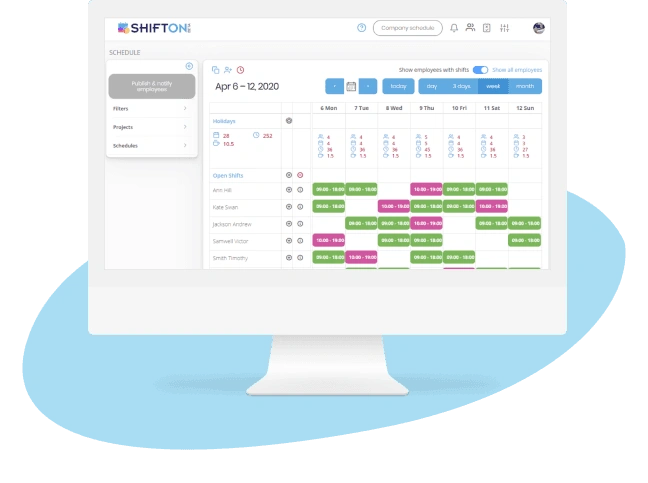
Plan the Studio Week and Publish It
The weekly calendar puts every designer on their own row with colour-coded blocks and exact start and end times. Work nobody has picked up sits in the open shifts row, which is where freelance and overflow capacity gets claimed instead of chased.
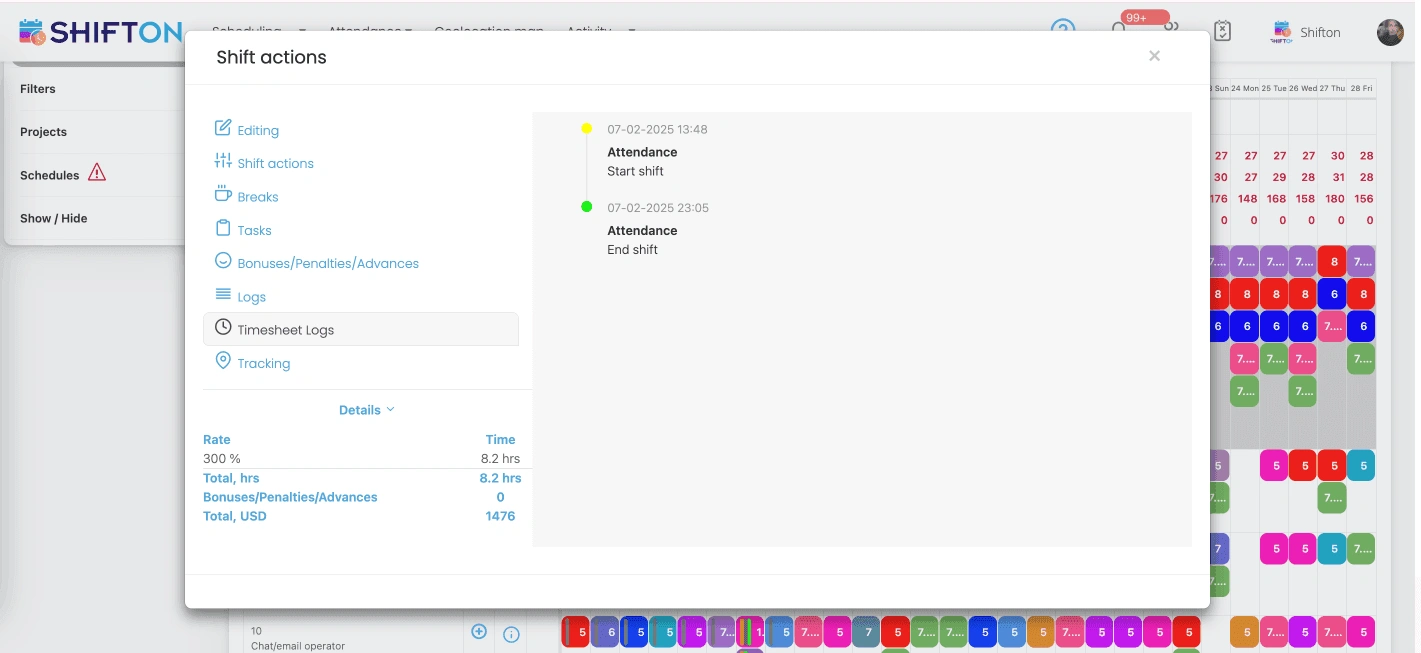
Real Hours, Breaks and Cost per Shift
Planned time and worked time part company the moment a deadline moves. The shift card records the real start at 13:48 and the real end at 23:05 against the same shift, with breaks, tasks, bonuses and the pay rate applied to those hours.
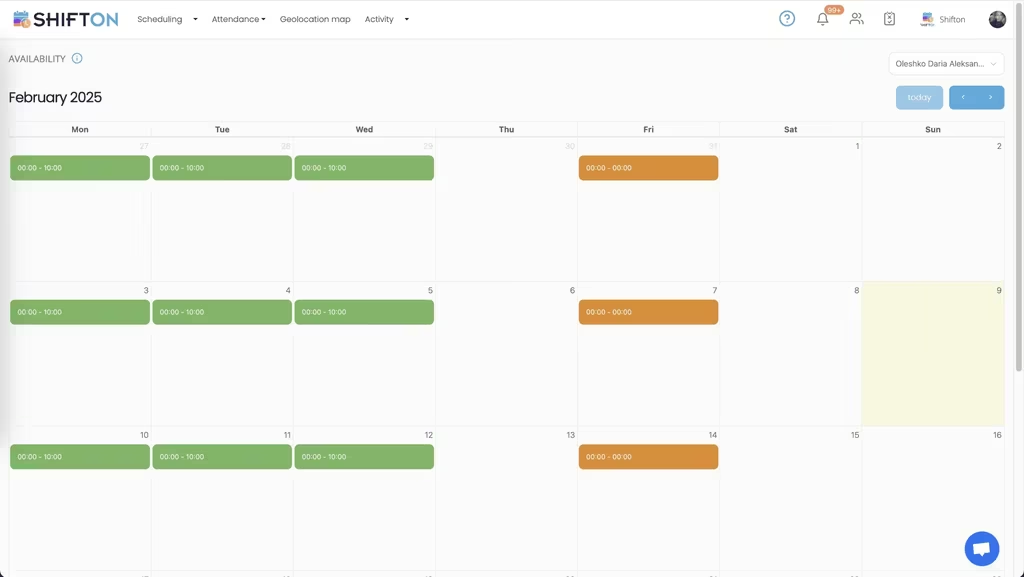
Availability for Studio and Remote Designers
Creative teams rarely sit in one room on the same hours. The availability calendar shows a full month per person, green for the hours they can take on and orange for the hours they cannot, so the week is planned against what people have already confirmed.
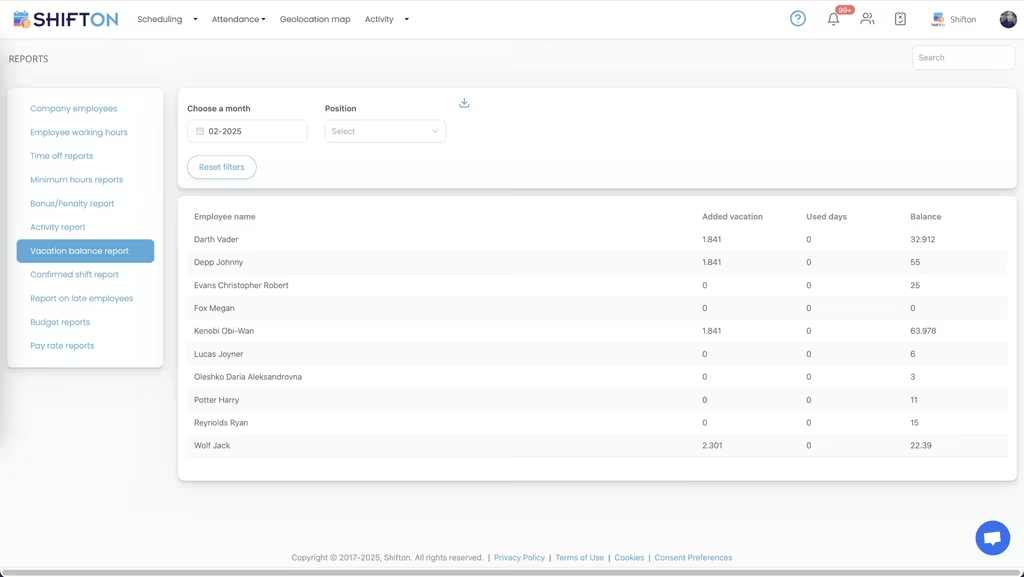
Reports on Hours, Budget and Pay Rates
Every tracked hour lands on the reports screen. Working hours, activity, time off and vacation balances are filtered by month and position, and budget and pay rate reports turn a month of studio time into a number finance can use.
Start with the Free Plan
No time limits. Get full access to core features and upgrade when you're ready.
Read the full guide to creative agency time tracking
A design studio sells hours. Not files, not decks, not revisions, hours of skilled attention that either land on a paying project or quietly disappear into internal work, rework and meetings nobody scheduled. Creative agency time tracking matters because that is the only inventory a studio has, and it is the one most studios measure worst.
The problem is not laziness. Creative work resists neat timesheets. A designer moves between three projects before lunch, a pitch swallows a Thursday that was booked for a client, and the person who is meant to reconstruct the week on Friday afternoon is already behind on the next one.
What creative agency time tracking has to solve
Four problems, and they are all commercial rather than administrative. Know what a project really consumed so the next quote is not a guess. Know who has capacity before a deadline is promised to a client. Capture the hours as they happen rather than reconstructing them a week later. And keep the whole thing light enough that a studio of eight will still be using it in six months.
An advertising agency time tracking software that answers those four is worth more than a heavier suite whose reports nobody opens after the second month.
Where studio time actually disappears
Ask any studio owner where the margin went on a project and the honest answer is usually a shrug. The overrun was real but invisible: an extra round of amends absorbed without a conversation, two days of internal work billed to nothing, a junior parked on a task for a week because nobody could see they were free.
When hours are recorded against a schedule rather than typed in from memory, that fog clears. Planned time sits next to worked time on the same shift, and the gap between them is a number rather than a feeling. Studios that adopt an advertising agency time tracking app usually find the first month uncomfortable and the second one profitable. The numbers do not need to be perfect to change a decision, they only need to exist before the next quote goes out.
Billable hours and the case for tracking as you go
Retrospective timesheets are guesses with decimal points. People round up, forget the small tasks and lose the interruptions entirely, and the total lands somewhere between generous and wrong. Tracking against a live schedule removes most of that error, because the shift already exists and clocking in takes a tap.
Shifton's time tracking stores the real start and end of each shift alongside breaks, tasks and the pay rate applied, which is what turns a week of studio work into a defensible line on an invoice. Advertising agency timesheet software that sits apart from the schedule always produces two versions of the truth and an argument about which one to bill. The best creative studio time tracking software is the one that never asks a designer to remember Tuesday.
Designer capacity: planning the week before it starts
Capacity is the other half of the job. A studio does not run out of talent, it runs out of Thursday. The weekly and monthly views show the hours each person is already carrying, and the availability calendar shows the hours they can take, so the answer to whether a new brief fits is visible rather than optimistic.
- See committed hours per designer before you accept a delivery date
- Spot the person who is quietly overloaded three weeks running
- Publish open studio time for freelancers or the wider team to claim
- Keep part-time and contract designers inside the hours they agreed
An advertising agency scheduling software that shows only today hides the pattern. The month view is where over-commitment becomes obvious while there is still time to move something, and it is the single feature that separates the best creative team scheduling app from a shared calendar with colours.
Studio, remote and freelance in one schedule
Most creative teams are now a mix: a core studio, remote specialists and freelancers who appear for a project and leave. Each person carries a position, an access level and their own time zone, so a remote designer reads shifts in local time while the manager keeps one consistent view. Freelancers get access to their own shifts and nothing else.
Studios that also carry an internal development or production team often plan both sides in one account, which is covered on our IT workforce scheduling page. Advertising agency workforce management software only helps when everybody who touches the work is on the same schedule. Advertising agency employee scheduling software that covers permanent staff but not contractors leaves the expensive half of the studio invisible, which is why the best digital agency scheduling software keeps both in one roster.
Timesheets people will actually complete
Adoption decides everything here. A designer will not open a desktop tool to log fifteen minutes, and a creative director will not police it. Clocking in from a phone against a shift that is already in the calendar takes seconds, which is the only version of an advertising agency time and attendance software that survives contact with a busy studio.
Push notifications carry schedule changes, time-off requests come through the same app, and approvals happen in a tap. The friction that kills advertising agency shift planning software is almost always in the first thirty seconds of a designer's experience of it. An advertising agency schedule app has to be readable on a phone in a corridor, and an advertising agency work schedule app that needs training is already lost. Advertising agency shift management software lives or dies on that first interaction, not on its settings screen.
Reporting that answers what a project cost
At month end the question is simple and the answer is usually slow. Working-hours reports give hours per person and period, budget and pay rate reports convert those hours into cost, and time-off and vacation balances explain the gaps. Everything filters by month or position and exports to spreadsheet, which is what an advertising agency scheduling system should hand to finance without a manual rebuild.
Shifton reports the hours and the cost, and invoicing stays where it already lives. The integration with QuickBooks and Zapier moves the numbers across without retyping them, which is the practical test of the best design agency time tracking software: whether it saves finance a day or gives them another export to reconcile.
Choosing time tracking for a design studio
Studios label themselves differently, from branding agency to design studio to digital production team, and the requirement barely moves. What gets sold as the best branding agency scheduling software and what gets sold as the best design studio time tracking software come down to the same two things: a schedule people read without asking, and hours that arrive without chasing.
Test any platform on a real week, including the pitch that ate two days and the freelancer who joined on Wednesday. Time how long it takes a designer to clock in. Check whether a schedule change reaches a remote team member the same minute. Ask what happens when somebody forgets to clock out, because that is the failure mode that quietly corrupts a month of data. An advertising agency scheduling platform that cannot absorb a freelancer joining mid-week will be worked around by Friday.
There is no universal best creative agency time tracking software, and no perfect advertising agency scheduling tool either, only the one your studio keeps using in month six, and the best design studio scheduling software for a team of six is rarely the right fit for a team of sixty. Under ten people, Shifton is free with no time limit, which covers a small studio moving off an advertising agency schedule template in a spreadsheet. As the team grows, paid plans add multi-project planning, deeper reporting and the modules an advertising agency rostering software is expected to carry at scale. The point stays the same: hours you can bill from, capacity you can see, and a studio week that holds together.
Frequently Asked Questions
What is creative agency time tracking?
Creative agency time tracking records the hours a studio team actually works and ties them to the schedule they were planned against. Shifton captures clock-in and clock-out per shift, breaks, pay rates and timesheet logs, then reports hours by person, position and period for billing and capacity decisions.
How do design studios track billable hours?
Plan the week first so every block of studio time belongs to a client project, then have designers clock in and out against those shifts. Breaks are logged separately, so paid time and billable time do not blur. The working-hours report gives the totals at the end of the month.
Can I see which designers have capacity next week?
Yes. The weekly and monthly views show hours already committed per person, and the availability calendar shows the hours each designer can take. Together they answer whether a new brief fits before you promise a delivery date.
Does it work for a mixed studio and remote team?
It does. Every person carries their own time zone, so a remote designer sees shifts in local time while the studio view stays consistent for the manager. The mobile app for iOS and Android covers people who are not at a desk.
Can tracked hours be exported for client billing?
Yes. Working hours, budget and pay rate reports export to spreadsheet and filter by month, position or period. Shifton produces the hour and cost data and connects to QuickBooks and Zapier, while invoices stay in the billing system you already use.
Is there a free plan for a small design studio?
Shifton is free for up to 10 team members with no time limit, which covers most small studios. Shift scheduling, basic time clock and attendance, the mobile app and reports are included. Larger creative teams move to paid plans priced per person per month.





See where your studio hours actually go
Start free for up to 10 team members and finish the week with hours you can bill from with confidence.