

Best Catering Management & Staffing Software 2026: Top 5 Tools
Catering teams live or die by logistics. Lose a BEO, double-book a server, miscount linens for a 300-head wedding – the night unravels, the client tells everyone they know, and the next quarter shrinks. That is why most catering operators eventually stop juggling spreadsheets, paper contracts, and three calendar apps, and start looking at proper catering management software.
This guide is for caterers, off-premise operators, hotel banquet directors, and food service managers shopping for the right catering software in 2026. We tested five popular tools – Shifton, 7shifts, Caterease, Connecteam, and Better Cater – against the workflows real caterers run every week: event booking, staff scheduling, BEOs, kitchen production sheets, on-site labor tracking, and post-event invoicing. Pricing is taken directly from each vendor site at the time of writing.
Throughout this comparison we look at catering management software as a system, not a feature checklist. A cheap catering booking system that does not talk to your scheduling tool will cost more in labor confusion than a “premium” all-in-one catering management tool that runs the whole event end-to-end.
Quick answer
Best catering management software in 2026 depends on what is breaking first. For multi-role staff scheduling, time tracking, and payroll across kitchen, servers, and on-site crews, Shifton is the strongest all-purpose pick. For dedicated event proposals, BEOs, and diagramming, Caterease leads. For restaurant catering arms, 7shifts. For deskless team communication and onboarding, Connecteam. For small caterers under 20 staff who want simple proposals and invoicing, Better Cater.
This might interest you:Shifton for restaurants and catering teams – how Shifton handles multi-shift scheduling for kitchen, servers, and event crews under one roof.
Our Top Picks
Five tools made the list. If you want the short version, these three cover most catering operations.
Shifton
Workforce platform for catering, where staff is the biggest cost: it ties scheduling, attendance and payroll together. Free for up to 10 people.
Caterease
The deep catering specialist, used by tens of thousands of caterers and event planners for BEOs and proposals. Paid only, from $99/mo.
7shifts
Restaurant team management that catering arms of restaurants reach for, with a free tier that has a ceiling.
Why trust us?
Shifton is our own product, and we ranked it first. We would rather say that up front than let you find it halfway down.
The rest we can defend line by line. Every free tier, user cap and price on this page came off the vendor’s own site, not a rival roundup, and where a vendor only quotes on a call, we print that instead of a number we invented.
How We Picked the 5 Best Catering Software in 2026
We looked at four practical filters that separate serious catering management tools from generic restaurant or scheduling apps. First, can the catering software handle event-shaped work – one-off bookings, deposits, guest counts that change at the last minute – rather than just recurring restaurant shifts? Second, does it cover staff: rosters, time clock, role-based assignments for cooks, captains, and dish? Third, does the pricing make sense for a catering business between 5 and 200 staff (the segment where most catering software for small business stalls or gets too expensive)? Fourth, what do real catering software reviews say across G2, Capterra, and operator forums – not what the marketing page claims.
We did not include event-only tools that lack staff management, and we did not include enterprise hospitality suites priced for 500-room hotels. Everything below is reachable by an independent catering business with a real budget.
The 5 Best Catering Management Software in 2026, Reviewed
Shifton
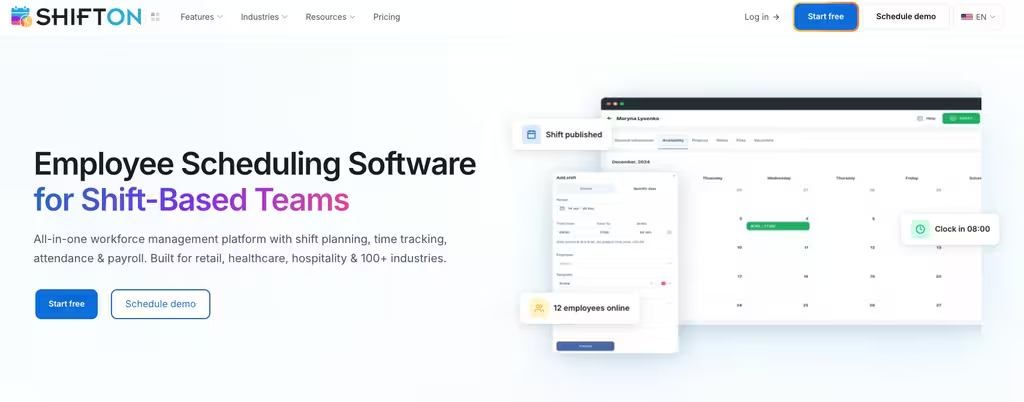
Shifton is a workforce management platform built around the exact problem most catering operators describe when they outgrow spreadsheets: too many roles, too many one-off events, and a payroll cycle that no longer ties cleanly to a static restaurant schedule. It is not a niche catering booking system – it is a catering staffing software that treats every event as a project with its own crew, hours, location, and labor cost.
For an independent caterer running 6 to 30 events a month, Shifton sits in the gap between basic schedule apps and heavyweight catering event management software. You build a master roster of kitchen, captains, servers, dishwashers, and drivers. Each event becomes a shift block with assigned roles, geofenced clock-in, break rules, and post-event reports that feed payroll directly. The mobile app means a server can swap a Saturday wedding shift with a teammate from the parking lot, and the manager sees the change in real time on the dashboard.
- Multi-role scheduling: assign cooks, captains, servers, drivers, and dishwashers to the same event with different pay rates and start times.
- Time tracking with location control: staff clock in only inside the event venue radius, with optional photo confirmation.
- Payroll-ready reports: hours, breaks, overtime, and bonuses export to your accountant without rebuilding the math.
- Vacation and time-off requests: servers request a Saturday off, manager approves on the phone, the open shift surfaces to the team.
- Multi-language interface: the platform UI runs in 40 languages, which matters for caterers with mixed kitchen and front-of-house teams.
Where Shifton is weaker than a dedicated caterer-only platform: it is not a BEO designer or a menu costing tool. If you need 3D ballroom diagrams or recipe-level ingredient costing, pair Shifton with one of the event-specialist tools below. What you get instead is a scheduling and labor engine that scales from a 4-person operation to a multi-location catering business, with the same software for catering business owners who run both an off-premise team and a venue.
Best for: catering operations where labor cost is the biggest line item and you need a real catering management system – more than a scheduling app – that ties scheduling, attendance, and payroll together. See shift scheduling and payroll management for the specific modules caterers use most.
Stop losing money to messy event schedules
Shifton plans every wedding, gala, and corporate lunch with the right crew, the right roles, and the right hours – and feeds it straight to payroll.
7shifts
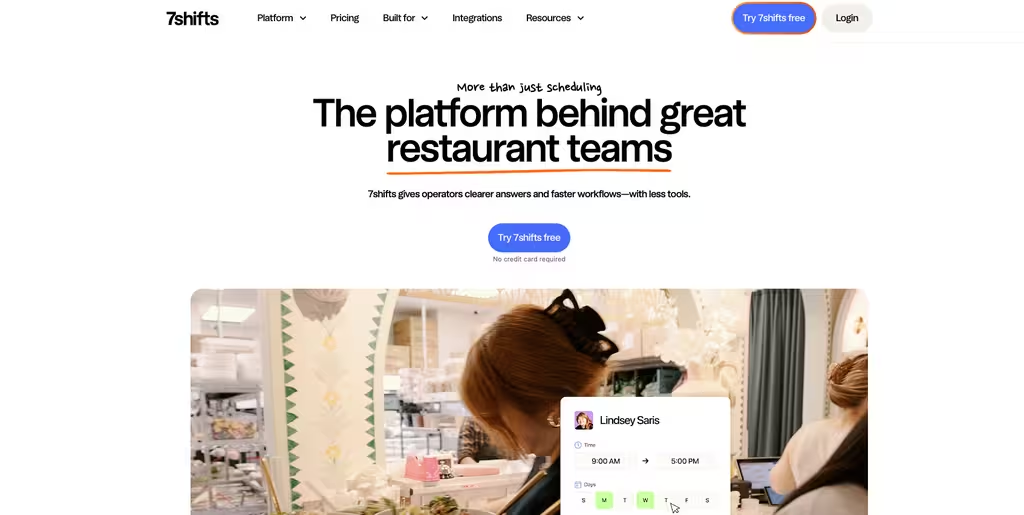
7shifts is restaurant team management software that catering arms attached to restaurants tend to adopt because the kitchen already uses it. Its homepage cites use by over 55,000 restaurants. For a restaurant with an active catering program – say, a barbecue spot doing 8-12 large drop-offs a week – 7shifts handles the front-of-house and back-of-house schedule that absorbs catering shifts as another channel of work.
It is not built as a dedicated catering software for restaurants in the proposal-and-BEO sense; it is built for scheduling, time clock, team chat, tip pooling, payroll, and labor compliance. A 14-day free trial of the paid plan is available without a credit card, and an entry-level free “Comp” plan is offered after the trial for very small teams.
- Drag-and-drop scheduling with templates and shift swaps approved by managers.
- POS integrations across Toast, Square, Clover, and most major US restaurant POS systems.
- Tip pool and payroll support with state-by-state labor compliance.
- Team chat and announcements inside the same app servers already use to see shifts.
Right fit: restaurants with a catering side hustle – if catering is the main business, you will outgrow the restaurant-shaped workflow within a year. Pricing tier details are on 7shifts.com/pricing (per-location billing).
Caterease
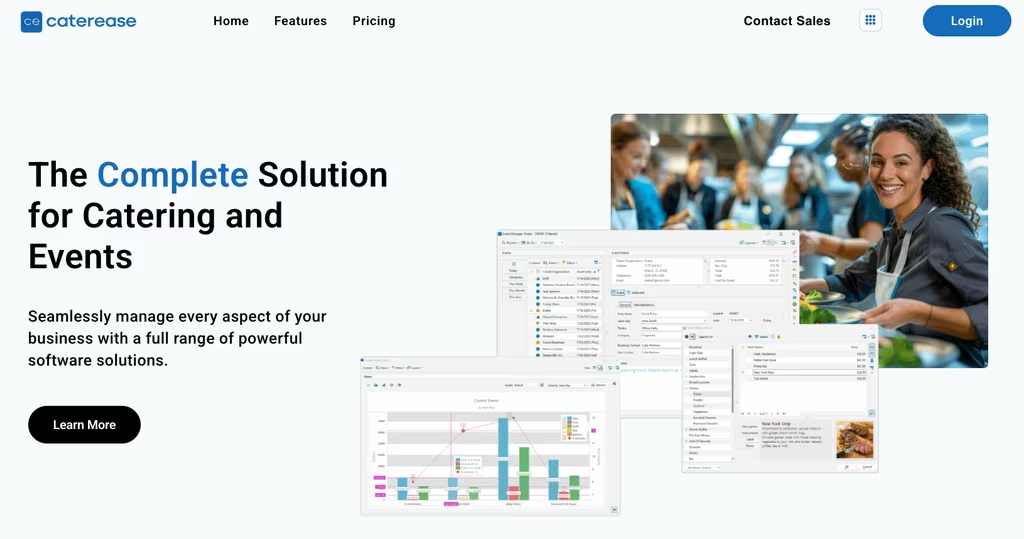
Caterease is the deep specialist in this list. The company says it serves over 50,000 caterers and event planners. If your shop is a full-service caterer doing weddings, galas, corporate events with detailed BEOs, room layouts, and multi-stage payments, Caterease is the catering event management software most operators eventually grow into.
Pricing is fully published, which is rare in this category. There are four tiers billed annually: Express at $99/month, Standard at $149, Professional at $199, and Complete at $399. Additional user seats run $28/month each, and optional modules – things like Guestrooms Manager, Document Builder, Banquet Rooms, Prospect Manager – are $25/month each. The Complete tier includes a one-time $200 launch fee per user. There is no published free plan.
What you actually get for that money is a heavyweight event catering software stack: booking wizard, proposal-to-contract-to-BEO automation, menu management with pricing rules, integrated payments through Mosaic (PCI-compliant), a customer portal where clients sign and pay, and the diagramming module that produces 2D, 3D, and 360-degree event layouts – useful when an event coordinator needs to show a couple how 240 chairs fit in a tent. A staff scheduling module handles event-day assignments, though deeper labor and payroll workflows are typically paired with a dedicated workforce tool.
- End-to-end booking, contract, BEO, and invoicing flow built specifically for caterers.
- 2D/3D/360 venue diagramming for ballrooms, tents, and outdoor events.
- Customer portal: clients view event details, sign contracts, and process deposits.
- Modular pricing: turn on Banquet Rooms or Prospect Manager only when you need them.
Made for: full-service catering companies and venues running enough volume that the four-figure annual cost pays back in saved coordinator hours within the first quarter.
Connecteam
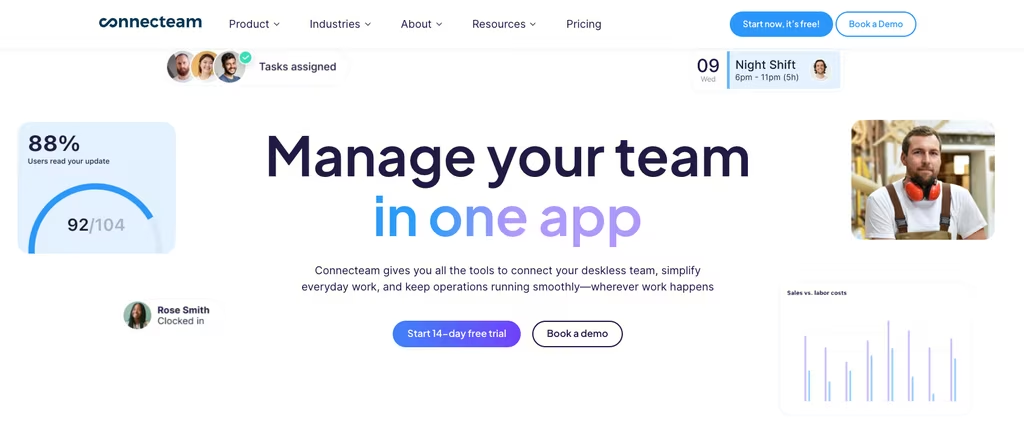
Connecteam is a deskless team app rather than a catering-specific tool, and that framing matters when you evaluate it. It is sold in three modular “hubs”: Operations (time clock, scheduling, forms, task management), Communications (chat, updates, knowledge base, events, help desk), and HR & Skills (time off, courses, documents, recognition, hiring, onboarding). You only pay for the hub you actually use.
Pricing is per hub. The Small Business plan is free for organizations up to 10 employees and includes access to all hubs. Above 10 staff, each hub starts at Basic $29/month for the first 30 users, Advanced $49, Expert $99, with per-user fees beyond 30 (Operations adds $0.80/user on Basic; Communications and HR add $0.50/user on Basic). Enterprise is quote-only. Annual billing saves 18%.
- Custom forms that catering crews fill in on-site – delivery confirmations, food temperature logs, equipment check-ins.
- Built-in courses module for onboarding new servers and bartenders without paying for an LMS.
- Time clock with GPS and geofence, plus a knowledge base in the same app as scheduling.
- Communications hub keeps event-day group chats out of personal WhatsApp.
Works well for: catering operations that need internal comms, training, and basic scheduling under one app, especially under-10-employee shops that benefit from the free Small Business tier.
Better Cater
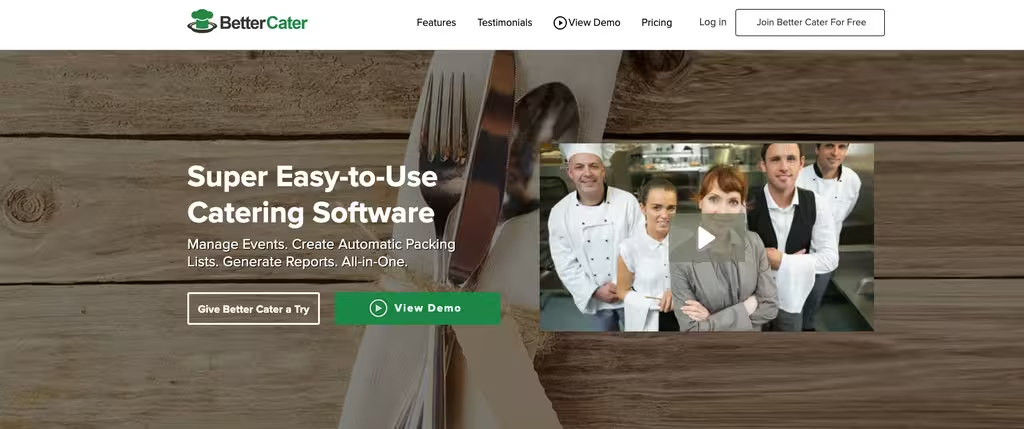
Better Cater is the simplest pick on this list and positions itself accordingly. The company says it serves more than 1,000 businesses and pitches a “book your first party within 10 minutes” onboarding experience. For a small caterer, a one-person off-premise operator, or a food truck doing private bookings, Better Cater is built for you, not for a 200-staff banquet department.
Pricing is straightforward: $57/month billed annually ($684/year) or $69/month billed monthly. Additional users run $25-30/month depending on plan. Electronic Signatures is a $15/month add-on. A 30-day risk-free trial with money-back guarantee is offered.
Day-to-day, the product covers what a small catering business actually does: professional proposals, BEO templates, packing lists and kitchen production reports, recipe and sub-recipe building with ingredient quantification, a CRM database, venue records, calendar sync to Google/Outlook/Apple, sales and supplier reports. You will not find ballroom 3D diagramming or a heavy staff scheduling engine – that is by design.
- Automatic packing lists and kitchen production reports generated from each event.
- Recipe and sub-recipe building with ingredient quantities for accurate food cost.
- BEO templates that mirror what venues and corporate clients expect.
- Calendar integration with Google, Outlook, and Apple.
Built for: small caterers, off-premise operators, and food trucks who want one clean catering management tool to replace the spreadsheet, the Word proposal, and the half-remembered packing list.
What Is Catering Management Software, Really?
Catering management software is the system a catering business uses to run the operational chain that turns an inquiry into a paid event. In a mature setup it covers six things: lead capture and CRM, proposal-to-contract-to-BEO, menu and recipe costing, staff scheduling and time tracking, on-site logistics and packing, and invoicing and payments. Some vendors lean toward event-shaped workflows (proposals, BEOs, room layouts); others lean toward workforce-shaped workflows (scheduling, attendance, payroll). The strongest catering management system covers both – or integrates cleanly with whichever side it leaves to a partner.
What separates a generic restaurant tool from proper catering business software: events are one-off, the guest count moves, and staffing rebuilds for every booking. A weekly restaurant schedule template is not enough; you need a catering software for restaurants that knows Friday at 6 PM is a 240-cover wedding, not a regular dinner shift.
Catering Software for Small Business vs Enterprise Catering Systems
Asking “best catering software for small business” is less about features and more about price-to-payback. Under about 15 events a month, you do not need 3D diagramming or a multi-property booking engine. You need clean proposals, reliable BEOs, a staff list that knows who is on call Saturday, and an invoice that prints with the deposit already deducted. Better Cater and the free tier of Connecteam often cover that. Once you cross 25-40 events a month, the math shifts: a missed BEO costs more than a Caterease seat, and a payroll mistake costs more than a Shifton subscription. That is when small operators upgrade to a full catering management system rather than stitched-together apps.
Enterprise catering systems – large hotel banquet operations, contract catering for stadiums, corporate dining – usually combine a specialist catering event management software with a workforce platform, plus a POS or PMS. None of the five tools below replaces a hotel PMS, but Shifton, Caterease, and 7shifts each integrate at the workforce or POS layer of one. Catering software programs at enterprise scale are about integrations as much as about features.
Catering Event Management Software vs Catering Booking System
These two phrases get used interchangeably online, and they should not. A catering booking system is narrow: it captures inquiries, turns them into bookings, locks the date, and collects a deposit. Anything else – rosters, BEOs, menu costing – lives elsewhere. A catering event management software stack is wider: it covers booking, contract, BEO, kitchen prep, staff assignment, on-site execution, and post-event invoicing as one flow. Restaurant event management software adds the wrinkle of running events inside an active restaurant – private dining rooms, ticketed nights, buy-out events – which is what 7shifts customers most often need.
If you are shopping right now, the test is simple: ask the vendor to walk a single event from inquiry to invoice. A booking-only tool will hand you off to “your accounting software” or “your scheduling tool” three times in that walkthrough. A real event-shaped catering software keeps the event in one record the whole way.
Free Catering Software vs Paid: What You Actually Trade
Free catering software exists, but the offers are narrower than the marketing pages suggest. Connecteam’s Small Business plan is genuinely free for the first 10 employees, including time clock, scheduling, chat, and forms – the most generous offer in this comparison. 7shifts maintains a free Comp plan after the 14-day paid trial, useful for very small teams running basic scheduling. Shifton has a free plan for teams up to 10 (scheduling, time clock, mobile app, and reports), with paid add-on modules that include a 60-day free trial. Caterease and Better Cater do not publish a free plan, only a paid trial in Better Cater’s case.
What you trade by staying on free catering management software is three things: the cap on users, the integrations (payroll exports, accounting, POS), and the support tier. For under-10 catering teams that is fine. Crossing the 11-employee line is the breakpoint where free becomes expensive: you suddenly need the paid features anyway, and the original free tool now costs as much or more than the alternatives. That is what most honest catering software reviews on G2 and Capterra agree on once you filter them by team size.
How to Choose the Right Catering Management Tool in 2026
Forget the feature matrix for a second. The right catering management tool is the one that fixes the breakage costing you the most this quarter. If three weddings in a row had short staffing because the spreadsheet got copied wrong, fix scheduling first – Shifton, Connecteam, or 7shifts. If two corporate clients re-quoted because your BEO arrived two days late, fix the event flow – Caterease or Better Cater. If your accountant is reconstructing labor hours from text messages, fix time tracking and payroll – Shifton.
A few practical buying checks before you commit:
- Run a real event through the trial. Use Saturday’s booking, not a demo dataset. If the tool struggles with your guest-count change at noon Friday, it will struggle every Friday.
- Ask about export. If you cancel in 18 months, can you pull your CRM, your BEO history, and your time-tracking data out? The answer reveals how the vendor thinks about you.
- Test on the phones your crew actually owns. The apps for catering business field crews need to work on whatever Android model the dishwasher brought to shift, on whatever phones the crew actually carries, not only the newest iPhone.
- Price the second year, not the first. Promo discounts are normal, but the regularly published rate is what you will pay in month 13.
- Decide if you want online catering software you can use from a venue parking lot, or a desktop-first tool. All five here have web access; only Shifton, 7shifts, Connecteam, and Better Cater have catering-grade mobile flows.
Related reading: if your team is more crew than caterer-specific, also see best crew management software and best employee roster apps for adjacent picks.
Honest summary: no single tool wins every category. Caterers running heavy event volume often run Shifton for workforce alongside Caterease or Better Cater for event flow. Restaurants doing a catering side line stay on 7shifts and add Better Cater when proposals start eating their week. Small operators get to start with one platform and expand later – the cost of switching is real, but lower than the cost of staying on a tool that no longer matches the business.
Comparison: Top 5 Catering Management Software at a Glance
| Tool | Best for | Starting price (USD) | Free option | Standout feature |
|---|---|---|---|---|
| Shifton | Catering staff scheduling, time tracking, payroll across roles | Free trial, paid plans posted on site | Free trial | Multi-role rosters with auto-payroll for caterers |
| 7shifts | Restaurant catering arms and food-truck operators | Paid plans + free Comp tier | Free Comp plan | POS integrations and labor compliance built for restaurants |
| Caterease | Full-service caterers and event venues running large books | Express $99/mo, Standard $149, Professional $199, Complete $399 (billed annually) | No free plan | 2D/3D/360 event diagramming and customer portal |
| Connecteam | Deskless team comms, training, simple scheduling | Operations Hub: Basic $29/mo, Advanced $49, Expert $99 (first 30 users) | Free Small Business plan up to 10 employees | All-in-one app for chat, courses, forms, time clock |
| Better Cater | Small caterers and food trucks under 20 staff | $57/mo billed annually ($684/year) or $69/mo billed monthly | 30-day trial | Proposals, BEOs, and packing lists in one workflow |
FAQ: Catering Management Software in 2026
What is the best catering software for small business in 2026?
Is there free catering software for restaurants?
How much does catering management software cost?
What features should catering business software include?
Can catering software replace separate CRM, scheduling, and invoicing tools?
What is the difference between catering software and a catering booking system?



Start making changes today!
Optimize processes, improve team management, and increase efficiency.