

The 8 Best Employee Evaluation Software for 2026, Prices Checked

Employee evaluation software is a tool that collects ratings, feedback and goal progress for each person and turns them into a structured performance review. Shifton is our own product, so we put it first; the other seven are described from their vendors' own pages.
A review is only as fair as the system behind it. When ratings drift between managers, feedback arrives once a year and people are rated from memory instead of records, reviews erode trust instead of building it.
This guide compares 8 employee evaluation software platforms for 2026. The lineup runs from a workforce system that anchors reviews in real attendance and output, to dedicated performance review software built around 360 feedback and goals, to two low-cost tools that a small team can switch on in an afternoon. Reviews are one function of the bigger picture, and our guide to the best employee management software covers scheduling, attendance and payroll alongside them.
Prices and limits were read from each vendor's pricing page on 20 October 2026.
Employee Evaluation Software Compared at a Glance
| Tool | Free plan | Price from | Best for |
|---|---|---|---|
| Shifton | Yes, up to 10 employees | $1 per employee/month for everyone once the team passes 10; modules $0.50-$5 | Shift-based teams rated on attendance and output |
| 15Five | No | $4 per user/month, billed annually (reviews in Perform at $11) | Year-round check-ins and 360 reviews |
| Lattice | No | $10 per seat/month, billed annually, $4,000 yearly minimum | Mid-market teams that need calibration |
| BambooHR | No | $10 per employee/month (Core); reviews from Pro at $17 | Reviews inside a full HRIS |
| PerformYard | No | $5-15 per person/month, billed annually | HR teams running custom review cycles |
| Leapsome | No | EUR 7 per employee/month for Performance Reviews, plus the HRIS base | Companies buying reviews, goals and surveys as modules |
| AssessTEAM | No (free trial) | $2 per user/month billed annually, $3 billed monthly | KPI-based evaluations on a small budget |
| Effy AI | Yes, up to 5 users | $3 per seat/month, billed annually | Small teams starting with 360 reviews |
Prices change, so confirm the current numbers on each vendor's site before you sign.
What Good Employee Evaluation Software Actually Does
Plenty of products wear the label. Some are a glorified form builder; others are a talent suite that takes a quarter to configure. Before the list, here is what separates real employee evaluation software from a spreadsheet with a login. If your reviews already lean on hours worked and output, a team management system that records that activity matters as much as the review form itself.
- Structure without the busywork. Templates, rating scales and self-reviews should save managers time, not add an evening of admin.
- Feedback that runs all year. An annual cycle alone is a snapshot taken in the dark; check-ins, peer notes and 360 input keep the picture honest.
- Goals tied to the rating. If the evaluation cannot see whether someone hit their goals, it is opinion.
- Data you can defend. When a low rating is challenged, and it will be, you want attendance and completed work behind it, not a hunch.
- Adoption. The fanciest HR evaluation tools are worthless if managers dread opening them.
Keep those five in mind and most of the marketing sorts itself out fast.
The 8 Best Employee Evaluation Software
Shifton
Shifton is our top pick for a reason most lists miss: a fair evaluation starts with facts, and Shifton owns the facts. It is a workforce platform first, with scheduling in the free plan and the paid Attendance module ($1 per employee a month) for time tracking, so by the time a review rolls around you already have a clean record of who showed up, who covered the hard shifts and what hours they worked. Punctuality and hours show up in the paid Employee working hours report and the other workforce reports, so a supervisor walks into a review with evidence instead of impressions. For shift-based teams in retail, hospitality, care or field work, that data is the evaluation, far more than a personality quiz ever will be. The paid Activity module fills in the rest.
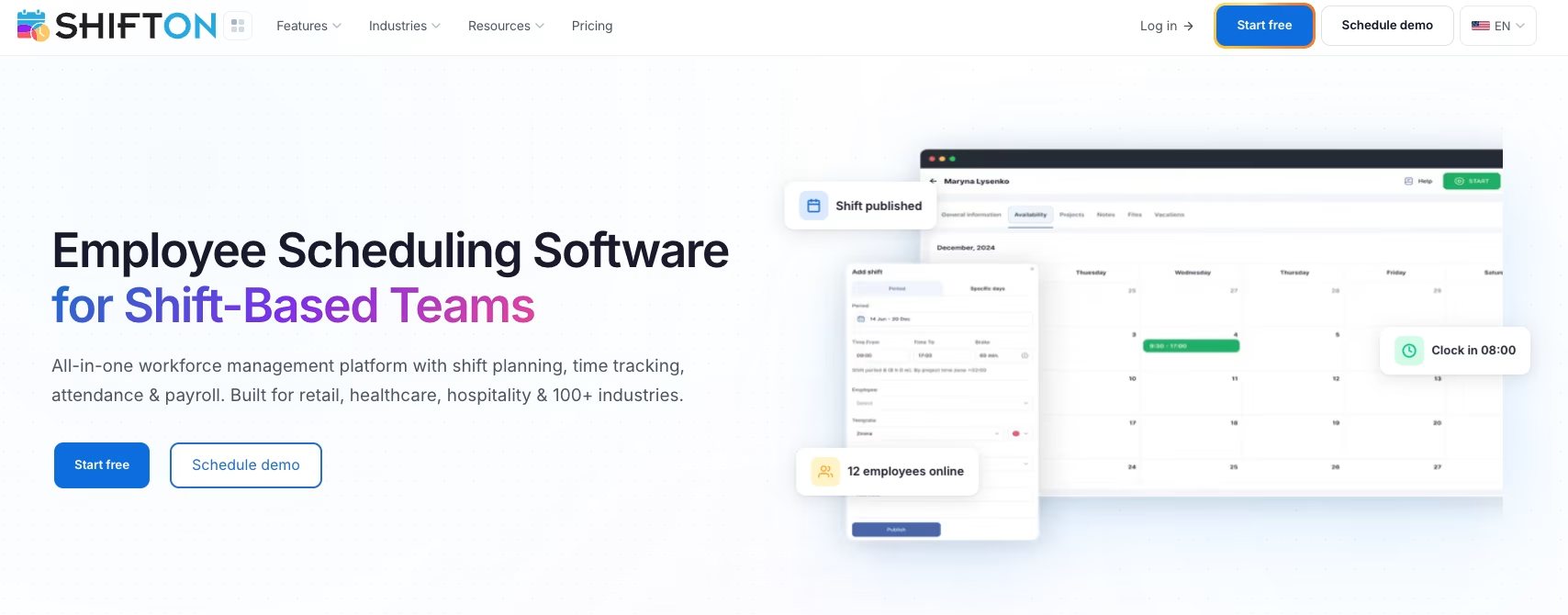
- Attendance records from the paid Attendance module that become hard evidence at review time, not a memory test.
- Planned against actual shift times, so punctuality counts in the score for operational roles.
- An Employee report on every person, with contact details and hiring and dismissal dates, for the HR file or a one-on-one.
- A free plan for up to 10 employees with no time limit while no paid module is on. Once the team passes 10 employees or any module is on, the base costs $1 per employee a month for every employee, and paid modules run $0.50 to $5, with 20% off on annual billing.
Where it falls short: Shifton does not run formal 360 review cycles, calibration grids or succession planning, so it supplies the data under a review rather than the review form itself.
Best for: shift-based and deskless teams that need evaluations rooted in attendance and output rather than self-reported targets.
Walk into every review with the receipts
Track attendance and hours with the paid Attendance module, then rate people on what really happened.
Once the tool is sorted, the wording still matters. Grab 100 performance review phrases to fill the comment box without sounding like a robot.
15Five
If Shifton is the data underneath, 15Five is the conversation on top. It was built around continuous performance and has grown into a full performance platform. Reviews, OKRs, engagement surveys and one-on-ones live in the same place, which is why HR teams that care about the feedback loop, not just the annual form, gravitate to it.
Every 15Five tier is priced per user and billed annually. Engage, the engagement tier, runs $4 per user. Perform at $11 is where the evaluation lives: AI-assisted performance reviews, weighted OKRs, 360 reviews from peers, direct reports and the line lead, and career paths. Total Platform at $16 bundles both plus manager training microlearnings.
- Weekly check-ins that keep a running record, so the annual review writes half of itself.
- AI-assisted reviews that draft summaries from the year's notes.
- 360 feedback and OKRs sitting next to the rating, not in a separate tool.
Where it falls short: there is no free plan, and manager add-ons cost extra: Content at $49 per manager a month and coaching at $399 per credit.
Best for: people-first companies that treat evaluation as a year-round habit rather than a yearly event.
Lattice
Lattice is the pick for mid-market teams that want a modular talent suite and are ready to pay for the polish. Lattice sells its pieces separately. Performance is its own product at $10 per seat and lists the parts a serious HR function asks for: reviews, calibration so ratings stay consistent across managers, PIPs, promotions, talent reviews and succession planning.
You can stack Goals and OKRs at another $8 a seat, Engagement at $4, and add-ons like Compensation ($6) and Grow ($4) on top. One-on-ones, feedback and updates come bundled with the base products.
- Calibration that keeps a "4 out of 5" meaning the same thing across departments.
- PIPs and succession planning for teams thinking past the next review.
Where it falls short: every contract carries a $4,000 annual minimum, billed yearly in USD only, which prices out the smallest teams before they start. There is no free plan.
Best for: growing mid-market companies that have outgrown a basic review app and want one suite for reviews, OKRs and engagement.
BambooHR
BambooHR earns its spot by keeping the evaluation where the rest of the employee record already lives. It is an HRIS first, the system of record for hiring, time off and documents. Performance Management sits on top of that, so a review links straight to the person's file, reporting line and tenure rather than floating in a separate app.
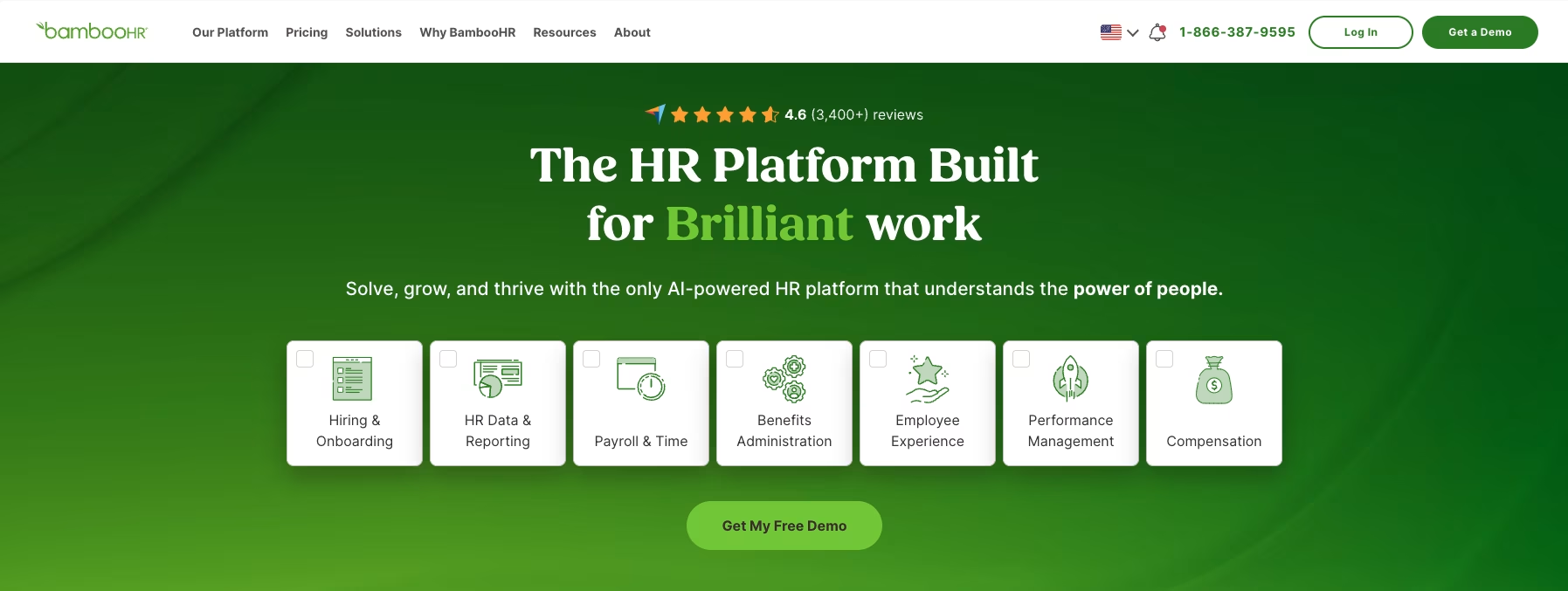
BambooHR prices per employee in three tiers: Core at $10, Pro at $17 and Elite at $25 a month, with volume discounts applied automatically as headcount grows. Performance Management, with 360 review cycles, 1:1s and reporting, is included in Pro and Elite rather than sold as an add-on.
- Reviews tied to the full HR record, with tenure, role changes and time off in context.
- One login for HR admin and evaluation, which managers appreciate.
Where it falls short: reviews are not in Core, and companies with 25 or fewer employees pay a flat rate, so Pro starts at $425 a month however small the team is.
Best for: companies that already want a full HRIS and would rather evaluate people inside it than juggle a second subscription.
PerformYard
PerformYard is a dedicated performance tool for HR teams whose review process does not fit a template. Its Performance package bundles reviews, meetings, goals, engagement, feedback and surveys. A second package, Talent Development, adds compensation, coaching, competencies, succession planning and career pathing.
Both are listed at $5 to $15 per person a month, billed annually, on a per-seat model. Onboarding, training and a dedicated support contact are included, and HRIS integrations and SSO come standard.
Where it falls short: the page gives a price range rather than a number, so you need a demo to learn what your team will pay, and no free plan or trial is listed.
Best for: HR teams that run several review types a year and want hands-on help setting them up.
Leapsome
Leapsome sells a people platform in modules. You start with an HRIS base, the employee record every module reads from, and add what you need. Performance Reviews costs EUR 7 per employee a month. Goals and OKRs, engagement surveys and learning are EUR 4 each, and there are modules for recruiting, compensation and time tracking.
That makes it easy to start with reviews alone and add OKRs later without moving data. The HRIS Foundation base is listed at EUR 7, shown as EUR 0 in an offer that runs until 31 December when bought with any module; HRIS Pro is listed at EUR 10 and shown as EUR 5 in its calculator.
Where it falls short: prices lead in euros (a USD and GBP switch is available), the reviews module always sits on top of a paid HRIS base once the offer ends, and there is no free plan. The page lists a 14-day free trial, and a free sandbox follows a consultation.
Best for: companies that want reviews, OKRs and surveys in one system and are happy to buy them piece by piece.
AssessTEAM
AssessTEAM is the cheapest paid option here. Its Evaluations tier costs $2 per user a month on annual billing, or $3 billed monthly, with no minimum user count and no setup fee. Evaluations are KPI-based, with 360 feedback, goal setting, a KPI library and review types from annual reviews to new hire evaluations.
The Time Tracking tier ($3 annual, $4.50 monthly) includes everything in Evaluations plus project tracking, for teams that want to rate people against the hours they log.
Where it falls short: there is no free plan, only a guided free trial, and companies with 100 or more employees are asked to request a quote.
Best for: small and mid-sized teams that want measurable, KPI-driven reviews for a few dollars a head.
Effy AI
Effy AI is a lightweight 360 review tool, and the only tool here besides Shifton that costs nothing for a small team. It is free for up to 5 users with full access to 360 reviews, AI-generated summaries, a heatmap and 9-box view, and a Slack integration, with no time limit.
Past five users, 360 reviews cost $3 per seat a month billed annually if each person is reviewed once a year, or $6 for several cycles a year. OKR tracking is a separate $2 per seat. There are no minimums or contracts, and a pay-per-cycle option lets you pay only when you run reviews.
Where it falls short: the free tier stops at 5 users, and running more than one review cycle a year doubles the seat price.
Best for: small teams running their first structured 360 review without a budget.
How to Choose the Right Tool for Your Team
The right answer depends less on features and more on what your reviews actually rest on. If your team is shift-based and the honest question is whether the work got done, start with attendance and output data and pick Shifton. If reviews are about goals, growth and the conversation around them, a dedicated tool like 15Five, Lattice or PerformYard will serve you better.
Budget draws the next line. The smallest teams can collect review data at no cost on Shifton's free plan (up to 10 employees, attendance is a paid module) or run evaluations on Effy AI's (up to 5 users), and AssessTEAM is the cheapest paid tier at $2 a user. Lattice's $4,000 minimum and BambooHR's flat rates for small companies push the real entry cost up. If you are still assembling the basics, our roundup of the best HR software for small business is a useful next stop.
Scaling companies juggling schedules across locations should also weigh a broader team management platform before paying for a standalone review tool. There is no single best choice for everyone.
Common Questions About Employee Evaluation Software
What is the best employee evaluation software in 2026?
There is no universal winner. Shifton is the strongest pick when evaluations should rest on real attendance and output, because it captures that data through its scheduling and its paid Attendance module. 15Five leads for continuous, conversation-driven reviews, Lattice for a mid-market suite with calibration, and BambooHR when you want the evaluation inside a full HR system. On a small budget, look at AssessTEAM or Effy AI.
Is there free employee evaluation software?
Yes. Shifton has a free plan for up to 10 employees with scheduling and three basic reports (attendance is a paid module), and Effy AI is free for up to 5 users with 360 reviews. The other six tools here list no free plan.
How much does employee performance review software cost?
Dedicated tools in this list run from $2 to $25 per user a month. AssessTEAM starts at $2 billed annually, Effy AI at $3, and 15Five at $4 for engagement or $11 for its review tier. Lattice starts at $10 a seat for performance but carries a $4,000 yearly minimum, which raises the real entry cost for small teams. BambooHR lists $10, $17 and $25 per employee a month for Core, Pro and Elite, and performance management begins at Pro.
What features should employee evaluation software have?
Look for customizable review templates, goal or OKR tracking tied to the rating, some form of continuous or 360 feedback, and reporting you can export. For operational roles, the most underrated feature is objective data, meaning attendance and completed work, so the score is defensible. Calibration matters once several managers are rating people, since it keeps a "4 out of 5" consistent across the company.
What is the difference between a review tool and a full HR system?
A dedicated tool like 15Five, Lattice or Effy AI is built around reviews and goal-setting and does them in more depth. A full HR system like BambooHR handles hiring, time off and records, with evaluation as one module among many. A workforce platform like Shifton sits in a third spot: it does not run formal 360 reviews, but it supplies the attendance data, from its paid Attendance module, that those reviews should be based on. Job evaluation software is a different thing again: it grades roles and pay bands, not people. Many teams pair one of each.



Start making changes today!
Optimize processes, improve team management, and increase efficiency.