

Panama Shift Schedule Software for Factories and Plants
Run a panama shift schedule, 4 on 4 off, continental or DuPont rotation across every line, keep monthly hours balanced and cover absence without stopping the plant.

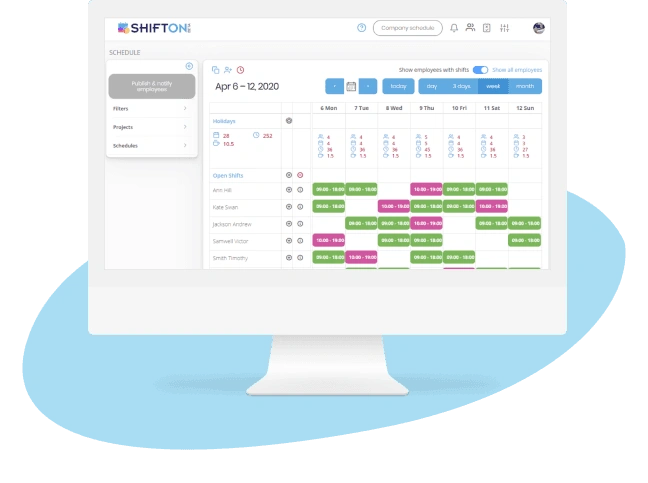
Build the Week and Publish It to Every Crew
A factory week is built around the line, not around one person. The weekly grid gives every operator a row and every assignment a colour-coded block with its start and end times, so a shift manager can confirm each position is covered before anything is released. Filters, projects and schedules split a large site into the units people actually work in.
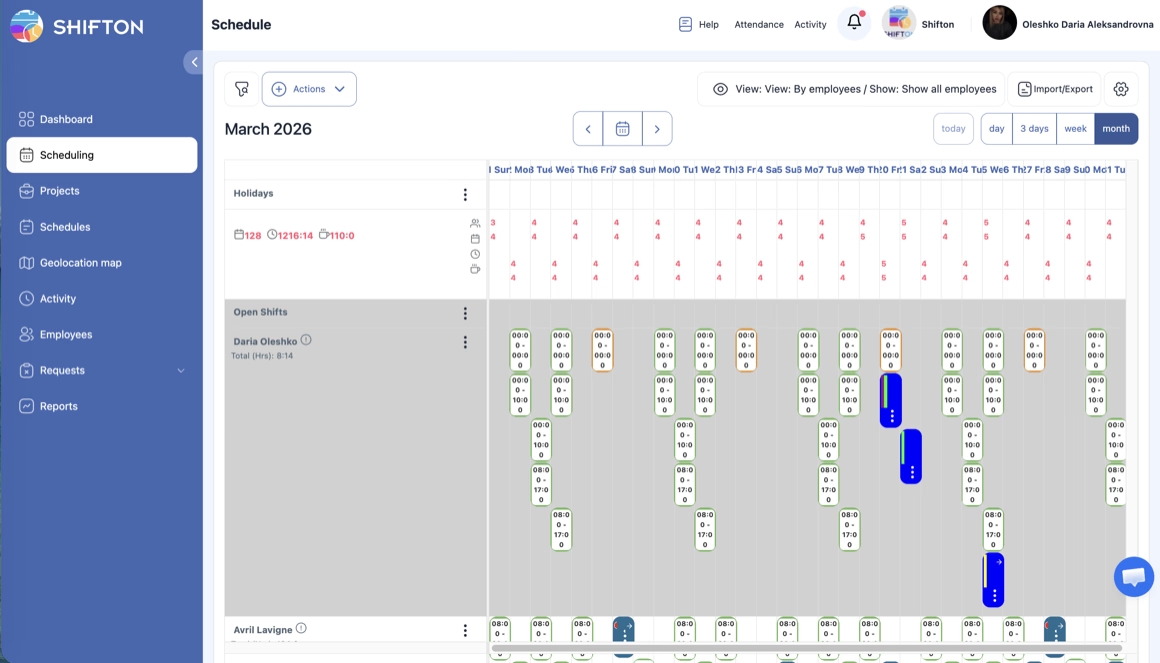
Plan a Full Month and Import or Export It
Continuous patterns only make sense read across a month. The month view shows a whole rotation cycle at once, open shifts included, so a planner can check that the pattern closes correctly at the end of the period instead of finding out in week four. The view switches between a single employee and everyone on site.
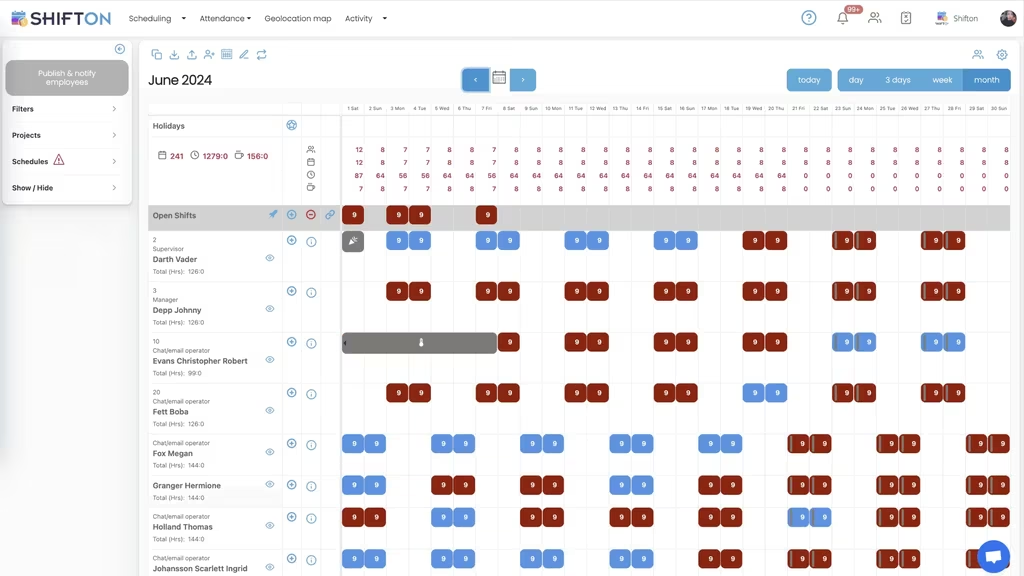
Day and Night Rotation With Balanced Hours
A continuous operation alternates days and nights, and the month view renders that rotation as alternating colour blocks of equal length. Reading a full month is the only reliable way to confirm the pattern spreads nights evenly and that nobody finishes the cycle carrying far more hours than the crew beside them. Monthly totals sit at the end of every row.
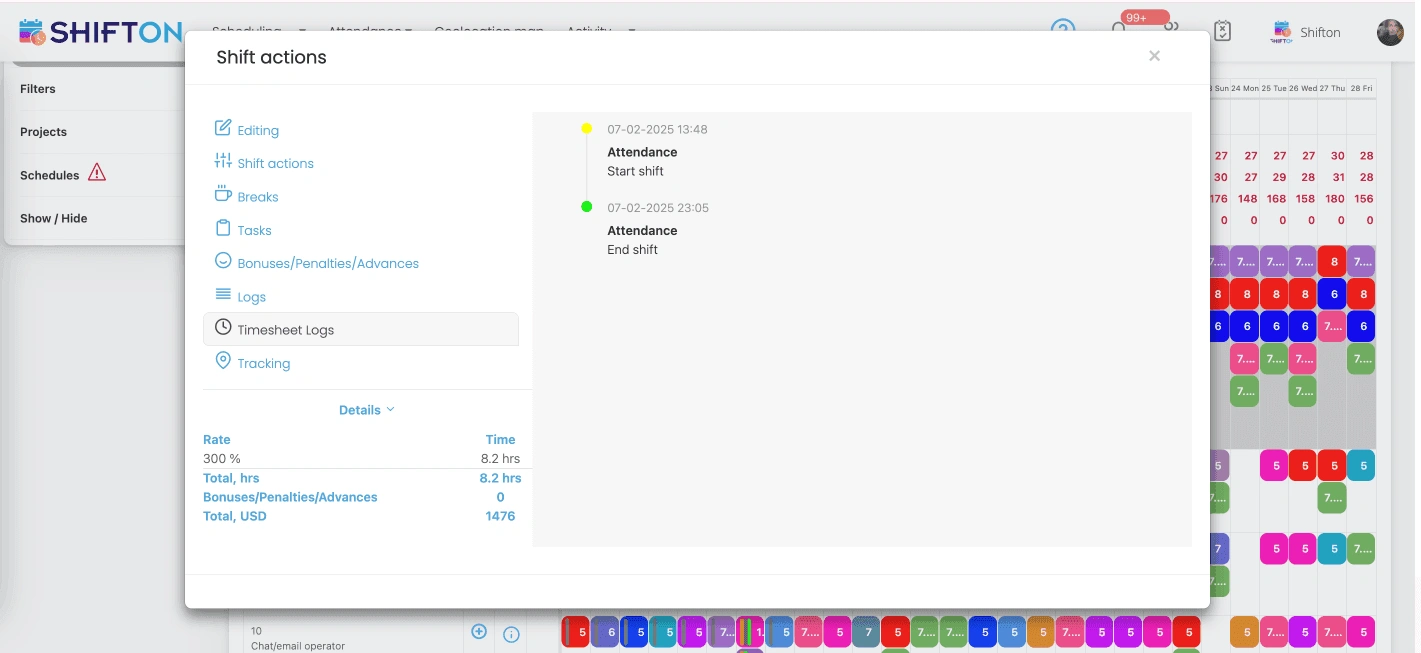
What Each Shift Actually Recorded and Cost
Planned hours and paid hours are rarely the same number. Opening a shift shows the attendance record attached to it, the start and end that were actually logged, next to the rate applied, the hours counted and the resulting figure in money. Breaks, tasks, bonuses and penalties each sit on their own tab of the same shift.
Start with the Free Plan
No time limits. Get full access to core features and upgrade when you're ready.
Read the full guide to factory shift patterns
A production line does not care which day of the week it is. If the plant runs continuously, somebody has to be standing at every position at three in the morning on a Sunday, and the arithmetic of making that happen fairly, legally and without burning through overtime is the whole discipline of factory shift planning. The panama shift schedule is one of the oldest answers to that problem and still one of the most widely used.
What makes it hard is not the pattern. It is everything around the pattern: a crew running two people short, a line that needs an extra body for a changeover, holiday requests arriving in clusters, and a monthly hours total that has to land inside a legal limit for every operator. A rotation drawn on paper is a starting position, not a schedule.
What a panama shift schedule is and why plants use it
The panama pattern, often written 2-2-3, runs four crews on twelve-hour shifts through a fourteen-day cycle: two days on, two off, three on, then the mirror image of that. Each crew alternates between days and nights, every position is covered around the clock, and nobody works more than three consecutive shifts. Averaged across the cycle it lands at roughly forty-two hours a week.
Sites adopt it for two reasons. Long blocks of time off, including a full weekend every other cycle, make it popular with the people actually working it, and a fixed cycle makes staffing predictable months ahead. The cost is that twelve-hour shifts leave almost no slack. One absence in a crew of the wrong size and the gap gets filled with overtime from somebody who has just come off nights.
The other patterns a plant runs
Most sites end up running more than one. A 4 on 4 off shift pattern uses twelve-hour shifts in a straightforward eight-day cycle and suits lines where demand is flat. The continental shift pattern spreads eight-hour shifts across five crews in a longer rotating cycle, which fits operations needing three handovers a day rather than two. A DuPont rotation packs four crews into a four-week cycle with a full week off built in. And plenty of factories still run a plain 3 shift system of mornings, afternoons and nights rotating weekly, which remains the easiest thing to staff and the easiest for a new starter to understand.
The choice is a trade between coverage, the number of handovers a day, and how heavy each individual shift is. What matters for the software is that every one of them is a cycle, so it should be built once and repeated rather than retyped each month.
Shop floor scheduling software builds the pattern once
Templates do the structural work. Define the shifts that make up a single cycle, apply them to a crew, and the rotation extends forward across the month with no further input. A plant schedule template built this way also gives you something to copy when a new line opens or a second site comes online, instead of rebuilding the logic from memory or from an old spreadsheet. Our shift scheduling tools keep the templates, the open shifts and the published month in one place, so the pattern and the exceptions to it never live in separate files.
In a factory the month view matters more than the week view. A rotation is only correct if it closes properly at the end of its cycle, and no seven-day window will show you that. Production line scheduling software that can only think a week ahead forces the planner to hold the cycle in their head.
Absence cover without breaking the rotation
This is where factory scheduling software is really judged. Somebody calls in, and a supervisor has to find a replacement who is trained for the position, is not mid-rotation on nights, and will not cross a working-time limit by picking up the shift.
Posting it as an open shift handles most of that. The uncovered position goes out to everyone eligible, whoever is willing claims it, and the published schedule updates for the whole plant at once rather than travelling by phone call and rumour. Because each person's maximum hours and accumulated hours are on screen while the decision is being made, the cover does not quietly create a compliance problem for somebody to discover at month end.
Hours, overtime and the monthly balance
Continuous patterns produce uneven hours by design. One month a crew lands under contract hours, the next it lands over, and the balance is only fair when read across the full cycle. Per-employee monthly totals make that legible: a planner can see whether nights and hours have been spread evenly or whether the same three people have absorbed every gap since spring.
Overtime deserves separate attention. In a plant it rarely arrives as a decision. It arrives as accumulated absence cover, extended changeovers and short crews. Reports that split hours by rate instead of lumping everything into one figure show which line and which shift generate the premium time, and that is the only basis on which anyone can fix the cause rather than pay the bill.
Shop floor time tracking that matches the plan
A schedule is a plan and a timesheet is a fact, and the distance between them is where labour budgets go missing. Shop floor time tracking software closes the gap by recording a real start and end against the shift that was scheduled, with breaks logged rather than assumed from the pattern. Each shift then carries its own rate, its counted hours and its total value, plus any bonus or penalty applied to it.
That per-shift record is what makes labour cost arguable instead of approximate. It also removes the monthly ritual of comparing a supervisor's notebook, a paper sign-in sheet and the payroll export line by line to work out what really happened.
Where staff scheduling stops and shop floor management software begins
The boundary is worth naming plainly. Shop floor management software, in the sense most vendors use the term, plans production orders, sequences jobs against machine capacity and tracks output. Shifton does none of that. It schedules the people: who is on which shift, on which line, for how long, and what those hours cost. Most sites run both kinds of system, because one decides what the line makes and the other decides who is standing at it.
Warehousing attached to a plant sits close to this, since the shift patterns are near cousins of the ones on the line. Our warehouse staff scheduling page covers that side in more detail, including how shared staff move between the two.
Choosing plant scheduling software
Test any industrial scheduling system against your hardest cycle rather than your easiest. Build a full panama or continental rotation, then break it deliberately: pull one operator out mid-cycle, add an unplanned Saturday, and see how much work the recovery takes and whether the monthly totals stay honest afterwards. Check that a night-shift operator can open the published month on a phone, because a schedule that lives only on the office noticeboard is a schedule half the plant hears about late.
Shifton runs free for up to ten team members with no time limit, which is enough for a small workshop or a single crew, and paid plans add multi-project structure, deeper reporting and the work location module. Paid plans are charged per employee per month, so a site pays for the people it schedules rather than for the number of patterns it runs. If your rotation currently lives in a spreadsheet that one person maintains, the risk was never the pattern. It is the week that person is away.
Frequently Asked Questions
What is a panama shift schedule?
The panama shift schedule, also written 2-2-3, runs four crews on twelve-hour shifts through a fourteen-day cycle: two days on, two off, three on, then the mirror of that. Every position stays covered around the clock, nobody works more than three shifts in a row, and the pattern averages about forty-two hours a week. Crews alternate between days and nights so the load is shared.
How does a 4 on 4 off shift pattern work?
A 4 on 4 off shift pattern puts a crew on four consecutive twelve-hour shifts and then gives them four days off, repeating on an eight-day cycle. Four crews are needed to keep a line running continuously, usually two on days and two on nights. It is simpler to plan than a fourteen-day rotation, which makes it a common choice where demand on the line is steady.
What is the difference between a continental and a DuPont shift pattern?
A continental shift pattern spreads eight-hour shifts across five crews in a rotating cycle, which suits sites needing three handovers a day. A DuPont rotation uses four crews on twelve-hour shifts through a four-week cycle with a full seven days off built in. Continental means shorter shifts and more handovers, DuPont means longer shifts and longer breaks between them.
Can factory scheduling software run a 3 shift system?
Yes. A morning, afternoon and night rotation is set up once as a template and then applied to each crew, after which the schedule extends across the month without being retyped. Shifton also handles twelve-hour patterns, mixed patterns on different lines of the same site, and shifts that cross midnight, which are counted as one period rather than split across two days.
Is shop floor scheduling software the same as shop floor management software?
No. Shop floor management software plans production orders, sequences jobs against machine capacity and tracks output. A shop floor scheduling solution such as Shifton plans the people: who works which shift on which line, for how long, and what the hours cost. Most plants run both, because one decides what the line makes and the other decides who is standing at it.
Is there a free plan for a small plant or workshop?
Yes. Shifton is free for up to ten team members with no time limit and includes shift scheduling, the basic time clock, the mobile app and standard reports. Larger sites move to paid plans charged per employee per month, which add multi-project structure and deeper reporting. Geolocation and work location controls are a paid module rather than part of the free plan.






Put Your Factory Shift Schedule on Shifton
Build a panama or 4 on 4 off rotation once, publish it to every crew and let the hours count themselves.