

 English
  Español
  Português
  Deutsch
  Français
  Italiano
  日本語
日本語  中文
中文  हिन्दी
  עברית
עברית  العربية
  한국어
한국어  Nederlands
  Polski
  Türkçe
  Українська
  Русский
  Magyar
  Română
  Български
  Čeština
  Ελληνικά
  Svenska
  Dansk
Dansk  Norsk
Norsk  Suomi
Suomi  Bahasa Indonesia
  Tiếng Việt
  Tagalog
  ไทย
ไทย  Latviešu
  Lietuvių
  Eesti
Eesti  Slovenčina
  Slovenščina
  Hrvatski
  Македонски
  Қазақша
  Azərbaycan
  Afrikaans
  বাংলা
বাংলা Pool Service Dispatch Software for Cleaning and Maintenance Teams
Assign technicians to weekly pool visits, staff the summer peak without overtime surprises and tie every shift to a site with pool service dispatch software.

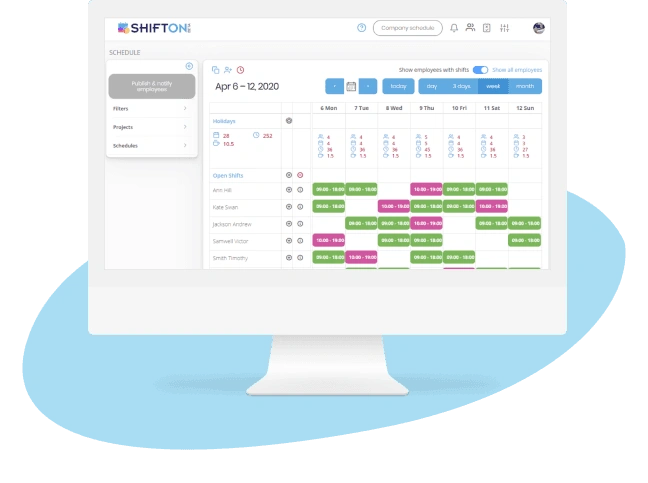
Build the Visit Week and Publish It
Pool service is a week of repeating commitments, and the schedule is the plan for meeting them. The weekly grid gives every technician a row and every assignment a colour-coded block with start and end times, so a manager can read the load balance across the team before the week is released. Filters, projects and schedules keep territories and account types apart.
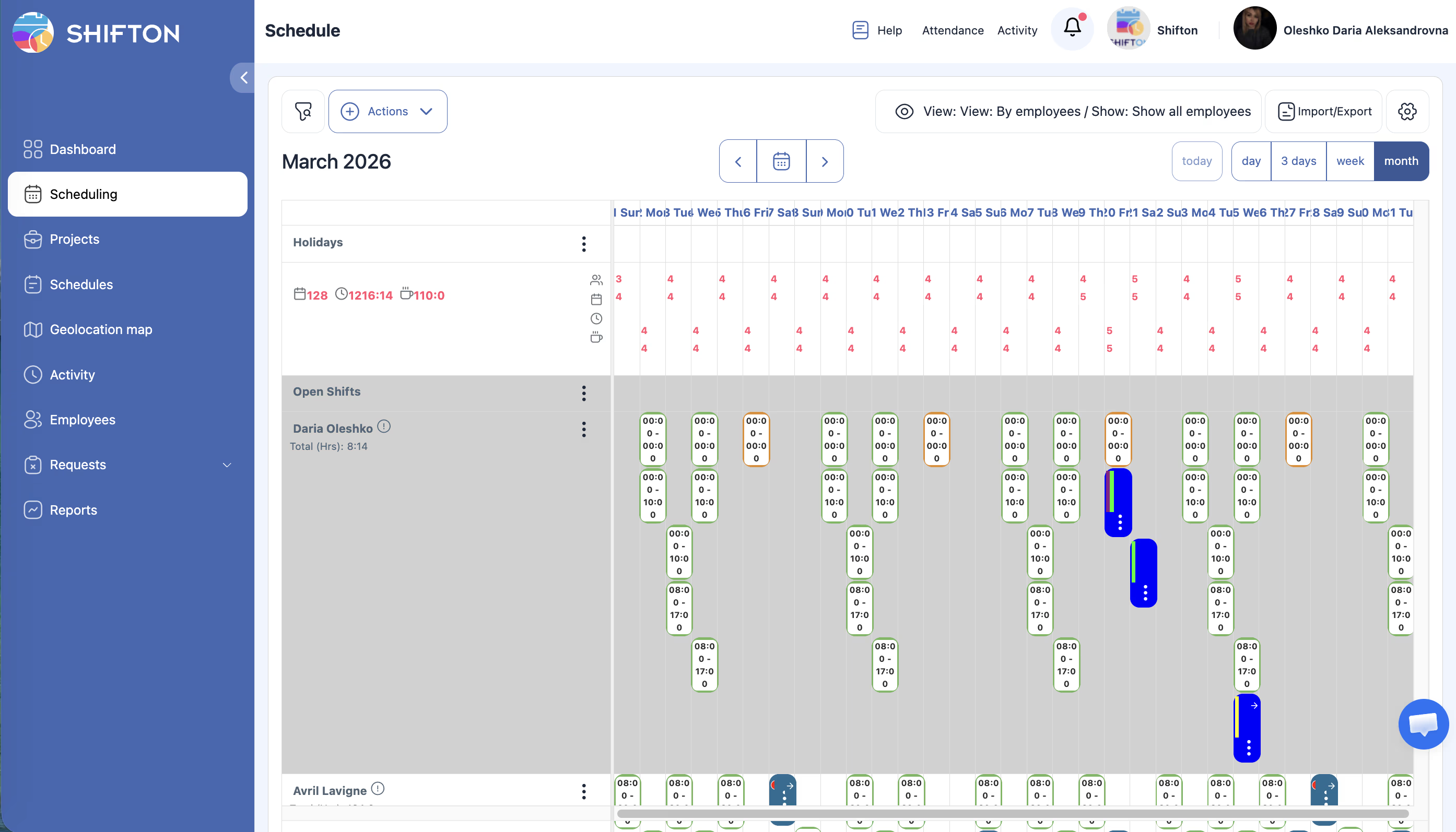
Plan the Season a Month at a Time
Pool work is seasonal, so the planning horizon that matters is a month rather than a week. The month view shows the whole period at once with open shifts still visible, and switches between a single technician and the full team, which is how a manager confirms the season is staffed before it arrives. Existing plans import in and the finished month exports out.
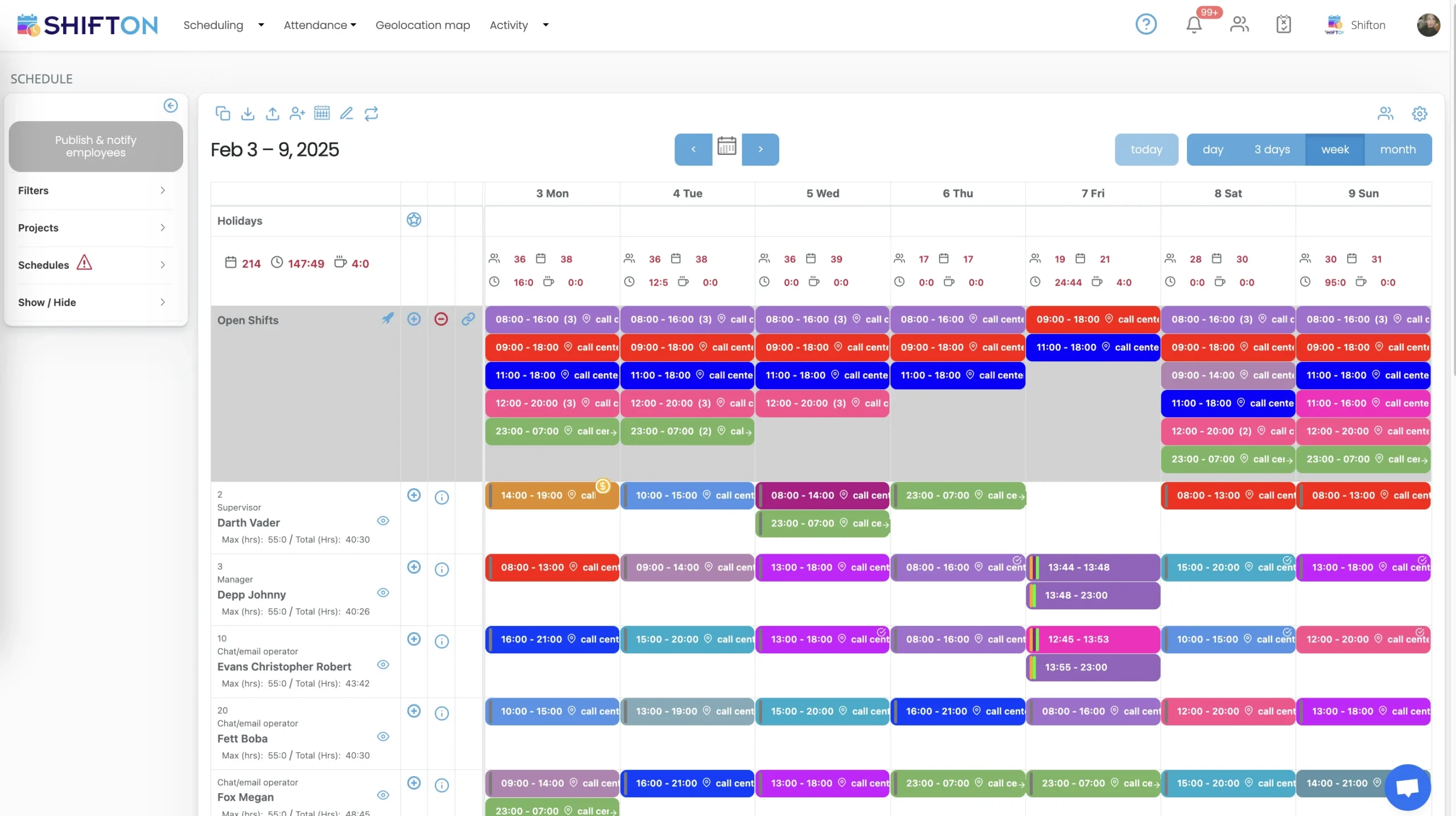
Peak Season Cover Across Every Role
In season the week fills up: several shifts a day, early starts before the heat, and commercial work that runs from late evening into the morning. Roles sit beside names in the grid, so a supervisor is on every block instead of being discovered missing halfway through. Maximum and total hours per person stay in view while the week is being packed.
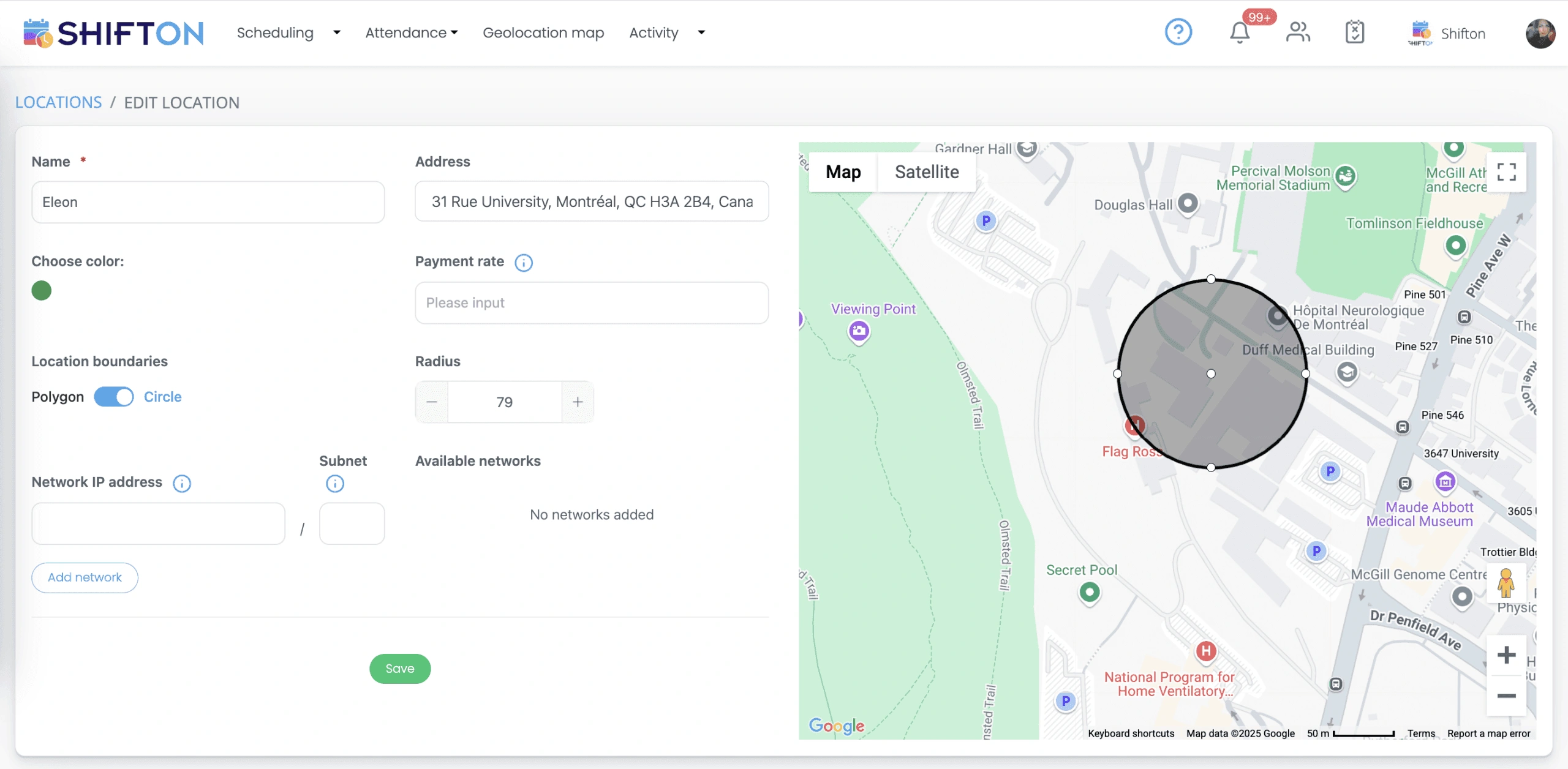
Give Every Site Its Own Boundary and Rate
Pool service happens at addresses rather than at a depot, so a site is worth defining once and reusing. A location record holds its name, address, colour and its own payment rate, and a boundary can be drawn around it as a circle or a polygon with a set radius, or defined by the network available on site. Work location is a paid module.
Start with the Free Plan
No time limits. Get full access to core features and upgrade when you're ready.
Read the full guide to pool service scheduling
A pool service business is fundamentally a promise to show up. Every account expects a technician on roughly the same day each week, the water does not pause between visits, and most of the margin sits in how many properties one technician can cover in a day without the quality slipping. Pool service dispatch software is what turns that promise into a plan somebody can actually run.
The complication is that the company is not the same size in January as it is in July. Demand climbs steeply through the season, seasonal and part-time technicians come and go, and the staffing that worked comfortably in spring falls apart the first week the heat arrives.
What pool service dispatch software actually means
The word dispatch gets used for two different things in this trade, and the difference matters when comparing products. One meaning is ordering the stops in a driving route. The other is assigning people to work: deciding which technician is on duty, for which block of hours, covering which accounts, and getting that decision onto their phone before they set off. Shifton does the second. It schedules the technician, it does not sequence the journey.
That is a narrower promise than a full field service suite makes, and it is deliberate. The staffing layer is the part most pool companies still run on a spreadsheet long after everything customer-facing has been modernised, and it is the part that breaks first as the team grows past a handful of people. That gap is what pool service scheduling software is built to close.
Weekly visit density and the technician's day
Density is the number that governs profitability. A technician covering fourteen properties a day across a tight cluster of neighbourhoods earns very differently from one covering nine spread over a county, and the difference is mostly time spent driving. Scheduling does not remove that driving, but it decides how many working hours are available to absorb it.
What a scheduler needs on screen is therefore straightforward: who is working, how many hours their day holds, and how much of the week they have already been given. When maximum hours sit beside assigned hours in the grid, the moment a technician's week becomes overcommitted is visible while it can still be changed. Adding a fifteenth property to a day that is already full becomes a decision rather than an accident discovered on Friday.
Chemical checks and the tasks that ride with a visit
Every visit has a standard shape: test the water, adjust, skim, empty the baskets, check pump and filter, note anything that needs a return trip. Newer technicians need that list in front of them, and the office needs to know it was completed, particularly on commercial accounts where somebody else's obligations depend on the work being done properly.
Attaching those checks to the shift as tasks puts them on the technician's phone alongside the shift itself and marks them off against the visit rather than in a notebook that never reaches the office. It is not a water chemistry system and does not pretend to be one. It is the operational checklist that keeps a visit consistent no matter which technician performs it, which matters most in the weeks when half the team is seasonal.
The summer peak and the winter trough
Pool service carries one of the sharpest seasonal curves of any field trade. Weekly service through the season, fortnightly or monthly outside it, openings clustered into a few weeks in spring and closings into a few in autumn. Headcount has to move with that curve, and the hiring decisions are made months before the pressure actually arrives.
Historic hours are what make that call rational instead of instinctive. Hours worked per technician per month across previous seasons show where the peak really landed, how much of it was absorbed by overtime rather than by extra people, and how early the ramp began. Seasonal staff then go onto the schedule for the months they are needed, with availability settings keeping them off it for the rest of the year, so what a manager is looking at reflects who is genuinely working this week rather than everyone who has ever worked here.
Hours, overtime and what a service day really costs
Labour is the dominant cost in pool service and hours are the only lever that moves it. The distance between the planned day and the real one is where margin quietly leaks: a green pool that took three hours instead of forty minutes, a Saturday call priced at a premium rate, a technician finishing at seven because the last two properties ran long.
Recording an actual start and end against the scheduled shift closes that distance. Hours then split by rate across technicians and projects, so the cost of a season is readable while the season is still running rather than after payroll has closed the books on it. Overtime that keeps appearing in the same week of every month is usually a staffing problem wearing a scheduling costume, and it is the report that makes the pattern obvious.
Tying shifts to the site they happen at
Because the work happens at addresses, defining those addresses once repays the setup. A location record carries its own name, address and payment rate, with a boundary drawn around it as a circle or polygon, and shifts attach to it afterwards. Commercial accounts that pay a different rate from residential work are then handled as a property of the site instead of a mental note somebody has to remember at the end of the month. Our work location module is a paid add-on rather than part of the free plan.
Pool service management software and where Shifton stops
The boundary is worth stating plainly. Pool service management software, in the sense the field service vendors use the term, holds customer accounts, service histories and chemical readings. Shifton holds none of that. What it holds is the workforce side: schedules and templates, availability and time off, worked and overtime hours, task lists attached to a shift, and the cost of the hours involved.
Companies running both usually keep the customer record where it is and move the staffing side across. Seasonal outdoor field teams face a near-identical shape of problem, which is why our landscape crew scheduling page covers much of the same ground for grounds and garden crews.
Choosing pool maintenance scheduling software
Test any platform against the season you dread rather than the one you enjoy. Build a peak week with the full team, then pull a technician out on the Monday and see how long redistributing the work takes and how quickly everyone affected finds out. Install it on the oldest phone in the fleet, because that is the phone your seasonal hires carry. Check that a technician can request time off in a few taps, and that hours export in a form your payroll process can consume.
Shifton is free for up to ten team members with no time limit, which covers a small operator running a couple of trucks, and paid plans add multi-project structure, deeper reporting and the work location module. Paid plans are charged per employee per month above that, so a company pays for the technicians it schedules rather than for the number of accounts it services. If the schedule today is a spreadsheet one person maintains and a group chat that carries the changes, the first thing worth fixing is how fast a change reaches the truck.
Frequently Asked Questions
What is pool service dispatch software?
In this trade the word dispatch covers two different things. One is ordering the stops in a driving route. The other is assigning people to work: deciding which technician is on duty, for how many hours, and getting that onto their phone. Shifton does the second. It builds the schedule, posts open shifts, records worked hours and reports what those hours cost.
How do you schedule recurring weekly pool visits?
The repeating week is built once as a template and applied forward, so the standard pattern of visits does not need retyping every month and only the exceptions need a decision. Swimming pool service scheduling software of this kind keeps the structure in the system rather than in one manager's head, which means the week survives a handover.
Can pool cleaning scheduling software handle the summer peak?
Yes, and the planning is done with hours rather than instinct. Working-hours reports from previous seasons show when the peak landed and how much of it was absorbed by overtime instead of by extra people, which is what justifies a seasonal hire. Seasonal technicians go on the schedule for the months they are needed and availability settings keep them off it outside the season.
Does Shifton plan driving routes between pools?
No. Shifton schedules the technician, not the journey. It decides who is working which shift, at which site, for how many hours, and publishes that to the team. Route sequencing between properties is a separate class of tool, and many pool companies run one alongside a scheduling system rather than expecting one product to do both.
Can technicians see their shifts and log hours from a phone?
Yes. The Shifton mobile app for iOS and Android shows each technician their published shifts, lets them clock in and out, submit availability and request time off. Push notifications reach them when the schedule is published or changed, so the version on the phone is always the current one. Geolocation and work location controls are a paid module.
Is there a free plan for a small pool service company?
Yes. Shifton is free for up to ten team members with no time limit and includes shift scheduling, the basic time clock, the mobile app and standard reports, which is enough for an operator running a couple of trucks. Larger teams move to paid plans charged per employee per month, and the work location module sits on the paid side.





Schedule Your Pool Service Team With Shifton
Plan the weekly visit load, fill open shifts in seconds and keep every technician's hours in one place.