English (US)
  Español (ES)
  Português (PT)
  Deutsch (DE)
  Français (FR)
  Italiano
  日本語
日本語  中文
中文  हिन्दी
  עברית
עברית  العربية
  한국어
한국어  Nederlands
  Polski
  Türkçe
  Українська
  Русский
  Magyar
  Română
  Български
  Čeština
  Ελληνικά
  Svenska
  Dansk
Dansk  Norsk
Norsk  Suomi
Suomi  Bahasa
  Tiếng Việt
  Tagalog
  ไทย
ไทย  Latviešu
  Lietuvių
  Eesti
Eesti  Slovenčina
  Slovenščina
  Hrvatski
  Македонски
  Қазақ
Қазақ  Azərbaycan
  Afrikaans
  বাংলা
বাংলা 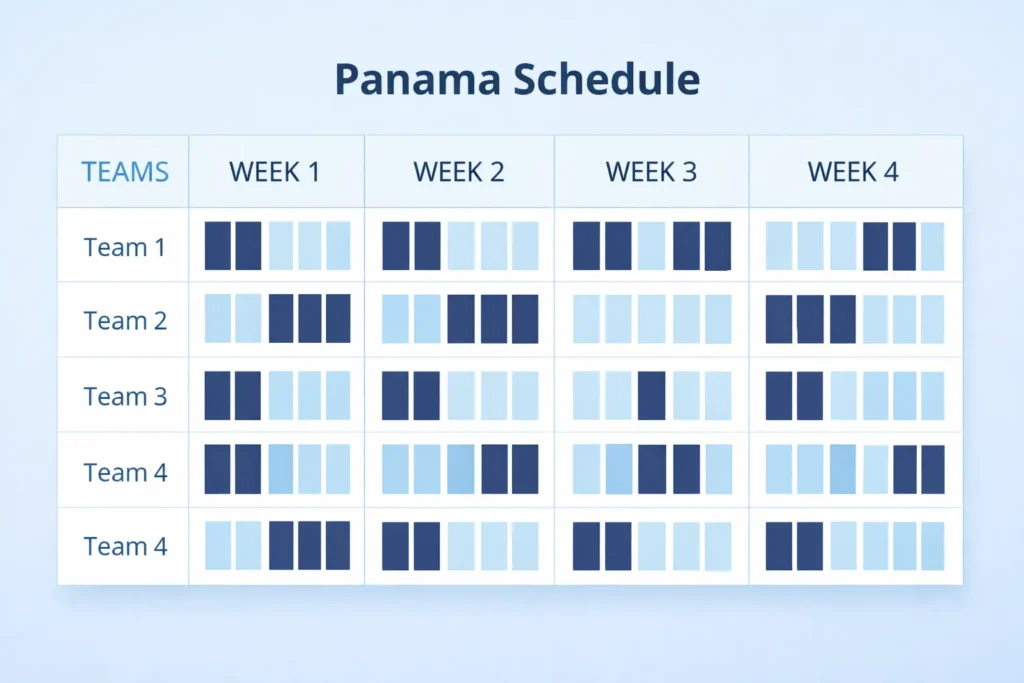
What is the Panama schedule?
The Panama schedule is a rotating 12-hour shift pattern designed for 24/7 coverage. In its common form, employees work two days on, two days off, three days on, then the pattern flips in the following week. Over time, the rotation spreads long work blocks, rest days, nights, and weekends more evenly than a simple fixed schedule. That is why people often connect it with other continuous-coverage patterns. If you want to compare it with one of the closest alternatives before deciding whether Panama is the better fit, this 2-2-3 work schedule guide is useful because the two models are often discussed together even though they are not always implemented in exactly the same way.How the Panama schedule actually works
At its core, the rotation is built around 12-hour shifts and a repeating structure that usually follows this rhythm:- 2 days on
- 2 days off
- 3 days on
- 2 days off
- 2 days on
- 3 days off
Panama schedule example
A practical way to picture it is to imagine one team on day shifts and another on night shifts, with both following the same pattern on different blocks. One employee might work Monday and Tuesday, have Wednesday and Thursday off, then work Friday, Saturday, and Sunday. The next week the sequence changes again, which is what helps spread weekends and rest days more evenly over time. This is exactly why the schedule tends to work better when the pattern lives in a clear shift scheduling system rather than inside spreadsheets, notes, and chat messages that different supervisors interpret in different ways.Why companies use the Panama schedule
The short answer is that around-the-clock coverage is hard to run fairly. Managers need a structure that keeps the operation staffed without making every week feel improvised. The Panama schedule helps because it creates a repeating pattern people can learn, predict, and plan around. That alone can reduce a lot of friction compared with a constantly changing rota. It also creates longer breaks than many fixed patterns, which can feel valuable for employees. A worker may not enjoy every 12-hour shift, but many people do appreciate a schedule where the off-days are visible and recurring instead of being random or uneven.Why employees either like it or hate it
This is where the human side matters. Some employees like the Panama schedule because the longer breaks feel real. They can actually rest, handle life outside work, or plan around days off that are not constantly moving. Others dislike it because the working days are long, especially when the job is intense, physically demanding, or mentally draining. That split reaction is normal. The schedule is not universally “good” or “bad.” It depends on the kind of work, the commute, the night rotation, and how well the company manages fatigue.Panama schedule and fatigue
This is the part many articles skip, even though it matters more than the calendar itself. A 12-hour schedule can look balanced on paper and still wear people down if the work is safety-sensitive, emotionally heavy, or badly staffed. Long shifts are not just a math problem. They affect focus, decision-making, sleep, and recovery. That is one reason it helps to place Panama inside the wider context of long-shift planning. A practical internal reference like these 24-hour shift schedule tips and examples fits naturally here because Panama works best when it is treated as one staffing model inside a broader coverage strategy, not as a one-size-fits-all answer. Outside your own site, it is also useful to ground the discussion in occupational guidance on shiftwork and fatigue. The Canadian Centre for Occupational Health and Safety explains the risks of shiftwork and fatigue in a way that helps managers remember that longer rotations affect people, not just coverage charts.Panama schedule vs Dupont schedule
Panama and Dupont are often mentioned in the same conversation because both are built for continuous operations, but they feel different in practice. Panama is usually easier to explain and often feels more predictable once employees learn the rhythm. Dupont can create a different balance of longer blocks, recovery periods, and shift continuity depending on how teams are structured. If you want to compare the two without reducing them to a single sentence, this guide to the Dupont schedule helps because it shows how another 24/7 model solves the same coverage problem in a different way.Panama schedule vs office-friendly compressed schedules
This is also where some confusion comes from. The Panama schedule is not built for the same reason as a 9/80 schedule. A 9/80 setup is usually about flexibility in office or project work. Panama is about continuous coverage in operations that do not stop. That difference matters because it changes what “success” looks like. In a 9/80 schedule, the question is often whether employees gain useful flexibility without hurting workflow. In a Panama schedule, the question is whether the business stays covered without exhausting people. That is why this 9/80 work schedule article makes a useful contrast: it shows a compressed pattern designed around a very different kind of working life.Who the Panama schedule fits best
The Panama schedule usually fits teams that truly need 24/7 staffing and can manage long shifts responsibly. It often works best in:- manufacturing and production
- utilities and infrastructure
- security operations
- some healthcare environments
- maintenance-heavy sites
- service environments that cannot close overnight