

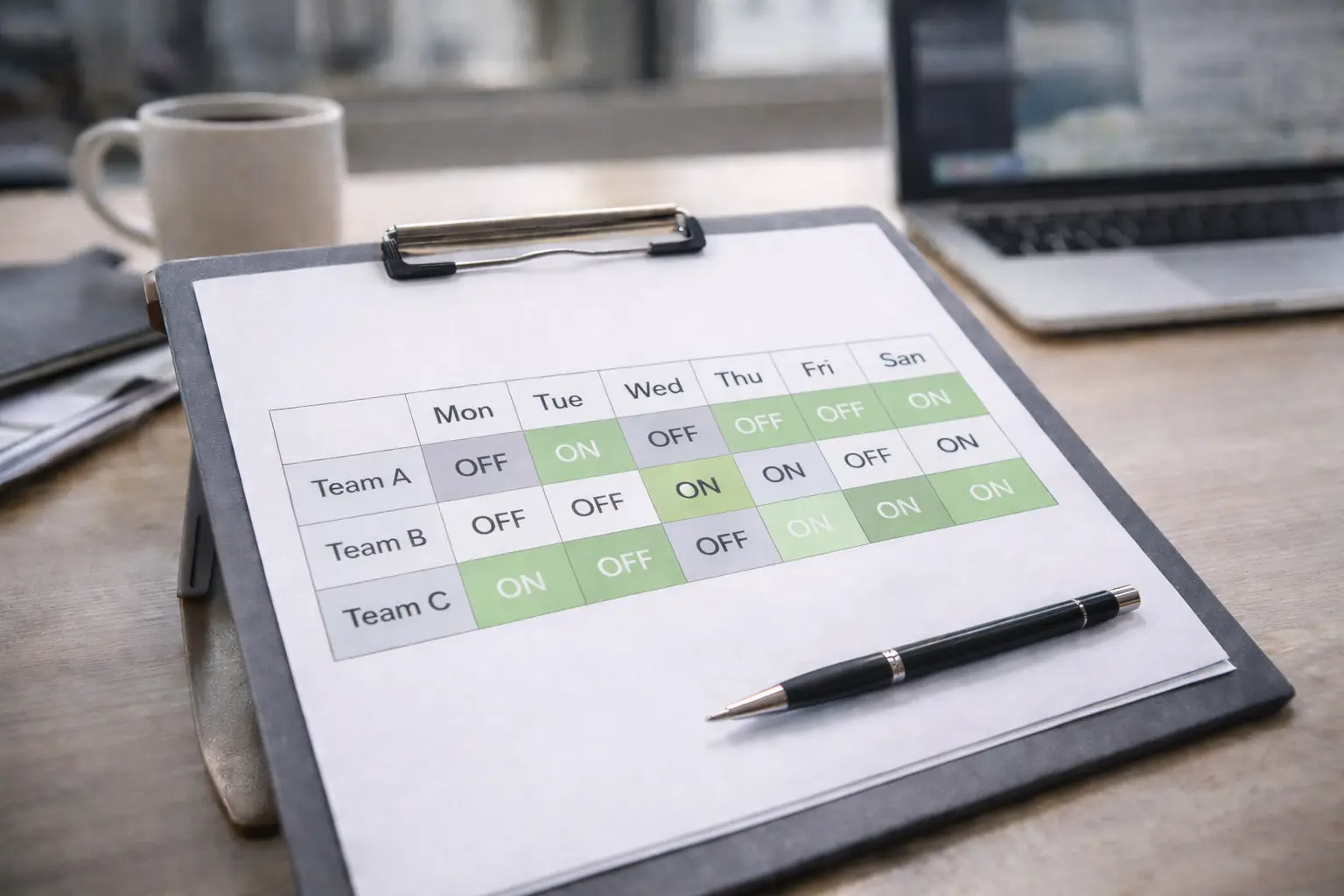
- How the 2-2-3 rotation works
- Why teams choose 2-2-3 instead of a simple weekly schedule
- Where the 2-2-3 schedule fits best
- Crew math: how many people a 2-2-3 actually needs
- The honest downsides of 2-2-3
- How to make a 2-2-3 schedule feel fair and predictable
- The most common mistakes teams make with 2-2-3
- How to test 2-2-3 before you commit
- FAQ
A 2-2-3 work schedule is a rotating shift pattern often used for 24/7 coverage. The name tells you the rhythm: two days on, two days off, three days on. Then the pattern flips, so teams share weekends and no one is stuck with the same “bad days” forever.
You might also hear it called the panama schedule breakdown. Different companies use slightly different versions, but the goal is the same: reliable coverage with built-in rest and a rotation that feels fair over time.
This guide explains how 2-2-3 works in normal human language, what it’s good for, and where it can go wrong if you don’t set a few basic rules.
Who is this page for?
Working a 2-2-3 and trying to read it?
Your own dates come from your employer, so we cannot pull them up. The section below sets out the full 14-day cycle, which is usually all it takes to work out where you sit in the pattern and when your next long weekend lands.
Putting a team onto a 2-2-3?
Then read on. This page covers one pattern in depth – the crew math, the fair-rotation rules, and the mistakes that make it fail in the first month. Shifton runs it for you afterwards: repeating cycles, swaps inside the system, and overtime warnings before the wage bill moves. Free for up to 10 employees.
How the 2-2-3 rotation works
Laid out across the full 14 days, the 2-2-3 work schedule looks like this. D is a day shift, N a night shift, and a dash is a day off. Four crews on these four rows cover every hour of every day with no gaps.
| Crew | Week 1 (Mon-Sun) | Week 2 (Mon-Sun) | Hours/week (avg) |
|---|---|---|---|
| A | D D – – D D D | – – D D – – – | 42 |
| B | – – D D – – – | D D – – D D D | 42 |
| C | N N – – N N N | – – N N – – – | 42 |
| D | – – N N – – – | N N – – N N N | 42 |
Notice that no crew ever works more than three shifts in a row, and that every crew gets a full three-day break inside each 14-day cycle. That is the whole appeal of the pattern, and it is why the 2-2-3 shift pattern is also known as the Pitman schedule. It is one of several 12-hour shift patterns used for round-the-clock cover, and the one most teams recognise first.
Most teams run 2-2-3 with two crews. Think of them as Team A and Team B. While one team is working, the other is off, so coverage stays continuous.
A simple way to understand the rotation is this: in a two-week cycle, each team works about the same number of days, and the weekends rotate. That weekend rotation is the big deal. It’s what prevents the same people from always working Saturdays and Sundays.
Many companies pair 2-2-3 with 12-hour shifts because it reduces the number of handovers per day. But 2-2-3 is still a rotation pattern even if your shift length is different. The pattern can be adapted as long as you keep the “2 on, 2 off, 3 on” rhythm and the flip in the following week.
Why teams choose 2-2-3 instead of a simple weekly schedule
Most shift schedules are a trade-off between coverage, fatigue, and fairness. Teams choose 2-2-3 because it often improves all three.
Frequent rest feels more sustainable
Instead of grinding through long streaks, people get breaks every few days. That matters in physically demanding work and high-focus roles.
Weekends rotate by design
Weekend fairness is one of the fastest ways to lose trust. With 2-2-3, weekends rotate, so the schedule feels less like favoritism and more like a system.
It supports real 24/7 coverage
If your business must run every day, a rotation that is built for continuous coverage is usually easier to manage than constantly patching holes.
Where the 2-2-3 schedule fits best
This rotation works best where staffing is not optional. Manufacturing plants, warehouses, utilities, security teams, and operations-heavy services often use it because coverage gaps show up immediately in output, safety, or customer experience. If you don’t need true 24/7 coverage but still want a structured alternative to the standard week, patterns like the 9/80 schedule can be a better fit for office-heavy teams.
A practical example is manufacturing, where crews need predictable coverage and managers need a rotation that won’t collapse the moment one person is absent. If you want a quick view of how shift-heavy operations think about coverage, this manufacturing industry page matches the reality that 2-2-3 is designed for.
Crew math: how many people a 2-2-3 actually needs
The pattern only works with four crews. Run it with three and the cycle cannot close, so someone ends up on a permanent overtime block to plug the gap. The table below sizes a 2-2-3 work schedule against the coverage you need at any one moment.
| People needed on shift | Crews required | Total headcount | Realistic headcount with cover |
|---|---|---|---|
| 1 | 4 | 4 | 5 to 6 |
| 2 | 4 | 8 | 9 to 10 |
| 4 | 4 | 16 | 18 to 20 |
| 6 | 4 | 24 | 27 to 30 |
The right-hand column is the one people forget. Four crews close the cycle on paper, but holiday, sickness, and training all land on top of it. Teams that budget only the paper number end up covering the difference with overtime within the first quarter.
Run a 2-2-3 without rebuilding it every fortnight
Set the crews once and Shifton repeats the cycle, keeps swaps inside the system, and warns you before anyone tips into overtime. Free for up to 10 employees.
The honest downsides of 2-2-3
A schedule is only “good” if it works in the real world. Here are the pain points teams should admit upfront.
It can be tiring, especially with long shifts
If you run 12-hour shifts, the three-day stretch can feel heavy. Yes, you get time off soon, but the workdays can be intense. This is one reason why recovery rules matter. If your rotation includes nights, a practical reference is this guide on sleep planning for 12-hour night shifts, which can help teams reduce fatigue and stay more consistent across the cycle. For a broader view of rotation structures, it is also worth understanding how 12-hour shift patterns compare in terms of fatigue and recovery.
Sleep can take a hit if you rotate days and nights too often
Some companies stack 2-2-3 on top of frequent day-to-night switching. That’s when people start feeling foggy and irritable, and mistakes become more likely.
A strong, non-commercial reference here is the UK Health & Safety Executive guidance on managing fatigue at work, which explains why tired teams make more errors and why long or disrupted patterns need guardrails in their fatigue overview.
Handover quality becomes critical
2-2-3 can reduce daily handovers if you use longer shifts, but the handovers you do have become more important. If one shift doesn’t pass key context, the next shift wastes time guessing, and small problems repeat.
The pattern can confuse people at first
If employees don’t understand the rotation, they’ll show up on the wrong day or miss important changes. This is not a “worker problem,” it’s a rollout problem.
How to make a 2-2-3 schedule feel fair and predictable
The rotation creates a structure, but your rules determine whether it feels fair.
Keep swaps inside the system
Swaps are normal. The damage happens when swaps live only in private messages. Then the schedule stops being real, and you get no-show surprises.
Make time-off visible early
Time off is the number one reason “perfect rotations” break. If vacations and leave are handled late or inconsistently, managers patch the schedule by leaning on the same reliable people.
Watch the real fatigue signals
A schedule can look fair on paper while still exhausting the team. Overtime frequency, last-minute call-ins, and repeated short-rest gaps are the signals that matter.
Use a scheduling setup that supports repeating rotations
2-2-3 is not hard, but it’s annoying to manage manually, especially when you have multiple roles or locations. Teams usually do better when the rotation can be published, adjusted, and communicated clearly in one place, which is why many rely on a dedicated tool for repeating shift patterns like the one described on Shifton’s Shift Schedule feature.
The most common mistakes teams make with 2-2-3
They roll it out without explaining it like a calendar
People don’t think in “patterns.” They think in dates. The easiest rollout is a clear calendar view that shows the next 4–6 weeks so everyone can feel the rhythm.
They ignore handovers
A rotation is only as strong as the handover habit. You need one simple standard: what happened, what’s done, what’s next, and who owns follow-up.
They forget that fairness is also about weekends and holidays
If one group keeps getting the same holiday weeks, trust collapses. Define how holiday coverage is shared and keep it consistent.
They don’t align time off rules with the rotation
If your leave process is unclear, the schedule becomes a patchwork. If you want an example of a clean request-and-approval workflow that reduces friction, the ideas in this leave management system article translate well to shift planning too.
How to test 2-2-3 before you commit
The smartest way to adopt 2-2-3 is to run a short pilot with one team, then measure reality:
Coverage gaps
Overtime changes
Shift swap frequency
Fatigue complaints
Handover issues
If the schedule reduces last-minute chaos and people understand it, you’re close.
If you want to sketch the rotation with real dates and see how it looks before changing the entire operation, you can set up a workspace and map out the cycle through this registration page.
To understand why day/night switching can feel so brutal even when the schedule “looks fair,” a useful medical reference is the National Library of Medicine’s overview of circadian rhythm sleep issues, which helps explain how shift patterns interact with the body clock in this NCBI resource.
If you are still weighing 2-2-3 against the other round-the-clock options, the wider comparison of 12-hour shift schedules puts it next to DuPont and 4-on-4-off, and the guide to rotating shift schedules covers the direction and speed decisions that sit underneath every one of them.
FAQ
Is the 2-2-3 schedule the same as the Panama schedule?
Yes. Many companies use the names interchangeably. The idea is a rotating two-week cycle built around two days on, two off, three on, and then a flip so weekends rotate.
Does 2-2-3 always mean 12-hour shifts?
No. It’s often paired with 12-hour shifts, but the rotation pattern can be adapted to other shift lengths as long as the rhythm and weekend rotation stay consistent.
Who should avoid a 2-2-3 schedule?
Teams that don’t need weekend coverage or continuous operations may find it unnecessarily complex. It can also be tough if you frequently rotate day and night shifts, because sleep disruption becomes a serious issue.
What’s the biggest risk with 2-2-3?
Poor handovers and unclear swap rules. When rotations are frequent, sloppy handovers create repeated mistakes and frustration.
Can 2-2-3 reduce overtime?
It can, especially if it stabilizes coverage and reduces last-minute patching. But it only works when time off and swaps are handled consistently.
How do you keep it fair over time?
Make weekend and holiday rotation rules clear, keep swaps inside the schedule, track overtime and call-ins, and adjust when the same people keep carrying heavy weeks.


Start making changes today!
Optimize processes, improve team management, and increase efficiency.