The 9/80 work schedule gets attention because it promises something a lot of employees want: an extra day off every two weeks without reducing full-time hours. On paper, that sounds simple. In real life, it only works well when managers understand the math, the overtime rules, and the daily effect on coverage, meetings, and handoffs.
That is why this schedule is worth explaining properly. It can improve morale, help with retention, and make the workweek feel more flexible. But it can also create payroll mistakes, uneven team overlap, and confusion around long days if the business treats it like “just another compressed schedule.”
What is a 9/80 work schedule?
A 9/80 work schedule is a two-week schedule where an employee works 80 hours across 9 days instead of 10. In most setups, that means eight 9-hour days, one 8-hour day, and one day off every other week. The total is still 80 hours over two weeks, but the time is arranged differently.
The main appeal is obvious. Employees get a recurring extra day off without dropping to part-time hours. Managers may also find that some teams are more focused when they know a longer break is built into the schedule.
If you want a broader look at non-standard schedules before deciding whether 9/80 fits your business, it helps to compare it with other flexible models, and
this guide to alternative work schedules in the US is a strong starting point because it places 9/80 inside the wider schedule landscape instead of treating it like a universal solution.
9/80 work schedule example
The easiest way to understand a 9/80 schedule is to look at one full two-week cycle.
Week 1
- Monday — 9 hours
- Tuesday — 9 hours
- Wednesday — 9 hours
- Thursday — 9 hours
- Friday — 8 hours
Week 2
- Monday — 9 hours
- Tuesday — 9 hours
- Wednesday — 9 hours
- Thursday — 9 hours
- Friday — Off
That creates 80 total hours over 14 days, but it does not automatically mean the setup is compliant or practical. The way the workweek is defined matters a lot, especially for overtime calculations.
Why employees like the 9/80 schedule
Most employees like it because the extra day off feels meaningful. It creates more space for errands, appointments, family time, travel, or recovery. For people who feel drained by a standard five-day rhythm every single week, that additional day off can feel more valuable than it looks on paper.
It can also improve morale because the schedule feels intentional rather than repetitive. A lot of workers respond well when the work pattern includes a built-in break instead of waiting for PTO or public holidays to create breathing room.
Why managers are interested in it too
Managers usually care about different benefits. They may want to improve retention, make the workplace more attractive, or offer flexibility without reducing output. In some teams, 9/80 can also reduce office crowding on one day of the cycle or help create longer uninterrupted work blocks.
Still, none of those benefits matter if coverage breaks down. A flexible schedule that creates planning confusion is not a real improvement.
9/80 vs 4/10 schedule
A 9/80 schedule is often compared with a 4/10 schedule, but they are not the same.
With
9/80, employees usually work eight 9-hour days, one 8-hour day, and get one extra day off every two weeks. With
4/10, employees work four 10-hour days each week and get one extra day off every week.
The 9/80 schedule is often easier on energy because the long days are slightly shorter. The 4/10 model is simpler to explain and can feel cleaner operationally, but 10-hour days are heavier and can be harder for some teams to sustain.
In other words, 9/80 often feels softer for employees, while 4/10 is often simpler for planning. The right choice depends on workload, meetings, customer expectations, and how well your team handles long days.
Where a 9/80 work schedule fits best
This schedule tends to work best in office-based, project-based, and predictable environments where one day off every two weeks does not break daily operations. Engineering, design, administration, finance, back-office teams, and some professional services roles often adapt more easily because work is less dependent on equal staffing every weekday.
It is usually harder to run in places where staffing has to stay level every day or where the same people must be available continuously. That does not make 9/80 impossible, but it does make planning more important.
If your team already runs other structured rotations, it can help to compare how different patterns behave over time. For example,
this article on the 2-2-3 work schedule shows how another schedule balances coverage and time off in a very different way, which makes the tradeoffs of 9/80 easier to understand. And if your challenge is true 24/7 coverage rather than office overlap, a rotation like
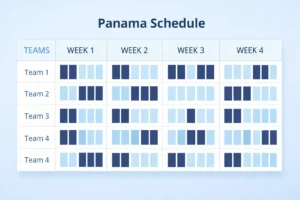
a Panama-style rotation for 24/7 coverage is often the more realistic comparison point.
Who should not use a 9/80 work schedule
A 9/80 schedule is usually a poor fit for teams that need equal weekday coverage, constant live support, or consistent handoffs from the same people every day. It can also be risky where long days increase safety concerns or where payroll is already messy.
If a team already struggles with late approvals, weak scheduling habits, or uneven workloads, changing the schedule format may only expose those problems faster.
Pros and cons of a 9/80 work schedule
Benefits of a 9/80 schedule
- An extra day off every two weeks without reducing full-time hours
- Stronger work-life balance for many employees
- Potential morale and retention benefits
- Longer uninterrupted work periods in some roles
- A practical alternative to more aggressive compressed schedules
Downsides of a 9/80 schedule
- Payroll and overtime calculations can become confusing
- Longer workdays may feel draining over time
- Meeting overlap can become harder to manage
- Coverage can weaken if the schedule is rolled out carelessly
- It does not fit every team or industry
The biggest mistake companies make with 9/80
The biggest mistake is thinking this schedule is mainly a perk. It is not. It changes how the week works, which affects overtime calculations, team overlap, customer response, and manager planning.
If one employee is off every other Friday but all approvals, handoffs, or client touchpoints still depend on that person, then the schedule is not flexible. It is fragile.
9/80 work schedule and overtime rules
This is where companies get into trouble. A 9/80 schedule often depends on splitting the workweek carefully so the 8-hour day sits across the workweek boundary. If that is not handled correctly, one of the 9-hour days may unexpectedly trigger overtime depending on federal or state rules.
That is why 9/80 is not just a scheduling decision. It is also a payroll and compliance decision. In the United States, overtime rules are shaped by how work hours fall inside a workweek, which is why many HR teams check the U.S. Department of Labor guidance on
overtime pay requirements before rolling out compressed schedules.
In California, this matters even more because state overtime treatment can be stricter than general expectations, and the California DIR overview of
overtime rules is useful when reviewing how long days may be treated in practice.
Once compliance is clear, the planning side becomes much easier. Teams usually do better when the structure lives inside
a clear shift scheduling system instead of spreadsheets, side notes, and chat messages that nobody reviews consistently.
How to know if 9/80 will work for your team
A good test is not “would employees like it?” Most employees probably would. The real test is whether work still flows smoothly when one day disappears every two weeks.
Ask these questions:
- Does the team need equal staffing every weekday?
- Will handoffs increase or become riskier?
- Do customers expect daily availability from the same people?
- Can payroll and overtime rules be handled cleanly?
- Will managers still have enough overlap for meetings and approvals?
If the answers are mostly yes, the schedule may fit. If the team already struggles with uneven workloads, unclear ownership, or weak coordination, a new schedule alone will not solve the problem.
How holidays and PTO affect a 9/80 schedule
This part gets overlooked all the time. A holiday that lands on the “8-hour day” or on the employee’s off Friday can create arguments if the company does not define the rule in advance. The same thing happens with PTO. Employees want to know whether one day of PTO equals eight hours, nine hours, or something else inside the cycle.
If that rule is vague, the schedule will start to feel unfair very quickly. The fix is simple: write the holiday and PTO logic before rollout, not after the first complaint.
How to implement a 9/80 work schedule without creating confusion
Start with one team, not the whole company
A pilot is safer than a company-wide launch. One team gives you real data on meeting overlap, handoffs, customer response, and whether employees actually use the extra day in a way that helps the workflow rather than hurting it.
Write the rules in plain language
Employees should not need a legal decoder ring to understand the schedule. Spell out which day is off, how the two-week cycle works, what happens on holidays, and how PTO interacts with the pattern.
Protect fairness
Any schedule feels worse when people believe it is only flexible for a few employees. Even a good structure creates friction if some employees always get the better version of it. That is why fairness matters as much as flexibility, and
this article on building a fair shift schedule fits naturally here because schedule trust is one of the first things that breaks when rollout rules are sloppy.
Review the first month carefully
Do not assume silence means success. Look at payroll, handoffs, missed overlap, and employee feedback after the first month. Most bad schedule rollouts fail because nobody reviews what changed in real life.
What 9/80 changes in daily management
Managers often focus on the extra day off and forget the smaller daily consequences. Nine-hour days feel manageable on paper, but they can still change energy levels, handoff timing, and meeting habits. Teams with a lot of approvals or same-day coordination will notice those changes quickly.
On the other hand, well-organized teams often adapt well because the schedule creates a clear rhythm. People know what they are working toward, and the extra day off can become a real recovery point instead of a random convenience.
When 9/80 is a bad fit
It is usually a poor fit when the business depends on daily coverage from the same people, when customers expect continuous weekday access, or when managers already struggle with scheduling discipline. It can also be risky in teams where overtime is already messy, because the longer days amplify payroll mistakes instead of fixing them.
If you are not sure whether this schedule will work for your team, it is safer to test it with one team first. Running the schedule inside
a shared scheduling workspace helps managers see how coverage, workload, and handoffs behave before making the change permanent.
FAQ
What is a 9/80 work schedule?
A 9/80 work schedule is a two-week schedule where an employee works 80 hours across 9 days instead of 10, usually by working eight 9-hour days, one 8-hour day, and getting one day off every other week.
Why do employees like a 9/80 schedule?
Most employees like it because it gives them a recurring extra day off without reducing full-time hours, which can improve work-life balance and make the schedule feel more flexible.
Does a 9/80 schedule always trigger overtime?
Not always, but it can if the workweek is set up incorrectly or if state rules treat the longer days differently. That is why payroll setup matters.
Is 9/80 the same as a compressed workweek?
It is a type of compressed work schedule, but not all compressed schedules are 9/80. Other formats distribute hours very differently across the week.
What jobs fit a 9/80 schedule best?
It usually fits office-based, project-based, and predictable workloads better than roles that require equal staffing and daily coverage.
What is the biggest risk of a 9/80 schedule?
The biggest risk is treating it like a simple perk instead of a schedule that affects payroll, overtime, meeting overlap, and coverage planning.
How should companies test a 9/80 schedule?
The safest way is to run a pilot with one team, define the rules clearly, monitor handoffs and coverage, and review payroll impact before expanding it.
Is a 9/80 schedule legal?
It can be legal, but legality depends on how the workweek is defined and how federal or state overtime rules apply to the longer days.
Can hourly employees work a 9/80 schedule?
Yes, but only when payroll and overtime treatment are set up correctly. Otherwise the company may accidentally create overtime or policy disputes.
Daria Olieshko
A personal blog created for those who are looking for proven practices.


 English (US)
  Español (ES)
  Português (PT)
  Deutsch (DE)
  Français (FR)
  Italiano
  日本語
日本語  中文
中文  हिन्दी
  עברית
עברית  العربية
  한국어
한국어  Nederlands
  Polski
  Türkçe
  Українська
  Русский
  Magyar
  Română
  Български
  Čeština
  Ελληνικά
  Svenska
  Dansk
Dansk  Norsk
Norsk  Suomi
Suomi  Bahasa
  Tiếng Việt
  Tagalog
  ไทย
ไทย  Latviešu
  Lietuvių
  Eesti
Eesti  Slovenčina
  Slovenščina
  Hrvatski
  Македонски
  Қазақ
Қазақ  Azərbaycan
  Afrikaans
  বাংলা
বাংলা