

 English
  Español
  Português
  Deutsch
  Français
  Italiano
  日本語
日本語  中文
中文  हिन्दी
  עברית
עברית  العربية
  한국어
한국어  Nederlands
  Polski
  Türkçe
  Українська
  Русский
  Magyar
  Română
  Български
  Čeština
  Ελληνικά
  Svenska
  Dansk
Dansk  Norsk
Norsk  Suomi
Suomi  Bahasa Indonesia
  Tiếng Việt
  Tagalog
  ไทย
ไทย  Latviešu
  Lietuvių
  Eesti
Eesti  Slovenčina
  Slovenščina
  Hrvatski
  Македонски
  Қазақша
  Azərbaycan
  Afrikaans
  বাংলা
বাংলা Evening Shift Hours: What They Are and How to Manage Them
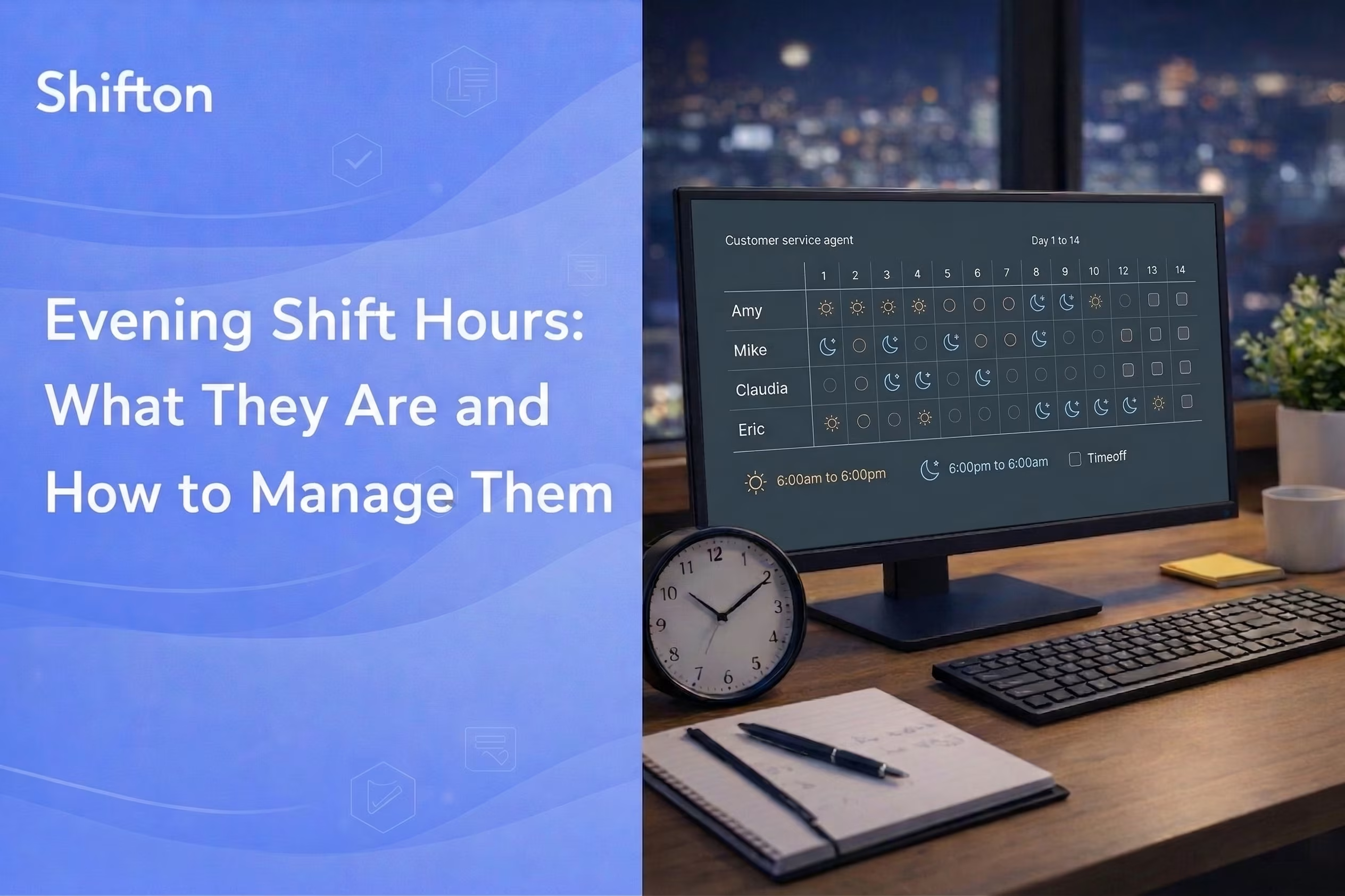
Most scheduling headaches don't start with the night shift or the morning rush. They start somewhere in the middle - that 3 PM to midnight stretch where crew overlap gets messy, communication gaps show up, and managers aren't always around to catch problems in real time.
Evening shift hours cover the window between the day shift and overnight, typically running from late afternoon through midnight. The exact span varies by industry: 3 PM to 11 PM in healthcare and retail, 4 PM to midnight in manufacturing, sometimes 6 PM to 2 AM in hospitality. What they share is a structural challenge - these hours need their own scheduling approach, not just a copy of the morning setup.
This guide covers what evening shift hours look like across industries, which rotation patterns hold up over time, and how consistent roster management prevents coverage failures when shifts change hands at odd hours.
What Are Evening Shift Hours?
Evening shift hours are the scheduled work period between the standard daytime shift and the overnight block. In most industries this runs from 3 PM or 4 PM through 11 PM or midnight - covering peak business hours in retail and healthcare, and providing a production handoff in manufacturing and logistics.
According to data from the Bureau of Labor Statistics, a substantial share of the U.S. workforce operates outside standard daytime hours. Healthcare, food service, transportation, and manufacturing all depend heavily on evening coverage, and in many of these sectors the evening shift carries the highest patient or customer volume of the entire day.
In 8-hour rotation systems, the workday typically splits into three: morning (6 AM-2 PM), evening (2 PM-10 PM), and night (10 PM-6 AM). In 12-hour systems it collapses into two: a day block and a night block, with the evening hours folded into the longer night shift depending on where the split falls.
Common Shift Patterns That Include Evening Hours
The rotation you use depends on your staffing levels, industry demands, and how much recovery time employees realistically need. These are the patterns that come up most often when evening shift hours are part of the equation.
12-Hour Shift Rotation
The 12-hour shift rotation splits the day into two 12-hour blocks, usually 7 AM-7 PM and 7 PM-7 AM. It's the dominant model in manufacturing and healthcare: fewer handoffs, more continuity per shift, and reduced administrative overhead. Employees typically work three or four shifts per week, with total weekly hours landing at 36 or 48.
The day-night 12-hour rotation is a specific version where workers alternate between day and night blocks on a fixed cycle. Some teams rotate weekly; others hold one pattern for months at a time. Research on shift work consistently shows that fixed schedules outperform rotating ones for sleep quality and sustained cognitive performance over the long term.
3-On-4-Off Schedule
The 3-on-4-off schedule gives workers three consecutive 12-hour shifts followed by four days off. Many healthcare staff prefer it for the extended recovery periods between demanding stretches. The operational trade-off is that full week coverage requires more people on the roster - you need additional staff to fill the gaps that the four-day blocks create, which raises headcount requirements.
Continental Rotation
Continental rotation cycles workers through morning, afternoon, and night shifts over a multi-week period, rotating forward through the pattern rather than jumping abruptly from days to nights. The pace is slower than most U.S. schedules, which gives the body more time to adjust between shift changes. It's one of the more sustainable extended shift schedule formats for teams that need to staff all three windows over a long period without burning through their workforce.
12-Hour Shift Patterns Outside Healthcare
Manufacturing, utilities, and emergency services also run 12-hour shift patterns, though the specific rotations differ from hospital scheduling. Pitman, Panama, and DuPont schedules all use 12-hour blocks and include evening coverage, each with a different cadence for how often workers rotate and how many days off accumulate between cycles. The evening portion of each is real work - not a transition buffer.
Evening Shifts in Healthcare and Nursing
Healthcare 12-hour shifts are the standard in most hospital systems. A typical nursing shift schedule runs 7 AM to 7 PM and 7 PM to 7 AM, with staff assigned to three shifts per week. That model has held up for decades because it reduces patient handoffs and gives nurses a long enough window to build genuine continuity of care.
But the costs are real. Evening and overnight nursing staff report higher fatigue rates, more medication errors near the end of long shifts, and lower job satisfaction when rotations include frequent day-to-night alternation. The nursing shift schedule functions as a retention variable as much as a coverage tool - people leave over scheduling, not just pay.
Extended shift schedules in nursing also raise compliance questions in certain states, where mandatory overtime laws and shift length caps apply. Scheduling teams need to track not just who is working, but cumulative hours across the pay period and whether consecutive-shift limits have been reached.
This is also where the gap between a tightly managed and a loosely managed evening rotation becomes most visible. A misconfigured schedule doesn't just create a staffing gap - it affects patient outcomes, incident report rates, and turnover numbers over time.
Managing 12-Hour Shift Fatigue
12-hour shift fatigue accumulates differently than standard workday tiredness. The last two to three hours of a long shift are when cognitive errors peak, reaction time slows, and judgment gaps show up. This pattern holds across warehouses, operating rooms, and any setting where extended hours are the norm - and it's predictable enough that schedule design can account for it in advance.
Long shift management starts with rotation structure, not break policy. The most effective interventions happen at the schedule level: how often workers change from days to nights, how many consecutive long shifts are allowed, and whether recovery days are genuinely protected. A 3-on-4-off configuration builds real rest into the cycle. A schedule that stacks six 12-hour shifts in eight days does not, regardless of what the posted break schedule says.
- Cap consecutive 12-hour shifts at three unless operationally unavoidable
- Schedule rotation direction to move forward (day to evening to night), not backward
- Build at least 11 hours between shift end and the next start
- Track cumulative hours per employee across the pay period, not just per individual shift
Using automated shift scheduling tools to flag over-allocation before the schedule publishes is more reliable than catching it after someone calls out. Rules-based scheduling catches what spreadsheets miss before it becomes a problem on the floor.
Build your evening rotation without the gaps
Set shift rules, track hours, and publish the schedule before fatigue becomes a coverage problem.
Get Started FreeHow to Build an Evening Shift Schedule That Works
The mechanics of a functional evening rotation come down to a few decisions made early: how long each shift runs, how the day-to-evening transition is structured, and how far in advance the schedule reaches employees.
Lead time matters more than most managers expect. Staff who receive their schedule two weeks out manage their personal commitments differently than those getting updates the day before. The difference shows up in call-out rates, last-minute swap requests, and overall reliability. Publishing late creates a ripple effect that costs coverage at the worst moments.
For industries running 12-hour rotations, handoff overlap has to be built into the schedule deliberately - not squeezed out for apparent efficiency. The 15 to 30 minutes where outgoing and incoming teams overlap is where information transfers, anomalies get flagged, and incidents are most likely to be caught before they escalate. In healthcare and manufacturing, a rushed handoff is a known risk factor.
- Define minimum staffing levels per hour block, not just per shift
- Identify roles that require specific skills and cannot be covered by general staff
- Set agreed limits on consecutive shifts and weekly hours before the schedule is built
- Create a swap process that flags unintended overtime automatically before approval
Frequently Asked Questions
What hours count as evening shift hours?
Most organizations define evening shift hours as the work period from approximately 3 PM or 4 PM through 11 PM or midnight. The exact window depends on the industry and rotation model. In 8-hour systems, evening is the second of three daily shifts. In 12-hour systems the evening block is typically absorbed into the longer night shift depending on where the split is set.
What is the difference between evening shift and night shift?
Evening shift covers late afternoon through midnight. The night shift, sometimes called the graveyard shift, typically starts at 11 PM or midnight and runs through 6 AM or 7 AM. In some 12-hour rotation models the distinction collapses entirely - what others would call an evening shift becomes part of a single block running from 3 PM or 7 PM through midnight or 7 AM.
Is a 3-on-4-off schedule sustainable long-term?
Many employees in healthcare and manufacturing report strong long-term satisfaction with 3-on-4-off arrangements. The four consecutive days off provide genuine recovery between demanding 12-hour shifts, which tends to show up in retention data. The main operational challenge is that full week coverage requires more staff than a standard 5-day rotation, increasing headcount requirements and scheduling complexity. Whether it stays sustainable depends largely on whether management treats those recovery days as protected time or pulls from them during short-staffing periods.
How does continental rotation differ from a standard 12-hour shift rotation?
Continental rotation moves workers through morning, afternoon, and night shifts over a longer multi-week cycle, typically rotating forward through the pattern. The slower pace allows for more gradual circadian adjustment compared to switching between day and night blocks weekly. Standard 12-hour shift rotation usually alternates between just two blocks without an intermediate afternoon phase, which means more abrupt schedule changes for workers who rotate frequently.


Start making changes today!
Optimize processes, improve team management, and increase efficiency.