

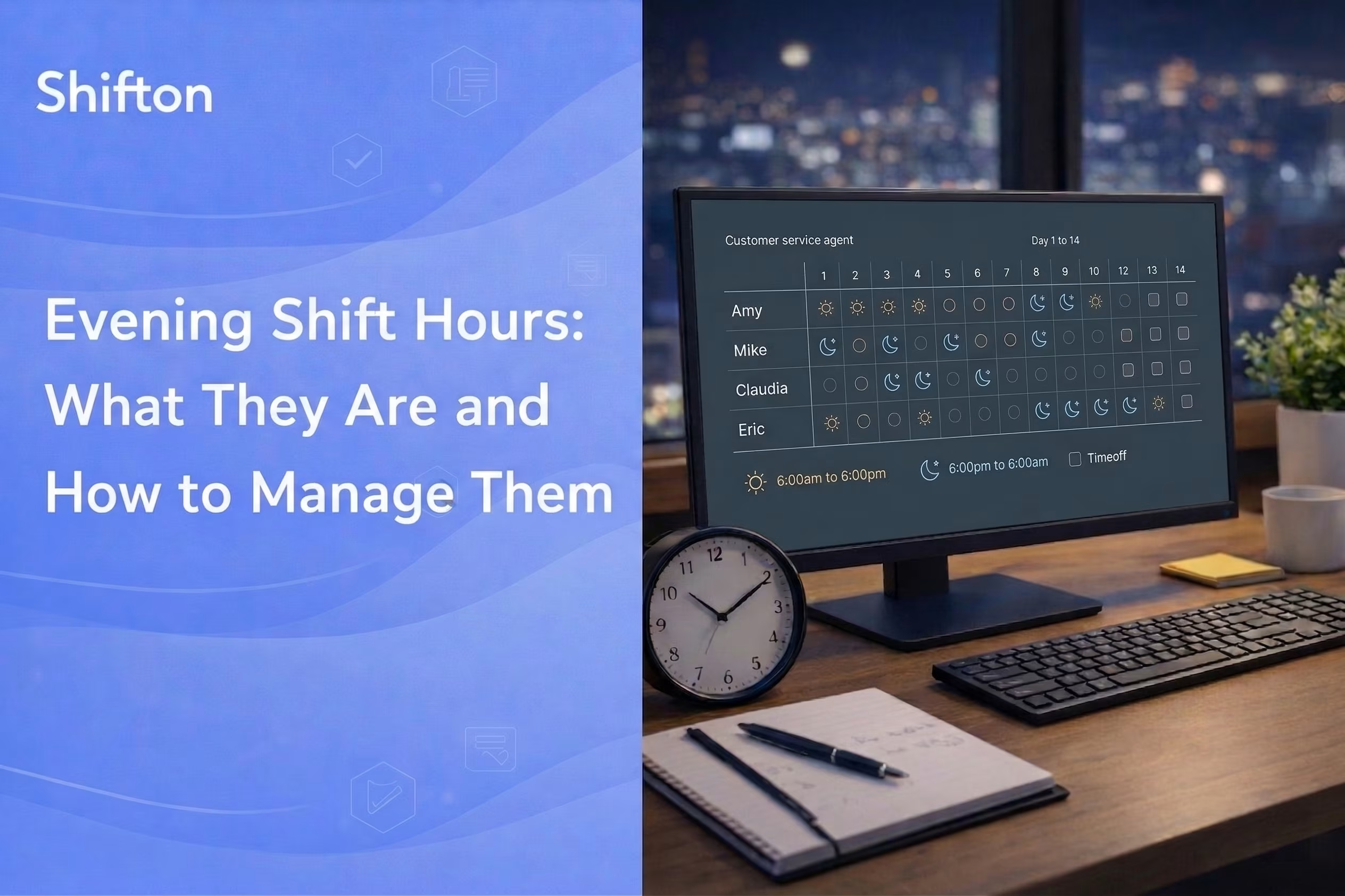
Most scheduling problems don’t start at the night shift or the morning rush. They start in the middle. That 3 PM to midnight stretch is where crew overlap gets messy, where communication gaps open up, and where managers aren’t always on the floor to catch a problem while it’s still small. Evening shift hours sit in a structural gap that most scheduling systems were never built around.
The window runs from late afternoon through midnight, between the day shift and the overnight block. Every industry draws the line a little differently. Healthcare and retail tend to run 3 PM to 11 PM, manufacturing pushes it to 4 PM to midnight, and parts of hospitality stretch it to 6 PM or even 2 AM.
One habit repeats almost everywhere: managers build the morning shift first, then drop the evening shift onto the same template. That copy-paste is where the coverage holes begin.
Below is how the standard blocks line up in an 8-hour, three-shift operation, so the terminology stays straight before any of the scheduling detail.
| Shift block | Also called | Typical hours | Where coverage concentrates |
|---|---|---|---|
| Day shift | First shift, AM shift | 6 AM to 2 PM | Standard business hours, office and retail open |
| Evening shift | Second shift, swing shift, PM shift | 3 PM to 11 PM | Retail and healthcare peak, production handoff |
| Night shift | Third shift, graveyard shift | 11 PM to 7 AM | Overnight coverage, lowest customer volume |
Who is this page for?
Checking when your own evening shift starts?
Shift times are set by your employer and vary by industry, so there is no universal answer we can give you. Your rota, your contract, or your manager will have the exact hours. If a shift premium applies, payroll or HR can confirm the rate.
Setting evening coverage for a team?
This page is for you. The patterns below cover how evening shifts are usually structured and where they break. Shifton is where you build them: rotations, swaps, overtime alerts, and a time clock that shows who actually turned up. Free for up to 10 employees.
What Are Evening Shift Hours?
Evening shift hours are the scheduled work period that sits between the standard daytime shift and the overnight block. In most industries that runs from 3 PM or 4 PM through 11 PM or midnight, covering peak business hours in retail and healthcare and the production handoff in manufacturing and logistics. You’ll also see it posted as the second shift, the swing shift, or the PM shift. The labels differ by employer, but the time window is the same one.
How long is an evening shift? In a three-shift, 8-hour operation it’s eight hours, usually 3 PM to 11 PM. In a two-block, 12-hour operation the evening hours fold into a longer 7 PM to 7 AM stretch, so there’s no separate evening shift at all. That split is the single biggest reason two companies can use the same word and mean different schedules.
Bureau of Labor Statistics time-use data shows a large share of the U.S. workforce on the clock outside standard daytime hours. Healthcare, food service, transportation, and manufacturing lean on evening coverage, and in several of those sectors the evening shift carries the highest patient or customer volume of the whole day. What hours are considered evening shift varies a little by organization, but the core meaning holds: it’s the work block between day and night.
In an 8-hour rotation the workday splits three ways: morning from 6 AM to 2 PM, evening from 2 PM to 10 PM, and night from 10 PM to 6 AM. In a 12-hour rotation it collapses to two, a day block and a night block, with the evening hours rolled into whichever side the split lands on. The second shift in an 8-hour system runs roughly 3 PM to 11 PM, and that’s the most commonly referenced evening shift time in U.S. operations.
Afternoon shift hours overlap heavily with what most teams call the evening shift, especially across the 2 PM to 6 PM window where day staff are finishing and evening workers are arriving. How tightly that handoff is run often decides whether the evening shift starts clean or inherits the day team’s unfinished problems.
Evening Shift vs Night Shift: Key Differences
Evening shift and night shift are related but separate. The evening shift covers late afternoon through midnight, typically 3 PM to 11 PM or 4 PM to midnight. The night shift, also called the graveyard shift or third shift, starts at 11 PM or midnight and runs through 6 AM or 7 AM. That line matters for scheduling, pay, fatigue management, and legal compliance in states that cap working hours.
Activity levels are the first real difference. The evening block sees more going on than the overnight one. In healthcare, admissions, procedures, and family visits all concentrate between 4 PM and 9 PM, so evening shift nursing hours carry a heavy clinical load. Retail and hospitality book most of their revenue in those same hours. Night shift workers face a quieter floor but a steeper circadian hit, because the hours fight the body’s natural sleep window head-on.
The two shifts wear people down differently: evening from sheer volume, overnight from the clock itself.
Swing shift adds the confusion. Some employers use it as a plain synonym for the 4 PM to midnight block. Others use it for a rotating pattern, where workers cycle through day, evening, and night over a set period. When a posting lists swing shift hours, confirm whether that means a fixed evening schedule or a rotating one before you accept. Those two arrangements look identical on paper and feel nothing alike by month three.
And evening shift versus day shift is mostly about timing and what it does to the rest of your week. Day staff line up with normal business hours and everyone else’s calendar. Evening staff clock out after most services have already closed, which reaches into childcare, errands, and social commitments. A manager building an evening roster has to plan around those constraints, because they drive availability, reliability, and retention in ways daytime scheduling never has to think about.
Common Shift Patterns That Include Evening Hours
Not every rotation suits every operation. These are the patterns that actually hold up once evening coverage is part of the mix, each with its own tradeoffs for staffing levels, recovery time, and how much schedule complexity a team can absorb.
12-Hour Shift Rotation
The 12-hour rotation splits the day into two blocks, 7 AM to 7 PM and 7 PM to 7 AM. Fewer handoffs, longer continuity per shift, less back-and-forth between the outgoing and incoming teams. Workers typically cover three or four shifts a week, landing at 36 or 48 hours.
Fixed versus rotating is the decision that actually matters here. Teams that hold one block for months at a stretch report better sleep and fewer performance problems than teams flipping between day and night every week. The research has pointed the same way for decades: each flip from day to night costs the body about a week of recovery, and frequent rotation between evening and overnight blocks stacks up fatigue faster than either fixed assignment would. So pick a block and leave people on it.
3-On-4-Off Schedule
Three straight 12-hour shifts, then four days off. Healthcare staff favor it because the four-day block leaves real room to sleep, run errands, and reset before the next stretch. Two days off only buys one of those, and you feel the gap fast in how rested a crew is when they clock back in.
Continental Rotation
Continental rotation cycles workers through morning, afternoon, and night shifts over a multi-week period, advancing forward through the pattern instead of jumping between extremes. The slower cadence gives the body more room to adjust between transitions. Most U.S. operations find it logistically fiddly, but for teams running all three windows over a long horizon it produces lower burnout than faster alternating schedules. The whole advantage comes from two choices: move forward, and move slowly.
12-Hour Shift Patterns Outside Healthcare
Pitman, Panama, and DuPont all run 12-hour blocks with evening coverage built in, and each cycles rotation frequency and days off differently. Manufacturing and utilities like them for the reason hospitals do, fewer daily handoffs, but where the evening block falls and how long it runs before rotation differ enough that you can’t treat the three as interchangeable.
Pick the wrong pattern for your headcount and facility and you create coverage holes that are hard to patch mid-cycle. Reading through the full range of rotating shift schedule arrangements before you commit helps you avoid a structure that looks clean on paper and breaks the second a worker calls out. There’s a model-by-model breakdown in this guide to extended 12-hour shift scheduling patterns.
Evening Shifts in Healthcare and Nursing
In most hospital systems, 7-to-7 is the default. Nursing shifts run 7 AM to 7 PM and 7 PM to 7 AM, three days a week. It became standard because it cuts patient handoffs and keeps one team in place long enough to catch the things a shorter window loses: a change in condition, a pattern building over hours, a detail that never makes it into a rushed note.
Late afternoon is the busiest stretch on most units, and the roster has to staff for it rather than treat the evening as a wind-down.
The evening hours carry a specific clinical load. Admissions peak in late afternoon, family visits cluster in early evening, and the day-to-evening transition is exactly when most handoff errors happen. Evening shift nurses need accurate, current information from the team they’re relieving. An incomplete handoff puts patient safety on the line, and inconvenience for the next crew is the lighter of the two outcomes.
The fatigue picture is documented, not anecdotal. Evening and overnight nursing staff log higher medication-error rates toward the end of long shifts, and nurses who rotate frequently between day and evening blocks turn over faster than those on fixed assignments. Scheduling drives retention as much as it drives coverage. People quit over a bad rotation, and replacing a trained nurse costs more than rebuilding the schedule did, every single time.
Some states layer on more: mandatory-overtime restrictions, consecutive-shift caps, and hour limits that scheduling teams have to track across the entire pay period. A roster that looks compliant shift by shift can still create legal exposure once you add up the cumulative hours per employee over two weeks. Treat schedule design as patient-safety policy, because that’s what it turns into the moment it goes wrong.
Evening Shift Pay and Differential
Evening shift pay usually includes a shift differential, an extra amount per hour or a percentage added to the base wage for working outside standard daytime hours. For evening workers that premium commonly lands between 5% and 15% above base, though the exact figure depends on industry, company policy, and any collective bargaining agreement in play. Healthcare pays higher evening differentials than retail or manufacturing because the competition for qualified evening staff is sharper.
Healthcare pays the most here, retail the least. The gap tracks how hard each one is to staff after dark.
Not every employer pays one. In plenty of non-union environments, retail and food service especially, the base wage applies no matter when you work. Anyone weighing evening shift jobs should check whether a differential exists, how it’s calculated, and whether it carries into overtime. Some employers run it as a flat per-hour add-on, others as a percentage of base pay, and that choice changes the math a lot at higher wage rates.
Second shift differential, the premium on the 3 PM to 11 PM block, is its own thing, separate from the night or third shift differential, which pays more because overnight work hits the body harder. Operations that run both evening and overnight schedules apply separate differential tiers. Map the full pay structure before you build an evening rotation, or the schedule looks cost-neutral right up until payroll runs and the differential line shows up.
Benefits and Drawbacks of Working Evening Shift
Working an evening shift pays off for the right person in the right situation. The benefit people name first is daytime flexibility: appointments, errands, and personal commitments that are hard to fit around a standard 9-to-5 all move into the open morning. For a parent with kids in school, the morning block before work tends to line up with school hours, which makes childcare easier to cover than it would be on a night shift.
The workplace itself feels different after dark. Fewer managers are around, which can mean more autonomy for experienced staff and a looser environment overall. In roles like IT support, logistics, and customer service, the evening shift handles a smaller, steadier flow of requests than the daytime rush. Some people genuinely prefer that pace and do measurably better work in it than they ever did during peak hours.
A few simply run better at night, and forcing them onto a 9-to-5 wastes it.
But the drawbacks are just as real, and they deserve to be named plainly. Social life takes the hit first, since evening events, dinners, and most recreation happen during working hours. Family coordination gets harder when one person’s schedule runs against everyone else’s. For workers with school-age kids, the evening block often means missing homework time, bedtime, and weekend activities whenever the rotation includes Friday and Saturday nights.
Health is the other major cost. Evening shift workers report disrupted sleep, rising rates of metabolic trouble over time, and more burnout than day-shift peers in comparable roles. The effects come in milder than what overnight workers deal with, but they’re present. The people who manage the schedule well over years protect a consistent sleep window, guard their wind-down time, and refuse to treat schedule consistency as optional, whatever their days off happen to look like.
How to Build an Evening Shift Schedule That Works
Two decisions made at the start shape most of what follows: how long each shift runs, and how far ahead the schedule reaches the people working it. Get both wrong and the rest of the planning barely matters. Evening scheduling carries constraints daytime scheduling skips, like later commutes, thin childcare options after 6 PM, and the need for a clean handoff overlap from day staff, and all three change how the roster has to be built from the first draft. None of it holds without consistent roster management underneath it, the discipline that keeps a clean schedule from unravelling once shifts start changing hands at odd hours.
Lead time is the one operations underestimate most. Staff who see the schedule two weeks out arrange childcare, book appointments, and plan their lives around fixed blocks. Staff who get it the day before improvise, and they call out when they can’t. You read the gap in call-out rates and last-minute swap volume, not as one bad week but as a steady leak that drains coverage out of every month.
Two weeks is the line. Past it, people plan around the schedule. Inside it, they react to it.
For 12-hour rotations the handoff overlap has to be protected. Those 15 to 30 minutes where the outgoing and incoming teams sit together is where information transfers, where anomalies get flagged, and where small problems get caught before they grow. In healthcare and manufacturing a rushed handoff is a known risk factor, not a scheduling nicety a manager can trade away. Cut the overlap to shave labor cost and you cut it out of every transition: lost information, double-charting, missed instructions, slower response to anything still in motion when the new crew walks in. A 20-minute paid overlap is cheap. An unreported deteriorating patient or an unchecked equipment fault handed off in two minutes is not. The apparent savings hit the labor budget immediately, and the real cost surfaces months later in incident logs and turnover, which is why finance pushes to shrink the overlap and operations pushes back.
- Define minimum staffing per hour block and per shift, not one or the other
- Flag roles that need specific skills and can’t be covered by general staff
- Set limits on consecutive shifts and weekly hours before the schedule is built
- Build a swap process that catches unintended overtime automatically before approval
- Publish the schedule at least two weeks out and protect it from last-minute changes except for genuine emergencies
Managing 12-Hour Shift Fatigue
The last two or three hours of a 12-hour shift are when things go sideways. Cognitive errors climb, reaction time drags, judgment slips in spots that looked fine at the start. Warehouse floor, operating room, dispatch desk, the pattern repeats across all of them. And it’s predictable enough to plan around when the rotation is built to account for it.
Rotation structure matters far more than break frequency. How often workers flip between day and night, how many long shifts stack before a real rest day, whether recovery days stay protected or get raided during a short-staffed week, those calls move fatigue more than anything on a posted break schedule. A 3-on-4-off builds genuine rest into the cycle. Six 12-hour shifts in eight days does not, whatever the break policy says. The schedule sets the fatigue ceiling, and break rules sit underneath it as a secondary lever.
Direction matters too. When workers move forward through a cycle, day to evening to night, the body gets slightly more time to adjust between transitions than when the rotation runs backward, night to evening to day. The NIOSH literature documents the gap well. Forward rotation lowers both reported fatigue and measured error rates compared to backward rotation, and switching direction costs essentially nothing, since you just publish the schedule the other way around.
The backward version is the one most schedules fall into by accident.
- Cap consecutive 12-hour shifts at three unless it’s operationally unavoidable
- Set rotation direction to move forward, day to evening to night, never backward
- Leave at least 11 hours between one shift’s end and the next one’s start
- Track cumulative hours per employee across the full pay period, since per-shift checks miss the buildup
Running automated shift scheduling tools to flag over-allocation before the schedule publishes beats catching it after someone has already called out. Rules-based scheduling catches what a spreadsheet misses, before it lands on the floor as a real problem.
Build your evening rotation without the gaps
Set shift rules, track hours, and publish the schedule before fatigue becomes a coverage problem.
Evening Shift Sleep and Work-Life Balance
Adjusting to an evening shift sleep schedule is one of the harder practical hurdles for anyone new to the block. The body expects sleep in a fairly fixed window, and an evening schedule pushes bedtime to 1 AM, 2 AM, or later, cutting straight across the social and family patterns that assume you’re awake in daylight. Workers who adapt well treat their sleep window as fixed and non-negotiable, the way a day-shift worker treats a morning alarm.
The most common failure is the split schedule: staying up late on work nights, then reverting to early sleep on days off. That produces the same circadian churn as rotating shifts, because the body never settles into one rhythm. Workers who hold the same sleep and wake times all week, days off included, report better sleep quality and lower fatigue than those trying to run two schedules at once.
Balance on an evening shift takes planning up front. Social commitments, family activities, and personal appointments have to be booked into the morning and early afternoon. That’s manageable when the schedule stays consistent, and it gets a lot harder when the schedule shifts week to week or a last-minute change drops someone into hours they never planned for. A steady evening schedule beats a variable one for work-life balance, even when the hours themselves are unconventional.
Frequently Asked Questions
What hours count as evening shift hours?
Most organizations define evening shift hours as the work period from roughly 3 PM or 4 PM through 11 PM or midnight. The exact window depends on the industry and rotation model. In 8-hour systems the evening shift is the second of three daily shifts. In 12-hour systems the evening block usually rolls into the longer night shift, depending on where the split is set.
What time does the evening shift start and end?
A standard evening shift starts at 3 PM and ends at 11 PM in most healthcare and retail operations. Manufacturing often shifts that to 4 PM through midnight, and some hospitality roles run 6 PM to 2 AM. When the evening shift starts depends on the employer’s rotation model, so check the posted hours rather than assuming the 3 PM default.
What is the second shift, and is it the same as the PM shift?
The second shift is the evening block in a three-shift, 8-hour operation, running about 3 PM to 11 PM, right after the first (day) shift. PM shift is another name for the same hours. Both terms point to the evening shift; employers just use different labels for it. The third shift is the overnight or night shift.
What is the difference between evening shift and night shift?
Evening shift covers late afternoon through midnight, typically 3 PM to 11 PM or 4 PM to midnight. Night shift starts at 11 PM or midnight and runs through 6 AM or 7 AM. In 12-hour rotation models the distinction often disappears: what one operation calls an evening shift another calls a night block, depending on where the 12-hour split falls.
What is the difference between evening shift and swing shift?
Swing shift and evening shift are sometimes used interchangeably for the 3 PM to midnight or 4 PM to midnight block. But swing shift can also mean a rotating pattern, where workers cycle through day, evening, and night over a set period, describing a rotation structure rather than a fixed window. When you evaluate a swing shift position, confirm whether the hours are fixed or rotating before you accept. The two look identical on paper and feel completely different by month three.
Does evening shift pay more?
Often it does. Healthcare, manufacturing, and logistics add a 5% to 15% differential for evening hours, while non-union retail and food service frequently skip it. Confirm the pay structure before you accept.
How long is an evening shift?
Eight hours in a three-shift operation, generally 3 PM to 11 PM. In a 12-hour, two-block rotation there’s no separate evening shift at all; the hours fold into a 7 PM to 7 AM stretch.
What are the main benefits of working evening shift?
The main benefits are daytime availability and, in many organizations, a pay differential above the base rate. Evening shift workers can run errands, attend appointments, and handle personal responsibilities during regular business hours. In some workplaces the evening hours are quieter and offer more autonomy than the day shift. Workers who are naturally active later in the day often find the schedule fits their energy better than a standard morning start.
What are the main disadvantages of evening shift?
The main drawbacks are social and health-related. Evening shift workers miss most social events, family dinners, and recreation that happens in the evening. Sleep schedules need consistent adjustment and active maintenance to keep fatigue from building. Over time, workers who don’t manage their sleep window deliberately report more burnout than day-shift peers in comparable roles. Weekend and holiday evening coverage adds another layer when the rotation includes high-demand nights.
Is a 3-on-4-off schedule sustainable long-term?
For many employees in healthcare and manufacturing, yes. The four consecutive days off provide recovery time a standard five-day rotation does not, which is one reason retention numbers stay high in healthcare. The catch is operational: full-week coverage needs more staff than most standard rotations, which raises headcount before the schedule’s benefits appear. Whether it stays sustainable depends on whether management protects those four recovery days or raids them as a staffing buffer during short-staffed weeks. The second approach erodes the schedule’s main advantage within a few months.
How does continental rotation differ from a standard 12-hour shift rotation?
Continental rotation moves workers through all three shift windows, morning, afternoon, and night, over a longer cycle, rotating forward through the pattern. The gradual pacing allows more circadian adjustment between changes. A standard 12-hour rotation usually alternates between two blocks only, which means more abrupt transitions when workers rotate between day and night assignments.




Start making changes today!
Optimize processes, improve team management, and increase efficiency.