

 English
  Español
  Português
  Deutsch
  Français
  Italiano
  日本語
日本語  中文
中文  हिन्दी
  עברית
עברית  العربية
  한국어
한국어  Nederlands
  Polski
  Türkçe
  Українська
  Русский
  Magyar
  Română
  Български
  Čeština
  Ελληνικά
  Svenska
  Dansk
Dansk  Norsk
Norsk  Suomi
Suomi  Bahasa Indonesia
  Tiếng Việt
  Tagalog
  ไทย
ไทย  Latviešu
  Lietuvių
  Eesti
Eesti  Slovenčina
  Slovenščina
  Hrvatski
  Македонски
  Қазақша
  Azərbaycan
  Afrikaans
  বাংলা
বাংলা Employee Handbook: What to Include and How to Write One Right

In short: An employee handbook is a document that spells out your company's policies, expectations, and benefits in one place — so every team member knows the rules before questions turn into problems. A strong handbook protects the business legally, speeds up onboarding, and gives managers a consistent reference instead of making things up on the fly.
What Is an Employee Handbook?
Three weeks into a new job, a cashier asks her manager whether she gets paid for a 15-minute break. The manager says yes. Next store over, a different manager says no. Both are guessing — because the company never wrote it down.
That's the gap an employee handbook fills. It's the single document that lays out how your company works: attendance rules, leave policies, dress codes, disciplinary procedures, benefits, safety expectations — everything a person needs to know from day one.
Some companies call it a staff manual. Others say "company policy guide" or "team playbook." The name doesn't matter. What matters is that it exists, that it's current, and that people actually read it. (If you're also figuring out how many people you actually need, start with headcount planning — the handbook comes right after.)
According to the U.S. Department of Labor's compliance guidance, employers are expected to clearly communicate workplace policies — and a handbook is the most practical way to do that. Nearly 80% of employers maintain one, yet fewer than half update it annually. An outdated handbook can be worse than no handbook at all because it gives employees (and courts) something to hold you to that no longer reflects reality.
Why Your Business Needs an Employee Handbook
A 10-person startup might get away without one for a while. But once you cross 15–20 employees — or hire your first hourly worker — running without a handbook gets expensive fast. Here's why.
What to Include in an Employee Handbook
There's no universal template that works for every business. A hospital's handbook looks nothing like a retail chain's. But certain sections show up in virtually every effective handbook — here's the breakdown.
Company Overview and Mission
Skip the corporate fluff. Two or three paragraphs about who you are, what you do, and what matters to you. If your mission statement is longer than a tweet, rewrite it. New hires want context, not a manifesto.
Employment Basics
Employment classifications (full-time, part-time, contractor), at-will employment statement (if applicable in your jurisdiction), equal opportunity policy, and how the probationary period works. This section is dry but legally essential — get it right. If your business falls under the Americans with Disabilities Act, make sure your equal opportunity language covers reasonable accommodations — it's a common gap in first drafts.
Attendance and Scheduling Policies
For shift-based businesses, this is the section employees will actually read. Cover:
- How far in advance schedules are posted
- The process for requesting time off
- Rules for shift swaps and who approves them
- No-call/no-show consequences
- Tardiness thresholds and what counts as "late"
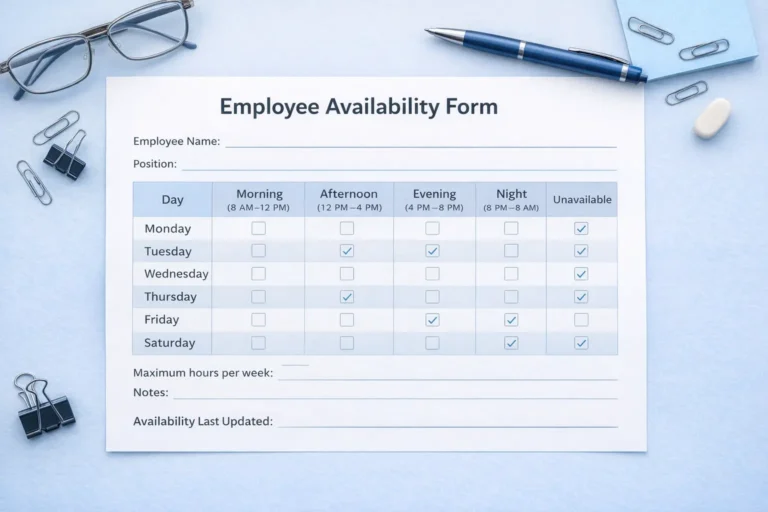
One common gap: companies define the rules but don't give employees a clear way to communicate availability. A standardized availability form built into your scheduling workflow solves that before conflicts start.
Pro tip: If your team uses a shift scheduling tool, reference it here. Employees should know exactly where to check their schedule, how to request swaps, and how far in advance they need to act. Linking the tool to the policy removes ambiguity.
Compensation and Benefits
Pay schedule, overtime rules, how bonuses work (if they do), and which benefits are available — health insurance, retirement, employee discounts. You don't need every plan detail here; point people to where they can find full plan documents. One area that often trips companies up: paid vs. unpaid breaks (a common source of wage disputes) — spell out the rules clearly so there's no confusion on either side.
Leave Policies
PTO, sick leave, FMLA, parental leave, bereavement, jury duty. Be specific about accrual rates and how unused time is handled. Vague leave policies generate more HR questions than almost anything else in the handbook. Spotting recurring absence patterns through scheduling data analysis can surface these issues well before they escalate.
Code of Conduct and Workplace Behavior
Anti-harassment and anti-discrimination policies, drug and alcohol policy, social media guidelines, dress code, use of company property. This is where you set behavioral expectations — make it clear, not preachy.
Safety and Security
Workplace safety procedures, reporting injuries, emergency protocols, and — increasingly — cybersecurity basics. If your industry has specific requirements, review OSHA's worker safety guidelines to make sure your handbook covers the essentials.
Disciplinary Procedures and Termination
Spell out the progressive discipline steps: verbal warning, written warning, suspension, termination. Define what constitutes grounds for immediate termination. This section isn't fun to write, but it's the one that saves you in court.
Acknowledgment Page
The last page should be a sign-off: "I have received, read, and understood the employee handbook." Get it signed during onboarding. Keep a copy. This one page is worth its weight in gold during disputes.
How to Write an Employee Handbook: Step by Step
Writing a handbook from scratch feels overwhelming. It doesn't need to be. I've seen companies spend six months and $20K on a handbook that no one reads — and I've seen a 12-page document thrown together in a week that actually changed how a 50-person team operates. The difference isn't polish. It's clarity.
Audit what you already have
Collect every existing policy document, email announcement, and Slack message that ever said "going forward, the rule is..." Most companies have more written policy than they think — it's just scattered across 14 different places.
Check your legal requirements
Federal, state, and local laws dictate what must appear in your handbook. FMLA notices, EEO statements, workers' comp info, predictive scheduling rules — requirements vary by jurisdiction and company size. When in doubt, have an employment attorney review the final draft.
Write in plain English
If a sentence needs a law degree to parse, rewrite it. Use short paragraphs, headers, and bullet points. The goal is comprehension, not impressiveness. Write it at an 8th-grade reading level — seriously.
Get feedback from managers AND frontline staff
HR writes the handbook, but managers enforce it and employees live with it. Before publishing, circulate a draft. You'll catch ambiguities, contradictions, and assumptions that never survive contact with reality.
Distribute, acknowledge, and schedule updates
Don't just email a PDF and hope for the best. Walk through key sections during onboarding. Collect signed acknowledgments. And set a calendar reminder to review the whole thing at least once a year — laws change, your business changes, and the handbook needs to keep up.
Employee Handbook Mistakes That Cost Companies Money
We've reviewed handbooks from companies of all sizes. The same mistakes come up again and again.
Copying a template word-for-word. Generic templates miss your state's specific requirements and your company's actual practices. A California handbook needs very different language than a Texas one. Use templates as a starting point, never as a finished product.
Being too specific about things that change. Don't list exact benefit plan names or specific PTO accrual amounts if they shift annually. Instead, reference where employees can find current details — your HRIS, benefits portal, or internal wiki. That way the handbook stays accurate longer.
Making promises you can't keep. Phrases like "permanent employee" or "guaranteed annual raise" create implied contracts. Courts have ruled against employers for this kind of language. Stick to factual descriptions and include a clear disclaimer that the handbook doesn't constitute a contract.
Burying the important stuff. If your no-call/no-show policy is on page 47 of a 60-page document, no one will find it until it's too late. Put the sections employees need most — scheduling, attendance, leave — near the front. Or at least create a solid table of contents.
Employee Handbook for Shift-Based and Hourly Teams
Most handbook advice is written for office environments. But if your workforce punches a clock, works rotating shifts, or operates across multiple locations, you need sections that address their reality specifically.
- When and where schedules are published
- Minimum notice period for schedule changes
- Shift swap rules and approval process
- On-call and standby expectations
- Clock-in/clock-out procedures
- Grace period (if any) and what counts as late
- Overtime eligibility and approval process
- Consequences for buddy punching
For companies using workforce management tools, the handbook is the right place to document which platform employees should use, how to access it, and what's expected — like submitting availability at least two weeks out or confirming shifts within 24 hours of posting.
With Shifton's time-off management, teams can handle schedule publishing, shift swaps, time-off requests, and attendance tracking in one place — making it easy to align your handbook policies with how work actually gets done. When the tool matches the policy, compliance stops being a headache.
How Often Should You Update Your Employee Handbook?
At minimum, once a year. But certain events should trigger an immediate review:
- New employment laws take effect (state or federal)
- You expand to a new state or country
- Benefits or compensation structure changes
- An incident exposes a policy gap
- You adopt new tools or workflows that change how employees interact with scheduling, leave, or time tracking
When you update the handbook, communicate the changes explicitly. Don't just silently upload a new version and expect people to spot the differences. Send a summary of what changed and why, and — if the changes are significant — collect new acknowledgments. Tools that centralize your leave management and scheduling make this easier — when the policy lives inside the tool employees already use, updates don't get lost in email.
Employee Handbook Template: Section Checklist
Use this as a starting framework. Not every section applies to every business — adapt based on your industry, size, and jurisdiction. For the scheduling and attendance rows, an employee availability form can serve as the bridge between policy and daily practice.
Employee Handbook FAQ
Your Handbook Sets the Rules. Shifton Makes Them Work.
Scheduling policies, attendance tracking, shift swaps, time-off requests — manage them all in one platform that your team will actually use.
Try Shifton Free →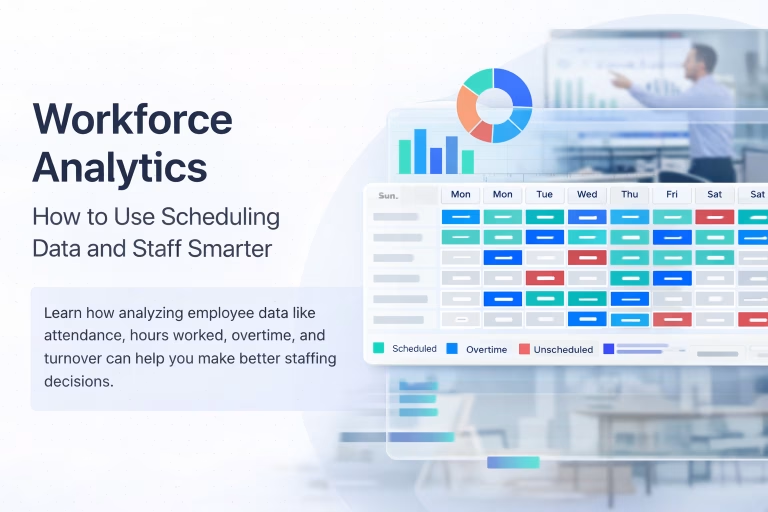

Start making changes today!
Optimize processes, improve team management, and increase efficiency.