Many industries cannot stop working when the day ends. Hospitals, manufacturing plants, utilities, and security operations often run 24 hours a day. To keep coverage stable, companies use rotating shift systems. One of the most widely used patterns is the Pitman schedule.
The Pitman rotation is built around longer shifts and repeating cycles that allow teams to maintain continuous coverage without constant schedule changes. While the system looks simple on paper, it has important operational details that managers should understand before using it.
Organizations exploring rotating schedules often compare several structures before deciding what fits their workforce. For example, some teams also review models like the
2-2-3 work schedule used in many 24/7 environments, since it shares a similar rhythm of workdays and rest periods.
What is a Pitman schedule?
The Pitman schedule is a rotating shift pattern designed mainly for organizations that require 24/7 coverage. Employees typically work
12-hour shifts and follow a repeating two-week cycle that balances workdays and recovery time.
The goal of this rotation is to keep operations fully staffed while still giving employees predictable time off. Because shifts are longer, fewer employees are needed per day compared with traditional eight-hour schedules.
In many organizations, the Pitman schedule is implemented using multiple teams that rotate through day and night shifts. Managers often rely on structured
shift scheduling tools that help visualize rotations so they can clearly see how teams overlap during different parts of the cycle.
Pitman schedule example
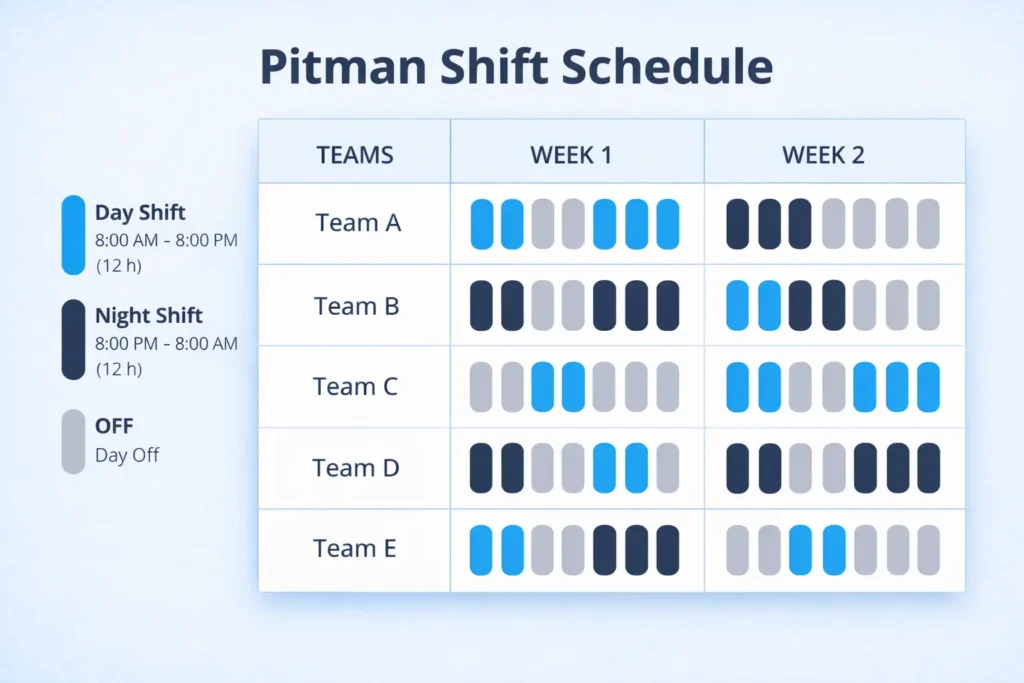
A common Pitman rotation follows a repeating two-week pattern built around 12-hour shifts. The cycle usually looks like this:
- 2 days on
- 2 days off
- 3 days on
- 2 days off
- 2 days on
- 3 days off
Across two weeks, employees typically work seven shifts. This structure allows teams to maintain full operational coverage while still creating longer rest periods than many traditional schedules.
Because rotations repeat predictably, employees can plan personal time in advance. This predictability is one reason some organizations prefer rotating systems instead of constantly adjusting schedules week by week.
Pitman schedule vs Panama schedule
The Pitman schedule is closely related to another well-known system called the Panama schedule. Both rely on 12-hour shifts and repeating patterns designed for continuous operations.
In practice, the difference often comes down to how teams are structured and how the rotation is implemented within a company. Some organizations even use the names interchangeably, although technically the patterns may vary slightly.
If you want to see how the rotation compares in detail, the
panama schedule used for long-shift operations explains another common structure that many companies evaluate before choosing a final model.
Why companies use the Pitman rotation
Organizations choose the Pitman schedule mainly because it supports continuous operations without requiring excessive staffing levels. Longer shifts mean fewer shift transitions, which can reduce communication errors during handoffs.
Another advantage is predictability. The repeating pattern makes it easier for employees to understand when they will be working and when they will have extended time off.
Managers often evaluate the rotation alongside workforce planning methods such as
capacity planning used to balance workload and staffing, which helps determine whether a long-shift rotation fits actual demand.
Pros and cons of the Pitman schedule
Benefits
- Predictable two-week rotation
- Longer blocks of time off
- Fewer daily shift handovers
- Strong coverage for 24/7 operations
Drawbacks
- 12-hour shifts can be physically demanding
- Fatigue may increase during long workdays
- Not ideal for unpredictable workloads
- Requires careful staffing balance
Pitman schedule and employee fatigue
Long shifts can improve operational continuity, but they also increase the importance of rest and recovery. Research into shift work shows that extended hours may affect alertness if employees do not receive sufficient time to recover between shifts.
Studies on shift work and sleep patterns from the
Sleep Foundation highlight how rotating schedules can disrupt normal sleep cycles when rest periods are not managed carefully.
Safety organizations also warn that fatigue becomes a serious risk in physically demanding jobs. Guidance published by
OSHA on worker fatigue explains why organizations operating long shifts should monitor workload intensity and recovery time.
When the Pitman schedule works best
The Pitman rotation tends to work well in industries where operations must remain stable throughout the day. Examples include manufacturing facilities, utilities, emergency services, and security monitoring centers.
These environments benefit from fewer shift transitions and more predictable staffing patterns. In contrast, industries with highly unpredictable workloads may require more flexible scheduling approaches.
Data from the
U.S. Bureau of Labor Statistics occupational employment database also shows that many roles in continuous operations rely heavily on rotating shift structures.
How to implement a Pitman schedule
Organizations rarely adopt a rotating schedule without testing it first. A careful rollout helps identify operational challenges before they affect the entire workforce.
- Define the rotation clearly for all teams
- Confirm overtime and labor rules
- Explain the schedule structure to employees
- Test the rotation with one team first
- Monitor fatigue, coverage gaps, and handoffs
Some teams simulate schedules before rollout. Running a small pilot inside a planning workspace such as the
platform registration environment can help managers visualize how rotations behave without disrupting existing operations.
Why understanding rotation systems matters
Shift schedules influence more than just working hours. They affect employee fatigue, staffing costs, and service quality. A rotation that looks efficient on paper may create unexpected problems if it does not match real workload patterns.
For this reason, experienced managers rarely adopt one system blindly. They compare several rotation models, observe team performance, and adjust the structure until it supports both operational needs and employee wellbeing.
FAQ
What is the Pitman schedule?
The Pitman schedule is a rotating shift pattern built around 12-hour shifts and a repeating two-week cycle designed for continuous operations.
How many hours do employees work in a Pitman schedule?
Most employees work seven 12-hour shifts across two weeks, typically totaling around 84 hours depending on the configuration used by the company.
Is the Pitman schedule the same as the Panama schedule?
They are closely related but not identical. Both use long shifts and rotating teams, although the exact structure may vary between organizations.
Which industries use the Pitman schedule?
Manufacturing, healthcare, security, utilities, and emergency services often use this rotation because they require constant coverage.
Is the Pitman schedule good for employees?
It can be beneficial when employees value predictable rotations and longer rest periods. However, long shifts may not suit every worker.
Does the Pitman rotation create overtime?
Overtime depends on how the workweek is defined and how local labor laws treat extended shifts.
Why do companies use rotating shift schedules?
Rotating schedules help organizations maintain continuous operations while distributing workload more evenly across teams.
Daria Olieshko
A personal blog created for those who are looking for proven practices.


 English (US)
  Español (ES)
  Português (PT)
  Deutsch (DE)
  Français (FR)
  Italiano
  日本語
日本語  中文
中文  हिन्दी
  עברית
עברית  العربية
  한국어
한국어  Nederlands
  Polski
  Türkçe
  Українська
  Русский
  Magyar
  Română
  Български
  Čeština
  Ελληνικά
  Svenska
  Dansk
Dansk  Norsk
Norsk  Suomi
Suomi  Bahasa
  Tiếng Việt
  Tagalog
  ไทย
ไทย  Latviešu
  Lietuvių
  Eesti
Eesti  Slovenčina
  Slovenščina
  Hrvatski
  Македонски
  Қазақ
Қазақ  Azərbaycan
  Afrikaans
  বাংলা
বাংলা